

On this page
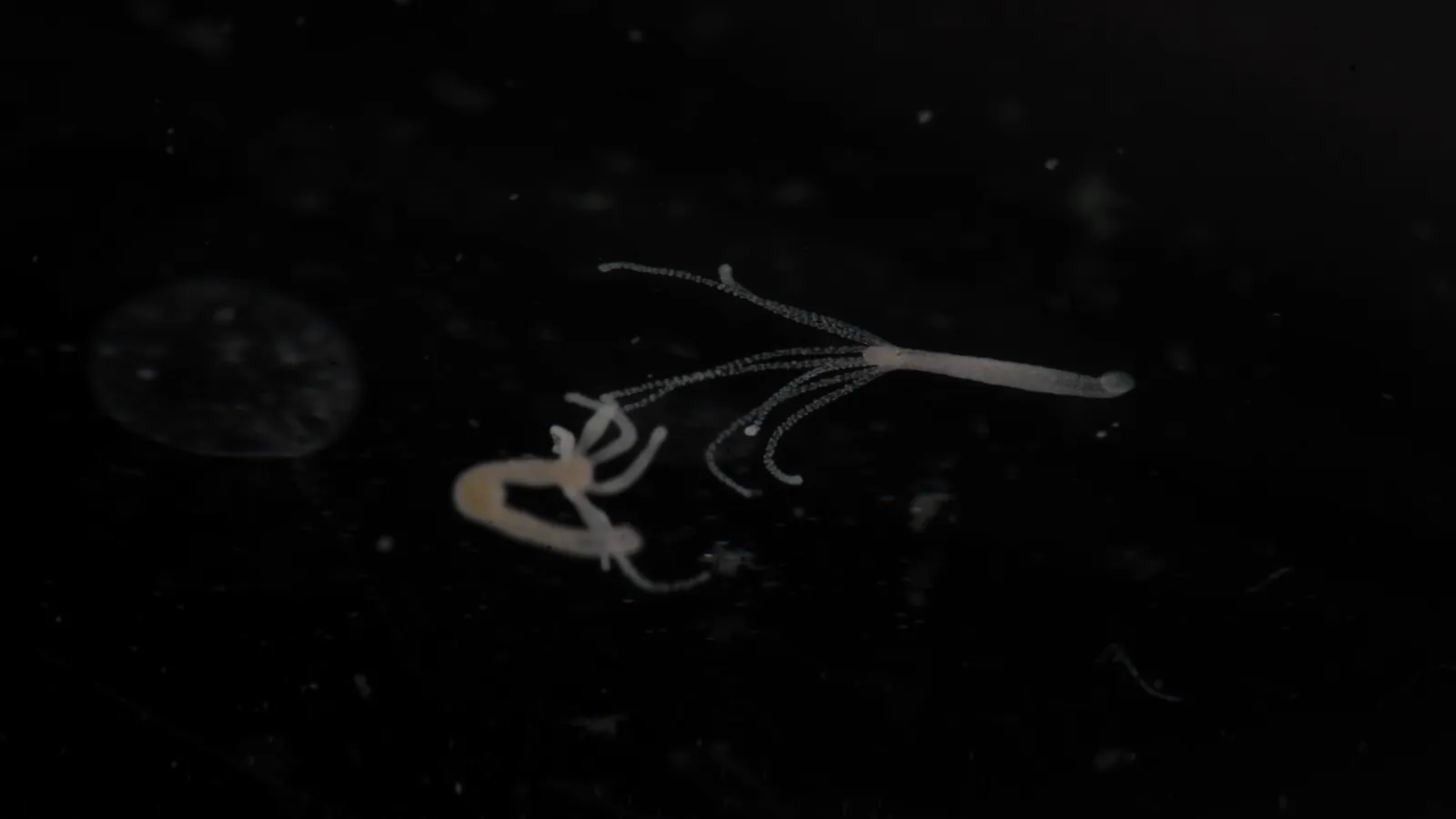
Poke a hydra and its whole body contracts, even though it has no brain to give the order. Working out why shows you what a brain actually adds.
What is the hydra nervous system?
The hydra nervous system is a nerve net: a mesh of neurons spread through the body, with no brain and no spinal cord. The NCERT Class 11 chapter Neural Control and Coordination says that in Hydra the neural system “is composed of a network of neurons”. The same page says insects have a brain along with a number of ganglia, and vertebrates have a more developed neural system.
The net is small. Hydra has “a few hundred to a few thousand neurons, depending on the size of the animal”, according to Christophe Dupre and Rafael Yuste in Current Biology (2017). An adult male human brain has on average about 86 billion neurons, by the count of Azevedo and colleagues (2009).
You may know the animal already from how hydra buds compared with yeast.
Why does a touch make the whole hydra contract?
First, signals do not travel one way. In cnidarian nerve nets, “conduction is unpolarized – it can run in any direction through the network of neurons”, writes Richard Satterlie in a 2011 review in the Journal of Experimental Biology. A signal starting at one point can therefore spread outward through neighbouring neurons.
Second, the wiring reaches the whole body. Dupre and Yuste imaged essentially every neuron in living hydras at once and found three major functional networks that “extend through the entire animal”. Each one is active during a particular behaviour, and one of them fires during longitudinal contractions, when the body shortens along its length.
A 2021 study in eLife by Badhiwala and colleagues used microfluidic devices and calcium imaging to watch how hydras respond to mechanical stimuli. The stimuli made the animals contract, and the response relied on at least two distinct networks of neurons, one in the mouth (oral) region and one in the foot (aboral) region. Calcium signals in neurons near the foot, and in the muscles, began rising within about 0.1 to 0.2 seconds of the stimulus. When the mouth region was removed, the animals still responded, but more weakly.
Nerve nets are not always uniform. Satterlie notes that some cnidarian polyps have ring-like condensations of nerve tissue around the mouth, “suggesting a degree of centralization”.
Nerve net vs centralised nervous system: what is the difference?
In humans, the central neural system is the brain and spinal cord, and it is “the site of information processing and control”, says the same NCERT chapter. It calls the brain the body’s “command and control system”. Afferent fibres carry impulses from tissues to the CNS, and efferent fibres carry regulatory impulses from the CNS back out to the organs.
Side by side:
Where processing happens. Hydra: across the net, with key networks at the mouth and foot ends. Humans: the brain and spinal cord.
Which way signals run. Nerve net: in any direction. Humans: into the CNS along afferent fibres, out along efferent fibres.
What the response looks like. Hydra: whole-body behaviours such as contracting and stretching out. Humans: the brain controls voluntary movements, so you can move one finger on its own.
How many neurons. Hydra: a few hundred to a few thousand (Dupre and Yuste). Human brain: about 86 billion (Azevedo and colleagues).
A brain lets an animal sort incoming signals and choose a precise response. A net gives a body-wide reaction without a single control centre. For how your own body handles fast automatic responses, see our explainer on voluntary and involuntary reflex actions.
How do you answer this in an exam?
A typical 3-mark short answer:
Question: Hydra has no brain, yet its whole body contracts when it is touched. Explain.
Model answer:
Hydra’s nervous system is a nerve net, a diffuse network of neurons spread through the body with no brain or central cord.
Impulses in a nerve net can pass in any direction, so a stimulus at one point spreads through neighbouring neurons across the body.
Networks of neurons extend through the whole body and fire together during contraction, so the response is a whole-body contraction rather than a local movement.
Avoid these common slips:
Writing “Hydra has no nervous system”. It has one; it lacks a brain.
Drawing a reflex arc with a spinal cord. Hydra has no spinal cord.
Saying the nerve net is “disorganised”. Imaging shows separate networks linked to specific behaviours.
Test yourself without notes: name the three animal groups NCERT uses to show neural organisation getting more complex, and say what each one has. Then read how Abraham Trembley studied hydra regeneration.
If the jump from nerve net to brain and spinal cord still feels shaky, the Fermi Concept Library has every concept in biology with its own lesson and its place in the map, so you can see where neural control fits before you revise the human brain.


