

On this page
What was Abraham Trembley's hydra regeneration experiment?
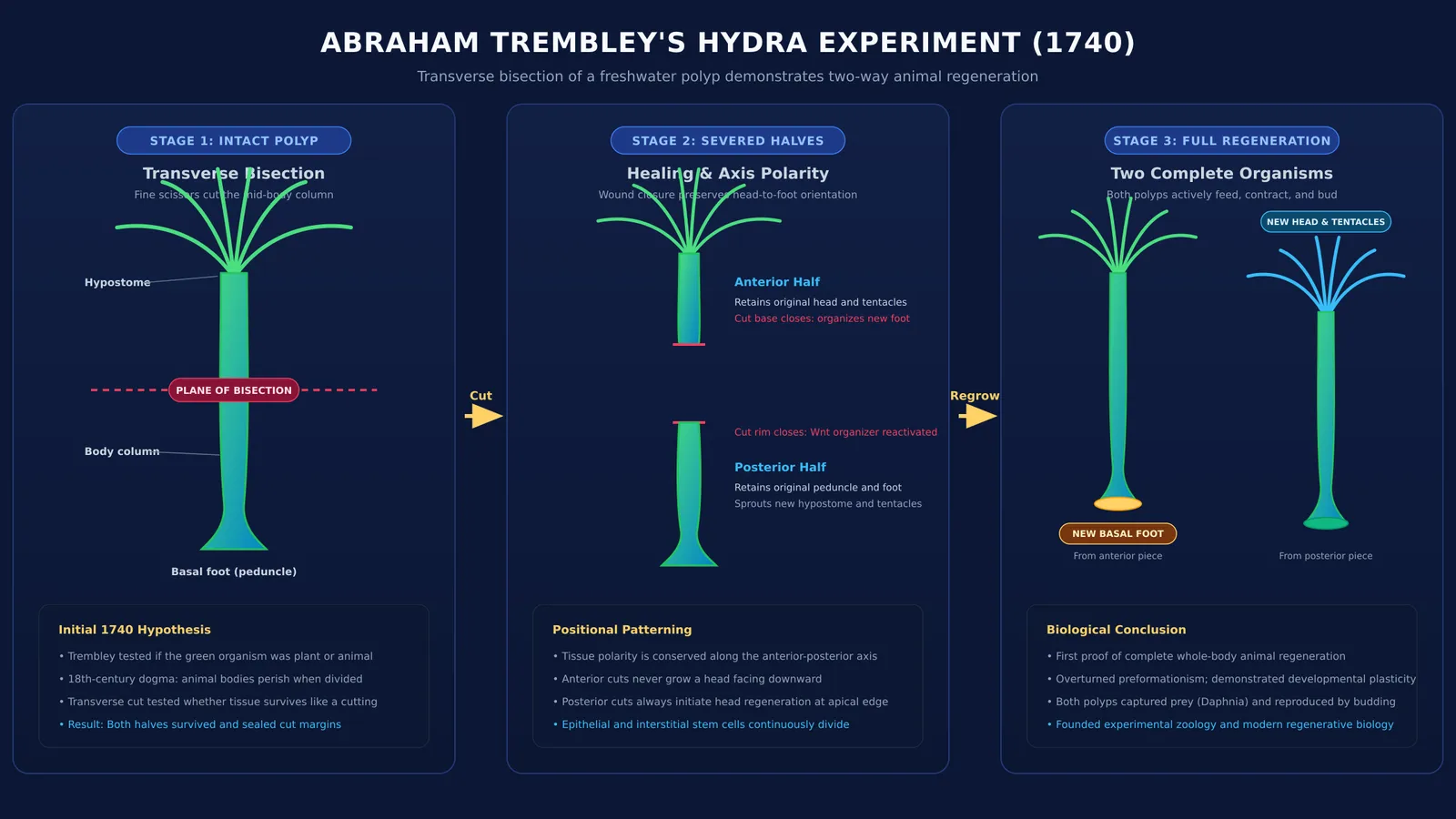
In late autumn 1740, at the Sorgvliet estate near The Hague, Genevan tutor Abraham Trembley gathered pond water to teach natural history to the sons of Count Willem Bentinck. Clinging to submerged weeds, he noticed pale green, cylindrical polyps. On 25 November 1740, as recorded in Abraham Trembley's experiments, he isolated a polyp in a water drop on his palm and snipped it transversely in half using fine scissors.
At the time, animals were considered indivisible machines that perished when severed. Over the following days, both halves contradicted that belief. The anterior half, carrying the mouth and tentacles, healed its base and grew a new adhesive foot. The posterior half sealed its cut rim, sprouted new tentacles, and opened a functioning mouth. By December, Trembley had two complete, predatory organisms from one.
Trembley reported his findings to René-Antoine Ferchault de Réaumur in Paris and Martin Folkes at the Royal Society in London, who published the observations in the Philosophical Transactions of the Royal Society. In 1742, Dutch physician J. F. Gronovius confirmed the discovery to Peter Collinson. The Royal Society awarded Trembley the Copley Medal in 1743, ahead of his 1744 book on freshwater polyps.
Why did Trembley cut the freshwater polyp in half?
Trembley cut the polyp to resolve a taxonomic puzzle. Earlier researchers, including Antonie van Leeuwenhoek's pioneer microscopy, had observed polyps in 1702, but could not settle whether they were plants or animals. The green organism resembled an aquatic weed, yet it contracted when touched, crawled like an inchworm, and captured water fleas (*Daphnia*) with tentacles.
Under the 18th-century doctrine of preformationism, an animal was considered an indivisible being created whole. Plants, however, grew readily from cuttings. Trembley designed bisection as a falsification test: if the pieces died, the creature was an animal; if they survived, it was botanical. The result overturned both categories, proving that animal bodies could regenerate from fragments.
What did Trembley's cutting and grafting trials prove?
After proving bisection, Trembley explored the limits of regeneration through systematic operations recorded in historical accounts of his work:
Longitudinal cutting: Slicing a polyp lengthwise produced two halves that curled into tubes and developed into complete animals.
Multiple sectioning: Cutting polyps into three or four transverse rings revealed that each segment preserved its polarity, growing a head at the apical end and a foot at the base.
The multi-headed hydra: By splitting the head repeatedly, Trembley grew a specimen with seven heads, naming it *Hydra* after the mythical monster. Carl Linnaeus formalised the genus name in 1758.
Inversion: Using a boar's bristle, Trembley turned polyps inside out like the finger of a glove, showing the organism could survive with inverted tissue layers.
Grafting: He pressed together segments from different polyps, producing the earliest recorded animal tissue grafts.
These trials proved that animal development is not fixed inside a rigid mould, but guided by dynamic positional instructions.
How does modern biology explain hydra regeneration?
Modern biology confirms why Hydra possesses this capacity. A review by Brigitte Galliot in 2012 highlights that Hydra maintains three continuous stem cell lineages: ectodermal epithelial stem cells, endodermal epithelial stem cells, and multipotent interstitial stem cells. As column cells divide, older cells are displaced to the extremities and shed, avoiding senescence.
Positional patterning is governed by the head organizer at the hypostome. As demonstrated by Hans R. Bode in 2012, this organizer secretes Wnt ligands that sustain the head-to-foot axis, balanced by local inhibitors. This mechanism links Trembley's work to Hans Spemann and Hilde Mangold's discovery of the embryo organizer and the reprogramming insights of Shinya Yamanaka's stem cell breakthrough.
What can STEM students learn from Trembley's method?
Trembley's investigations demonstrate how to test counterintuitive phenomena systematically:
Define a falsifiable boundary: Test hypotheses where each outcome excludes an assumption, as Trembley did with plant versus animal traits.
Isolate physical axes: Cut along distinct geometric planes (transverse, longitudinal, segmented) to trace tissue orientation.
Control variables: Keep temperature, water purity, and feeding schedules steady across all trials.
Seek replication: Share specimens and observational logs with colleagues before publishing broad claims.
When studying morphogen gradients and cellular axes, visual models help clarify abstract developmental rules. The Fermi Simulation Lab provides interactive simulations for ideas easier to see than read. To master animal tissues and developmental biology across competitive syllabi, students can review the Fermi Concept Library, which covers every concept in physics, chemistry, biology, mathematics and computing. For guided analysis of complex experiments, Fermi's AI tutor works out what you already know and builds a plan for the session, noticing where you get stuck and checking understanding as it goes.


