On this page
Raw rice and cooked rice contain the same starch. What changes in the pot is how that starch is packed, and that decides how easily your digestive enzymes can get at it.
Why is cooked rice easier to digest than raw rice?
Plants store starch as dense granules, with long glucose chains packed into ordered, partly crystalline layers. Amylase, the enzyme that cuts starch into smaller sugars, works only on chains it can reach, and in a raw granule most are locked away.
A review by Shujun Wang and Les Copeland in Food & Function explains that native starch is attacked slowly by enzymes, but after hydrothermal processing (heating with water) it becomes much easier for enzymes to break down (Wang and Copeland, 2013). The same review notes that most of the starch people eat has been processed or cooked, which gelatinises its granules.
In short, cooking opens the starch before you take the first bite. For the enzyme side of the story, see our explainer on how pH and temperature change salivary amylase activity.
What is starch gelatinisation?
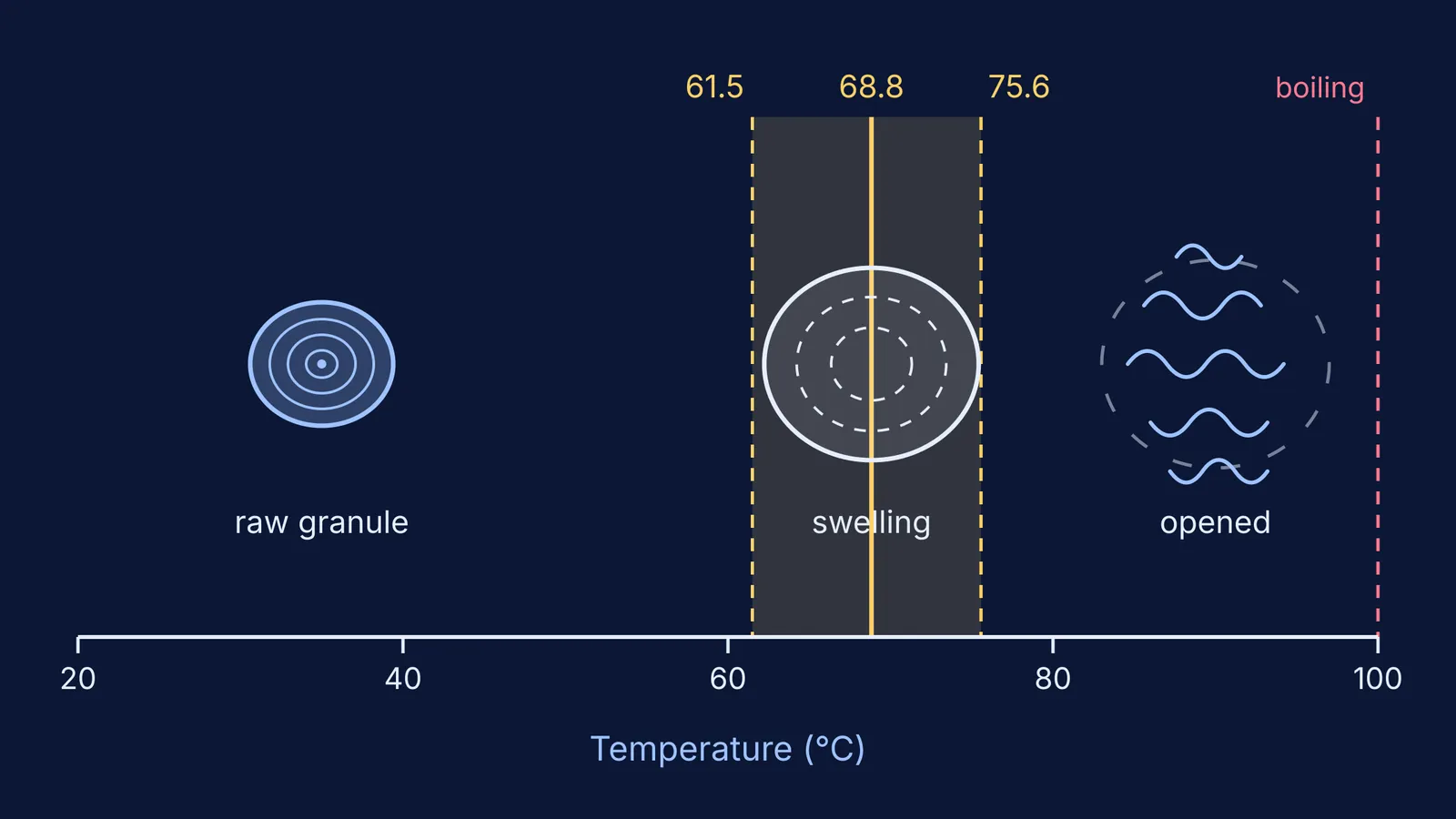
Starch gelatinisation is what happens when starch granules are heated in water: water gets in, the granules swell and deform, their crystalline order breaks down and amylose leaks out, as described in a 2025 study of rice starch in Polymers.
That study, by Teng, Zhang and Wang, measured starch from one rice variety used for noodles. Its gelatinisation began at 61.50 °C, peaked at 68.83 °C and finished at 75.57 °C (Teng et al., 2025).
As the researchers heated samples at higher temperatures, from 60 to 76 °C, the starch's relative crystallinity fell from 29.36% to 0.05% (Teng et al., 2025).
In their lab digestion test, starch heated to 76 °C reached its digestion plateau in about 2 hours, while native (raw) starch took about 12 hours (Teng et al., 2025). As the heating temperature rose, the share of rapidly digestible starch (the part broken down within 20 minutes) went up, and the share of resistant starch went down.
Boiling water at 100 °C is well above that window, so rice boiled until soft has had its starch heated past it. The leaked starch also makes the water cloudy, as we explain in why rice water gets thick when you cook rice.
Does cooking rice longer make it more digestible?
Not much, according to one lab study. Tamura, Singh, Kaur and Ogawa boiled polished rice for 10 minutes (partly cooked) and 20 minutes (fully cooked), then digested it in a lab gut model (Food Chemistry, 2016). They found no significant difference in total starch breakdown between the partly and fully cooked grains, but a clear difference between uncooked and cooked rice. Rice that had been homogenised (mechanically broken up) broke down further than whole grains.
In that study, the big jump came from cooking the rice at all, not from extra minutes in the pot.
Cooling changes the picture again. Wang and Copeland note that gelatinised starch partly re-orders itself as it cools, a process called retrogradation (Wang and Copeland, 2013). That is the science behind why cooked rice goes hard in the fridge.
How can you see the difference with an iodine test?
Iodine turns starch blue-black because iodine sits inside the coiled amylose chain, forming a complex that absorbs light at about 600 nm, according to a 2024 review in Molecules. Roughly, the darker the blue, the more dissolved starch is present.
You need raw rice, three small clear cups, a dropper and iodine solution from your school lab. Work with an adult nearby.
Cup A: soak a spoonful of raw rice in room-temperature water for 15 minutes, stir, then pour a few spoonfuls of that water into Cup A.
Cup B: boil rice in plenty of water until soft, then pour a few spoonfuls of the cloudy cooking water into Cup B and let it cool.
Cup C: add a few more spoonfuls of the same cooled water.
Add two drops of iodine solution to Cups A and B and compare the colours.
Spit a little of your own saliva into Cup C, keep it warm in your hand for 10 minutes, then add two drops of iodine.
What to expect: Cup A should stay yellow-brown or turn faintly blue, because cold water draws little starch out of raw grains. Cup B should go deep blue-black, because gelatinised starch has spilled into the water. Cup C should be lighter than B, because amylase in your saliva has started cutting the chains.
What should you remember for exams?
Link three ideas: starch is packed in crystalline granules, gelatinisation opens them, and amylase works only on chains it can reach. If enzymes or carbohydrates still feel shaky, the Fermi Concept Library gives each biology and chemistry concept its own lesson and shows where it sits in the map.