
On this page
The “effect of pH” and “effect of temperature” on salivary amylase practicals use one method. You mix starch with diluted saliva, take a drop every few minutes and test it with iodine until the blue stops appearing. NCERT's Laboratory Manual: Biology for Class 11 gives the base method and the temperature version as Exercises 26 and 27, and the pH version as Exercise 28. Here is what the manual leaves to you: reading the end point, graphing and the viva.
What happens in the salivary amylase practical?
Salivary amylase (ptyalin) hydrolyses starch into maltose, isomaltose and short glucose chains called dextrins, as NCERT's Exercise 26 explains. Starch turns iodine blue-black, so the blue fades as starch is broken down. For the chemistry, see why starch turns blue-black with iodine but cellulose does not.
The base setup in Exercise 26 is:
Saliva solution: 1 ml filtered saliva in 19 ml distilled water.
Reaction tube: 1% starch, 1% NaCl and pH 6.8 buffer, warmed in a 37°C water bath.
Indicator tubes: a row of test tubes, each holding iodine solution.
A control tube that gets distilled water instead of saliva.
One drop into a fresh indicator tube at 0 minutes, then every 2 minutes.
Why add NaCl? Human salivary amylase carries a bound chloride ion, according to a 1996 crystal-structure study by Ramasubbu and colleagues. A 2012 laboratory study of the enzyme found that 10 mM NaCl enhanced its activity. It is a viva question in Exercise 28; the one-line answer is that chloride ions activate the enzyme.
What is the achromic point in the amylase iodine test?
The achromic point is the time at which a drop from the reaction tube no longer changes the colour of the iodine solution; the NCERT manual calls it the “achromatic point” (Exercise 26). After it, the iodine keeps its own yellow-brown colour.
To read it cleanly:
Line the indicator tubes up against white paper.
Keep a tube of iodine plus a drop of water as your “no starch” reference.
Use the same drop size every time, as the manual asks.
Record the first time a tube matches the reference. That is t.
If a tube never matches, write “not reached by 20 min”, not a guess.
How do pH and temperature change the time?
For pH, Exercise 28 runs three tubes in a 37°C bath: A at pH 6.8, B at pH 4 and C at pH 9 (NCERT Exercise 28). The manual says most enzymes work best between pH 5.0 and 9.0, and outside that range the rate falls as enzymes are denatured. Studies of the enzyme put its optimum near neutral: Marshall and Miwa (1981)90093-0) give pH 6.9 for starch, and the 2012 study found pH 7.0 and 37°C.
For temperature, Exercise 27 puts tube A in ice at 5°C, tube B in a 37°C bath and tube C at 70°C (NCERT Exercise 27). The manual says the rate of many biological reactions roughly doubles with a 10°C rise, and that it falls sharply above and below an optimum temperature. Expect tube B to clear first; at 70°C the enzyme is denatured, so starch may remain.
How do you plot enzyme activity against pH or temperature?
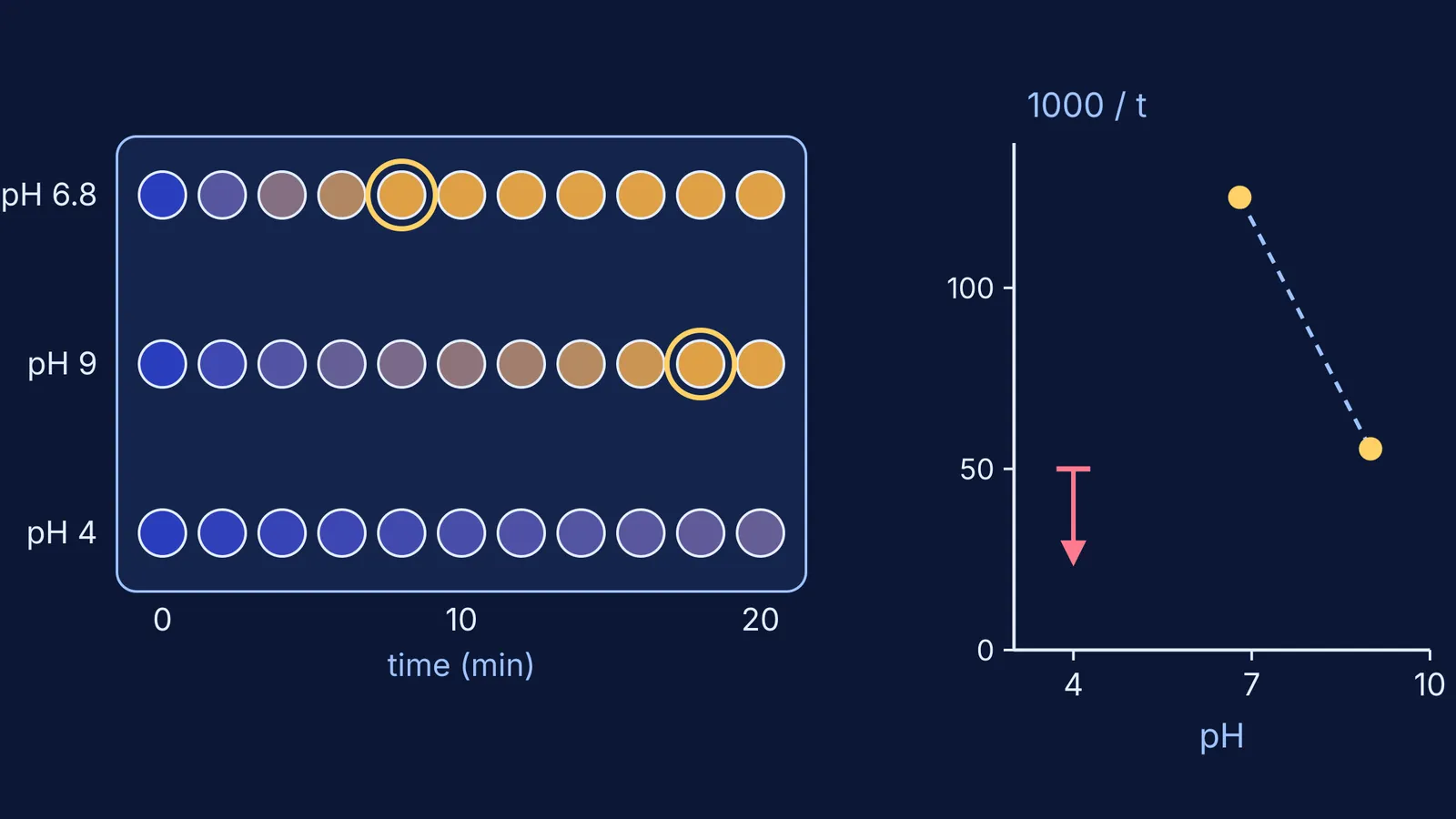
Time is not activity: a faster enzyme gives a shorter time, so plot 1000/t. A worked example with made-up practice readings, taken every 2 minutes as in Exercise 28:
pH 6.8: achromic point at 8 min, so 1000/8 = 125.
pH 9: achromic point at 18 min, so 1000/18 ≈ 56.
pH 4: not reached by 20 min, so 1000/t is less than 1000/20 = 50.
Put pH on the x-axis and 1000/t on the y-axis. Mark the pH 4 result at 50 with a downward arrow: you only know it is below 50, and plotting zero claims more than you measured. Join measured points with straight lines. Three points cannot pin down an exact optimum, so write “of the values tested, pH 6.8 gave the highest activity”. Temperature graphs work the same way.
For another enzyme graph you may be asked to sketch, see how enzyme rate changes as substrate concentration rises. To revise denaturation or optimum pH before the viva, the Fermi Concept Library has a lesson for every concept in biology, each with its place in the map. For graph numericals, the Fermi Problem Library has worked problems with a step-by-step solver that explains the reasoning.
What should you write in the discussion?
Fill in this script:
“Tube __ reached the achromic point first, at __ minutes.”
“Of the conditions tested, activity was highest at __.”
“Activity was lower at __ because __” (cold slows the reaction; extreme pH or heat denatures the enzyme).
For Exercise 26: “The control tube with water instead of saliva stayed blue, so saliva digested the starch.”
“Benedict's test on the digested mixture showed reducing sugar.”
To practise the timings before your lab, try our guide to the amylase iodine test and predicting starch digestion times.