

On this page
When you chew a plain cracker for a short time, it begins to taste sweet. This happens because salivary amylase, an enzyme in your mouth, is breaking down long chains of starch into simpler sugars like maltose. To see this invisible chemical reaction in a lab, biologists use the iodine test. By dropping the mixture onto a spotting tile every few seconds, you can measure exactly how long the enzyme takes to finish its job.
How does the amylase starch digestion iodine test work?
Starch molecules form long, coiled helices. When you add iodine solution (potassium iodide) to starch, the iodine molecules slip inside these coils and create a deep blue-black colour.
Amylase works by cutting these long coils into shorter fragments. As the starch is digested, the helices are destroyed and the iodine can no longer bind. When you test a sample and the iodine remains its natural yellow-brown colour, you have reached the achromic point—the moment all the starch has been digested.
If you are setting up the typical required practical, you will mix starch, amylase, and a pH buffer in a test tube, start a stopwatch, and take a drop out every 30 seconds according to standard protocols to test on a spotting tile.
How long does starch digestion take at 37°C?
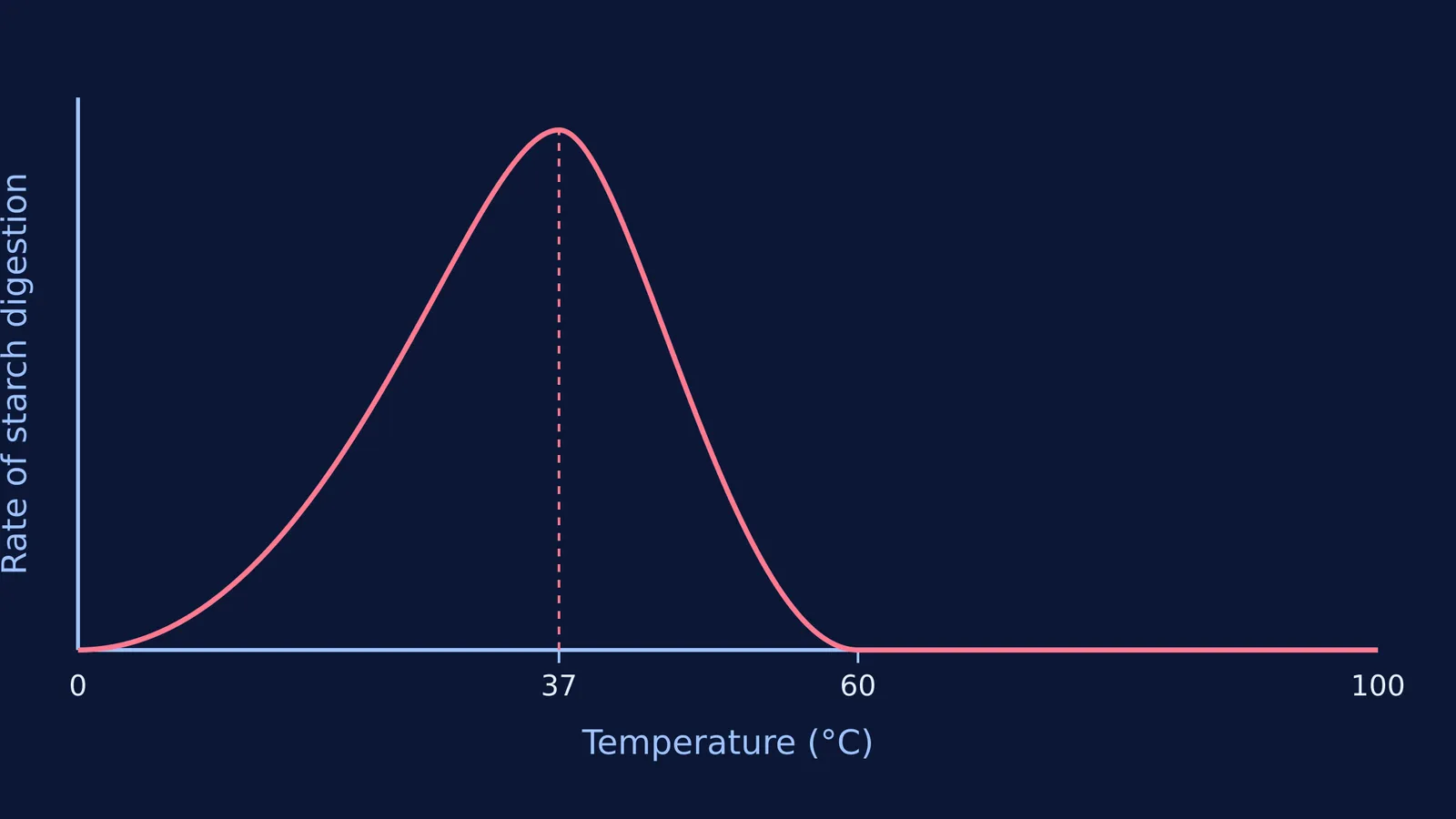
Enzymes are built to work best in their native environment. For human salivary amylase, the optimum temperature is 37°C, as noted in introductory biology texts.
In a standard laboratory setup at 37°C, amylase will fully hydrolyse a standard starch solution quickly, often in a few minutes, depending on the enzyme's concentration. The high kinetic energy at this temperature ensures frequent, successful collisions between the enzyme and the starch molecules. If you were plotting the data, you would see the spotting tile drops go from blue-black to brown, and finally to yellow-brown as the minutes pass.
This optimal speed is why understanding how reaction rates change with temperature is critical in biology and chemistry.
What happens at 0°C and 60°C?
If you change the temperature of the water bath, the time it takes for the starch to disappear changes dramatically, because enzyme activity heavily depends on temperature.
At 0°C to 10°C: The reaction is incredibly slow. The molecules have very little kinetic energy, meaning they rarely collide. The iodine test will remain blue-black for a very long time, showing that almost no digestion is happening.
At 60°C and above: The reaction stops entirely, and the iodine will stay blue-black permanently. High heat breaks the delicate bonds that hold the amylase protein in its specific 3D shape. The active site is deformed, meaning the starch substrate can no longer fit. This permanent loss of shape is called denaturation.
Amylase is a classic example of a hydrolase, one of the six enzyme classes, and its reliance on a perfect 3D shape applies to almost all enzymes in the human body.
Can you do the amylase starch digestion iodine test virtually?
In a physical lab, this experiment requires water baths, spotting tiles, and careful timing to avoid cross-contaminating your enzyme and iodine supplies. If you miss your timing window, your data curve is ruined.
Virtual labs remove the mess while keeping the underlying mathematics accurate. If you are struggling to picture why an enzyme denatures or how the reaction curve looks, the Fermi Simulation Lab provides interactive simulations for the ideas that are easier to see than to read, letting you run the experiment instantly. You can slide the temperature across a wide range, watch the kinetic energy of the molecules change in real-time, and see exactly when the active site loses its shape.
Fermi's AI tutor will work out what you already know and ask you to predict the digestion time before you run the test, helping you build a mental model of enzyme kinetics rather than just clicking through instructions.
A checklist for the iodine test
If you are planning to run this experiment or write about it for an exam, check these four variables:
Equilibration time: Did you leave the separate starch and amylase tubes in the water bath for a few minutes before mixing? If they are not at the target temperature before they meet, your timing will be wrong.
Buffer solution: Amylase is highly sensitive to pH. Always use a buffer to keep the pH constant while you change the temperature.
Clean pipettes: Never use the same glass rod or pipette for the reaction mixture and the iodine bottle.
Control tube: Run one tube with starch and water (no enzyme) to prove that the heating itself is not breaking down the starch.


