

On this page
Metamorphosis is the biological process by which an animal physically develops after birth or hatching, involving a conspicuous and relatively abrupt change in its body structure. For insects, this transformation takes one of two main paths. While both butterflies and cockroaches shed their outer layers to grow, the way they reach adulthood is entirely different.
What is complete metamorphosis in a butterfly?
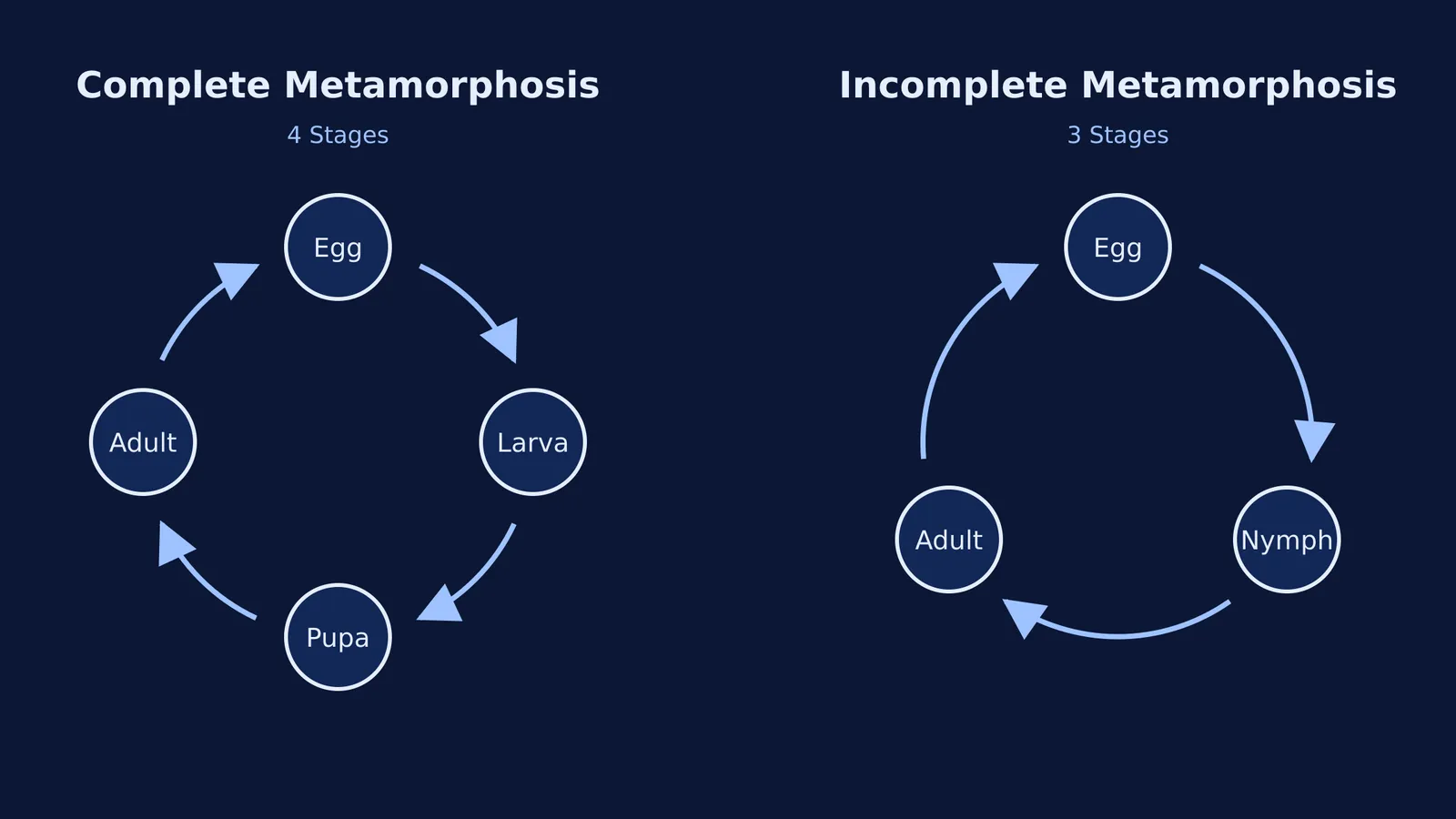
Butterflies undergo complete metamorphosis, also known as holometabolous development. This means the insect goes through four distinct life stages, and the young look nothing like the adults.
The four stages are:
Egg: The cycle begins when an adult female lays an egg, usually on a specific host plant.
Larva: A caterpillar hatches from the egg. This stage is dedicated entirely to eating and growing. Larvae often rely on completely different food sources than adults, which prevents them from competing for the same resources.
Pupa: Once fully grown, the larva forms a protective casing called a chrysalis (or a cocoon, in moths). This is a quiescent, or resting, stage. Inside, the larval tissues break down and are drastically reorganised into adult structures.
Adult: The mature, winged butterfly emerges, ready to reproduce and start the cycle again.
Because the larval and adult forms are so different, complete metamorphosis allows the species to exploit different environments. If you are exploring how organisms adapt in the Fermi Concept Library, you will find that this profound shift is a major evolutionary advantage.
What is incomplete metamorphosis in a cockroach?
Cockroaches follow incomplete metamorphosis, scientifically termed paurometabolous development in the biology curriculum. Instead of a dramatic transformation, the insect grows up gradually through just three stages.
The three stages are:
Egg: The female lays eggs enclosed in a protective capsule called an ootheca.
Nymph: The egg hatches into a nymph. A nymph looks very much like a miniature adult cockroach, but it is smaller, sexually immature, and lacks wings. Nymphs typically live in the same habitat and eat the exact same food as the adults.
Adult: This is the fully grown, winged, and reproductive cockroach.
Because an insect's exoskeleton cannot stretch, it must be replaced as the animal grows. The nymph sheds its old skin in a process called moulting, emerging soft and pale before its new, larger exoskeleton hardens. For a common species like *Periplaneta americana*, the nymph moults about 13 times before it finally becomes an adult. The wings develop gradually, with wing pads only appearing in the next-to-last nymphal stage.
The differences side by side
When comparing a butterfly to a cockroach, the differences come down to how drastically their bodies change.
Number of stages: Complete metamorphosis has four stages (egg, larva, pupa, adult), while incomplete metamorphosis has three (egg, nymph, adult).
The young form: A holometabolous young is a larva (like a caterpillar) that looks completely different from its parents. A paurometabolous young is a nymph that resembles a small adult.
The pupal stage: Only complete metamorphosis includes a resting pupa stage where the body is dismantled and rebuilt.
Wing development: Butterflies develop wings suddenly during the pupal stage. Cockroaches develop wings gradually, visible as wing pads late in the nymphal phase.
You can read about the scientists who studied how insects use these life cycles for survival in our post on Henry Walter Bates and the butterflies that copy others. To understand how different animals manage the waste their bodies produce during these life stages, see our guide on ammonotelic, ureotelic and uricotelic animals.
How do you spot the metamorphosis type in an exam?
If a biology question asks you to classify an insect's development, run through this quick checklist:
Count the stages: If you see a four-step cycle, it is complete. If you see a three-step cycle, it is incomplete.
Look for a resting phase: A question mentioning a pupa, chrysalis or cocoon always points to complete metamorphosis.
Check the diet and habitat: If the young (larva) eats different food than the adult, it is complete. If the young (nymph) shares the adult's diet and environment, it is incomplete.
Note the wings: If the problem describes "wing pads" on a juvenile, you are looking at incomplete metamorphosis.
By learning these distinct markers, you can easily tell apart the gradual growth of a cockroach from the dramatic transformation of a butterfly.