On this page
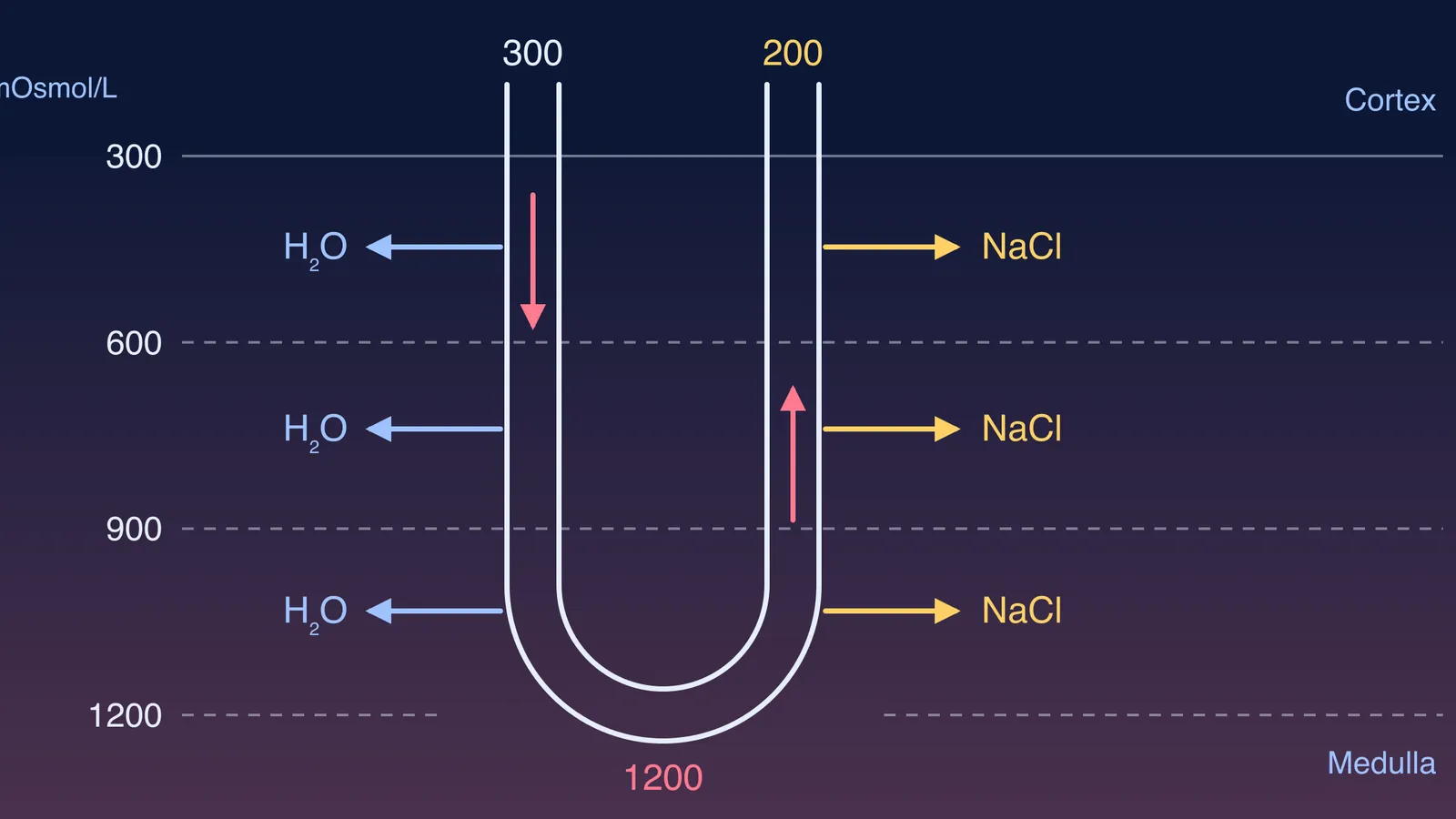
Open NCERT Class 11 Biology, Chapter 16, and find Figure 16.5. Two arrows tell the whole story: on the descending limb, H₂O points out of the tube; on the ascending limb, NaCl points out. Water leaves on the way down, salt leaves on the way up. A common mistake is swapping those two arrows in the NCERT chapter Excretory Products and their Elimination.
Which limb of the loop of Henle is permeable to water?
The descending limb. NCERT states that the descending limb "is permeable to water but almost impermeable to electrolytes", and that this "concentrates the filtrate as it moves down" (NCERT Class 11 Biology, Chapter 16).
Why does water leave? The tissue fluid around the loop, the medullary interstitium, gets saltier the deeper you go. NCERT gives the gradient as 300 mOsmol/L in the cortex rising to about 1200 mOsmol/L in the inner medulla, made mainly by NaCl and urea (section 16.4 of the same chapter). Water moves by osmosis from the filtrate into that salty fluid outside, and salt cannot follow it in because the wall barely lets electrolytes through.
At the cell level, the thin descending limb carries many aquaporin-1 water channels, which is why water crosses it so easily (TeachMePhysiology, Loop of Henle).
What does the ascending limb move out, and why does it keep water in?
The ascending limb does the opposite job. NCERT says it "is impermeable to water but allows transport of electrolytes actively or passively", so the filtrate "gets diluted" as it moves up (NCERT Chapter 16). Figure 16.6 in the same chapter gives the numbers: the fluid reaches 1200 mOsmol/L at the hairpin and has fallen to 200 mOsmol/L by the top of the ascending limb, more dilute than the 300 it entered with.
Figure 16.5 also splits the ascending limb into a thin segment and a thick segment, with NaCl leaving both. The thick segment is the main pump. A 2012 paper in the American Journal of Physiology-Renal Physiology opens by noting that the thick ascending limb "reabsorbs ∼30% of filtered NaCl but is impermeable to water" (Cabral and Herrera, 2012). The transporter doing the work is the Na⁺-K⁺-2Cl⁻ cotransporter, called NKCC2 (TeachMePhysiology).
That salt is why the loop works. Salt moved out of the ascending limb keeps the interstitium concentrated, which draws water out of the descending limb next door. NCERT calls this arrangement, with the vasa recta alongside, the counter current mechanism. For how it was worked out, read Werner Kuhn and the countercurrent multiplier in the kidney.
Can you redraw the two-column table from memory?
On a blank page, draw two columns headed Descending limb and Ascending limb. Fill each row from memory, then check against this list, taken from NCERT Chapter 16:
Water: leaves, permeable (descending) versus stays in, impermeable (ascending)
Electrolytes such as NaCl: almost impermeable (descending) versus moved out actively or passively (ascending)
Filtrate on the way through: concentrated (descending) versus diluted (ascending)
Osmolarity in Figure 16.6: 300 rising to 1200 (descending) versus 1200 falling to 200 (ascending)
Arrows in Figure 16.5: H₂O out (descending) versus NaCl out, plus urea in at the thin segment (ascending)
Memory hook: down, water out (descending) versus up, salt out (ascending)
Do it today and again in three days. Any row you get wrong is your revision for the week. To extend the table to the segments on either side, see functions of the PCT and DCT in the nephron.
How do you spot the assertion-reason trap on Henle's loop?
Assertion-reason questions check two things: whether each statement is true, and whether the reason actually explains the assertion. Our guide to assertion-reason questions covers the method. Try these three before reading the answers.
Assertion: Filtrate becomes more concentrated as it moves down the descending limb. Reason: The descending limb actively pumps NaCl into the filtrate.
Assertion: Filtrate becomes dilute as it moves up the ascending limb. Reason: The ascending limb is impermeable to water but transports electrolytes out.
Assertion: The ascending limb reabsorbs water. Reason: The medullary interstitium is hypertonic.
In 1, the assertion is true and the reason is false: the filtrate concentrates because water leaves, not because salt is added. This is the classic trap, a true effect paired with the other limb's job. In 2, both are true and the reason explains the assertion; it is close to NCERT's own sentence. In 3, the assertion is false and the reason is true: the interstitium is hypertonic, but the ascending limb is impermeable to water, so none leaves.
What should you practise next?
If the gradient feels shaky, the Fermi Concept Library has a lesson for each concept in biology, with its place in the map. For practice, the Fermi Problem Library has worked problems with a step-by-step solver that explains the reasoning rather than printing an answer.
Then close the book and redraw the table once more.