On this page
Your kidneys filter about 180 litres of fluid a day but release only about 1.5 litres of urine, so nearly 99 per cent of the filtrate is reabsorbed, according to the NCERT Class 11 Biology chapter on excretion. Taking that water back depends on a hairpin-shaped part of the nephron, and the idea of how it works came from a physical chemist, not a doctor.
Who was Werner Kuhn and what did he propose in 1942?
Werner Kuhn (1899–1963) was a Swiss physical chemist who directed the Physico-Chemical Institute at the University of Basel from 1939 to 1963 (biography)).
In 1942 Kuhn and Kaspar Ryffel published a German paper whose title translates as "Making concentrated solutions from dilute ones by mere membrane action: a model experiment on the function of the kidney" (DOI record). A historical review sums up the idea: in 1942 Kuhn proposed that the loop of Henle may be the natural analogue of a hairpin countercurrent multiplication system that concentrates urine in mammalian kidneys (Koulouridis and Koulouridis, 2014).
Jacob Henle had described the U-shaped loop in 1862, the same review notes, but his discovery was neglected. Kuhn's idea offered a reason for that hairpin shape.
How does the countercurrent multiplier work in the loop of Henle?
A countercurrent multiplier is a pair of tubes carrying fluid in opposite directions, where a small difference between them at every level is added up along their length into a large difference from one end to the other.
In the loop of Henle, the NCERT chapter gives the two rules that make this work:
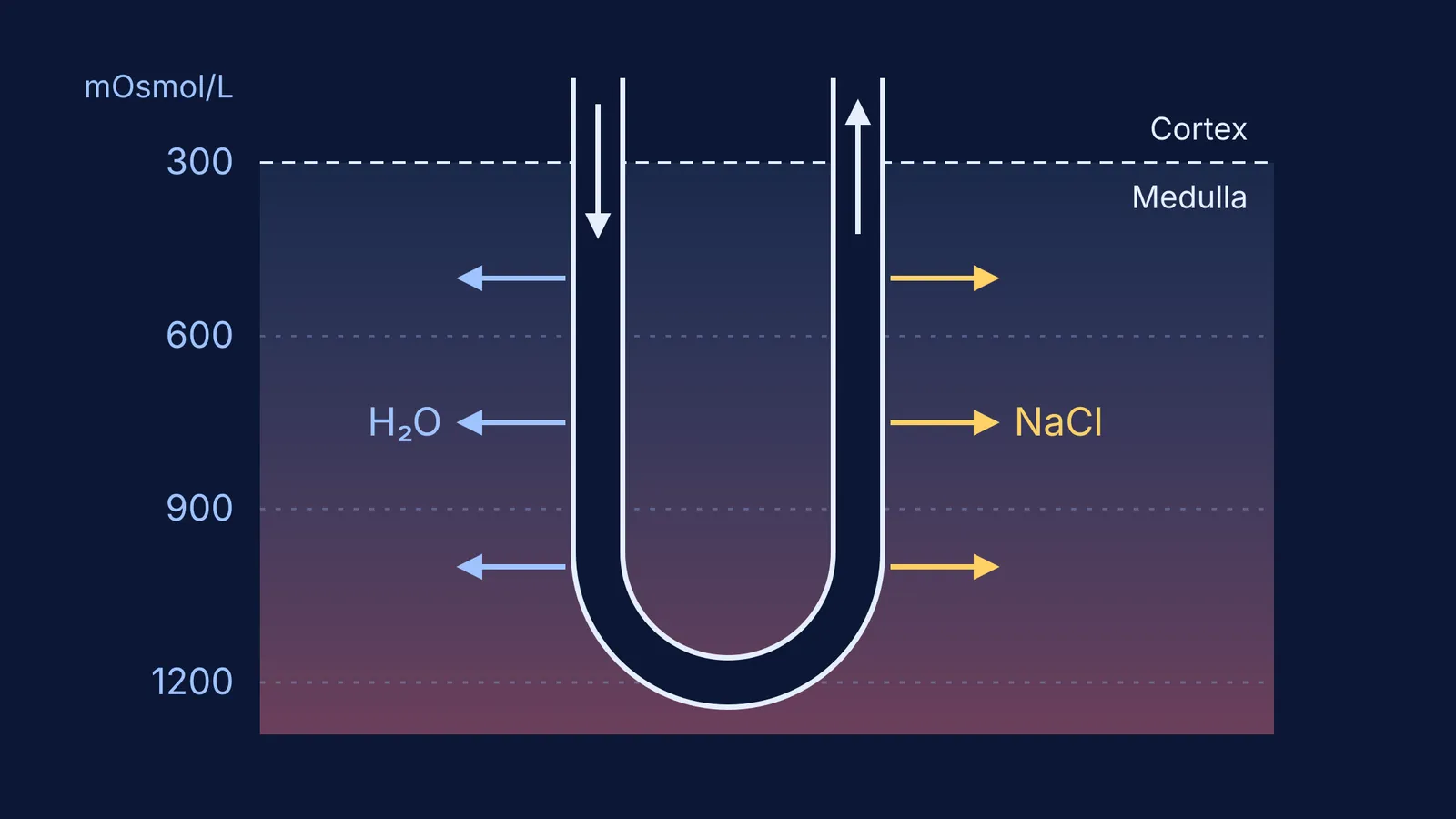
The descending limb is permeable to water but almost impermeable to electrolytes.
The ascending limb is impermeable to water but allows transport of electrolytes, actively or passively.
Together with the vasa recta, and with flow in opposite directions, they help maintain a gradient that NCERT puts at 300 mOsmol/L in the cortex to about 1200 mOsmol/L in the inner medulla (NCERT).
What happens to one drop of filtrate in the loop?
Here it is with the values in NCERT's Figure 16.6 (NCERT):
Entering the descending limb (about 300 mOsmol/L). The drop matches the cortex around it.
Going down. The tissue gets saltier with depth. Water leaves by osmosis, salt stays in, so the drop concentrates: 400, 600, 800, 1000.
At the hairpin (about 1200 mOsmol/L). The drop now matches the deepest tissue.
Going up the ascending limb. Salt leaves, water cannot follow, so the drop gets more dilute. It reaches the cortex at about 200 mOsmol/L, more dilute than when it entered.
Why this multiplies. The salt moved out going up is what pulls water out going down. Fresh fluid keeps arriving, so each small step is stacked on the one below.
The payoff comes in the collecting duct, which runs back down through that salty medulla. NCERT notes that large amounts of water can be reabsorbed here to make concentrated urine.
Why did the countercurrent theory take so long to be accepted?
In 1951 Kuhn, Hargitay and Wirz showed experimentally that the loop was the most important part of the system, the 2014 review records. One of their 1951 papers located the concentrating process in the kidney by "direct cryoscopy", measuring freezing points, according to a 1983 Citation Classic essay by Robert Berliner.
Many physiologists were still not convinced. Looking back on his own 1957 work in that essay, Berliner, of the Yale School of Medicine, wrote that "although the countercurrent hypothesis had been proposed by Wirz and Kuhn, it had not really penetrated the thinking of most renal physiologists."
The evidence that changed minds came from Carl Gottschalk and Margaret Mylle at the University of North Carolina. Using micropuncture, they sampled fluid from the loops, collecting ducts and vasa recta of rodent kidneys. Fluid at the bends of the loops was as concentrated as fluid in collecting ducts and vasa recta at the same level, which they reported in 1959 as consistent with a countercurrent multiplier (Gottschalk and Mylle, American Journal of Physiology). The review dates acceptance by English-speaking scientists to 1958, when the pair published their experimental work.
How do you answer countercurrent questions in exams?
Check that you can do all five without notes:
Say which limb lets water out and which lets salt out.
Draw the loop with the 300, 600, 900 and 1200 mOsmol/L levels from the NCERT chapter, deepest at the bend.
Explain why fluid leaving the ascending limb is more dilute than when it entered.
Name the multiplier (loop of Henle) and the exchanger (vasa recta).
Explain why the long loops of juxtamedullary nephrons matter here.
For that last point, see our post on cortical vs juxtamedullary nephrons. If your diagrams are messy, practise with how to draw a nephron in five minutes.
Flow in opposite directions is easier to follow once you have watched it; the Fermi Simulation Lab has interactive simulations for ideas that are easier to see than to read. If osmosis still feels shaky, the Fermi Concept Library gives each biology and chemistry concept its own lesson.