

On this page
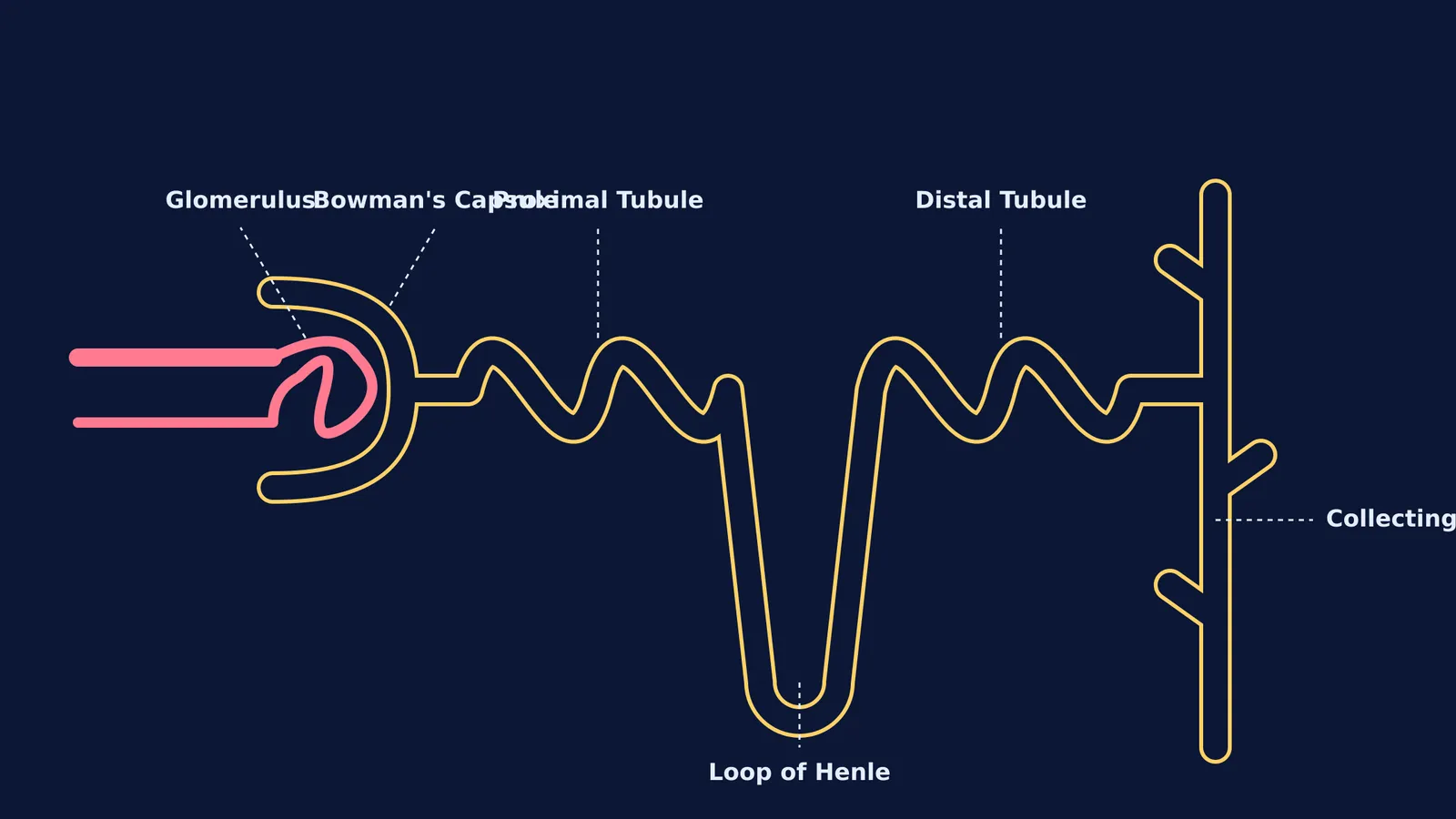
A common question in biology exams (including school boards and NEET-UG) is to draw and label a nephron. It looks like a complex tangle of tubes, but it is actually a single continuous pipe. If you know the order of its parts, you can sketch it accurately in under five minutes.
What are the main parts of a nephron?
Before picking up a pen, it helps to know what you are drawing and why it is shaped that way. The nephron has two main jobs: filtering the blood and then recovering the water and useful chemicals before they are lost.
Bowman's capsule and glomerulus: This is the filter. Blood enters a knot of capillaries (the glomerulus) under high pressure. Water and small molecules are pushed out into a surrounding cup called Bowman's capsule.
Proximal tubule: The highly twisted tube immediately after the capsule. This is where most of the recovery happens—the majority of the filtered water, along with glucose and essential nutrients, are reabsorbed into the blood here.
Loop of Henle: A long hairpin loop that dips deep into the kidney's medulla. It creates a salt gradient that allows the kidney to concentrate urine. The descending limb lets water out, while the ascending limb pumps salt out.
Distal tubule and collecting duct: A final twisted section that fine-tunes the fluid based on your body's hydration and hormonal signals, followed by a large vertical duct that collects waste from multiple nephrons and carries it towards the bladder.
How do you draw a nephron with a Bowman's capsule, glomerulus and tubule?
You do not need to draw a perfect 3D model. A clear, schematic line diagram earns full marks and saves you time during an exam.
Draw the cup first: Start on the left side of your page with a deep C-shape for Bowman's capsule. Keep it relatively large so you have room to draw inside it later.
Add the blood vessels: Draw a thick line entering the open mouth of the cup. This is the afferent arteriole, which brings blood in. Scribble a knot inside the cup for the glomerulus, and draw a thinner line exiting (the efferent arteriole). The difference in thickness is important: it creates the high pressure needed for filtration.
Trace the winding road: From the closed back of the cup, draw a thick, continuous line. Make two squiggly bumps for the proximal tubule. Then, drop the line straight down and bring it back up in a long U-shape for the loop of Henle. After the loop, make two more squiggly bumps for the distal tubule.
Attach the main drain: End your continuous line at a thick vertical pipe. Add a few small branches to this collecting duct to show that other nephrons feed into it. Remember, while each nephron has its own Bowman's capsule and tubule, many nephrons share a single collecting duct.
How does the nephron filter fluid every day?
The scale of this filtration system is staggering. Each human kidney contains approximately one million nephrons.
This massive turnover means your entire blood volume passes through these microscopic filters constantly. When you draw the long, twisted tubules and the deep loop of Henle, you are drawing the exact structures that perform this massive recovery. The twisted shape of the proximal and distal tubules is not random; it ensures the tubule is long enough to reabsorb nutrients while remaining packed into the small space of the kidney's cortex. Without them, we would lose all our water and essential salts in minutes. If you are reviewing excretion, comparing how humans produce urine with how other animals manage nitrogen—such as the differences between ammonotelic, ureotelic and uricotelic animals—is a logical next step. You can also map complex biological flows in other systems, such as studying respiration as an amphibolic pathway.
Drawing a nephron helps you remember its parts, but biology questions often test what happens inside them. Exams like NEET-UG will ask you to identify which part of the tubule is responsible for maximum water reabsorption, or how hormones act on the collecting duct. If you struggle to connect the physical structure to the physiology—like why the ascending limb is impermeable to water, or how the intricate process of countercurrent multiplication works—an AI tutor can bridge the gap.
For instance, you can ask the Fermi Concept Library to walk you through the loop of Henle step by step. Rather than just giving you a long textbook paragraph to memorise, Fermi works out what you already know, builds a plan for the session, and teaches through it. It holds a line of reasoning across a whole session, notices where you are stuck, and decides whether to explain, ask, or show—checking your understanding as it goes. This helps you understand exactly how the salt gradient concentrates urine before you face your next exam.


