On this page
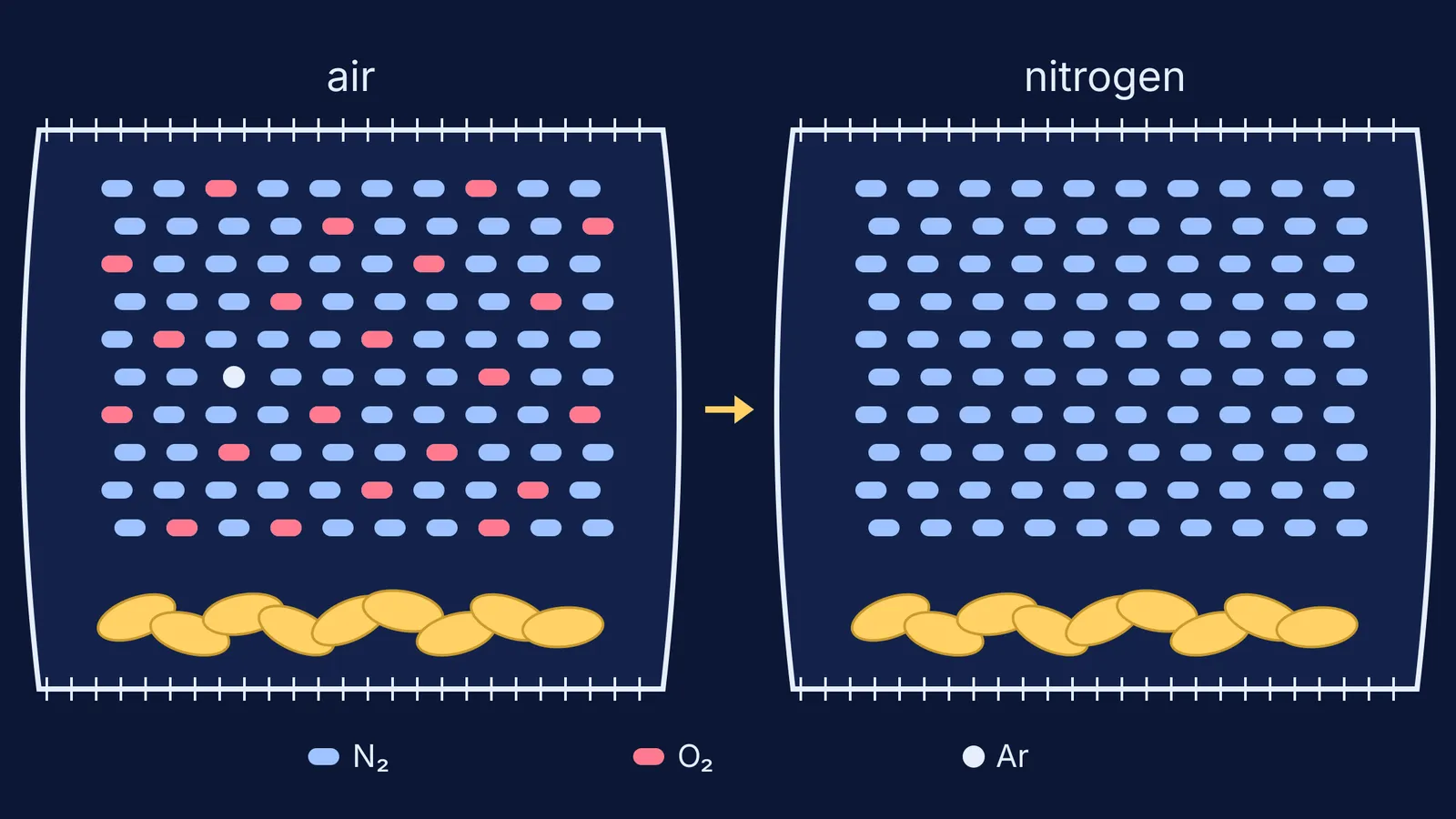
Tear open a packet of chips and the first thing that comes out is gas. Manufacturers fill the packet with nitrogen so that oxygen cannot reach the oil in the chips, and so that the puffed-up packet works as a cushion.
What does NCERT say about nitrogen in chips packets?
In section 1.3.2 of the NCERT Class 10 Science textbook, Chapter 1, the authors note that chips manufacturers “usually flush bags of chips with gas such as nitrogen to prevent the chips from getting oxidised”. The chapter's exercises then ask: “Oil and fat containing food items are flushed with nitrogen. Why?”
What is rancidity, and why do chips go rancid?
In the same NCERT chapter, a substance is oxidised if it gains oxygen or loses hydrogen during a reaction. The chapter lists rancidity as an everyday effect of oxidation: when fats and oils are oxidised, they become rancid and their smell and taste change. Corrosion, such as rusting, is the section's other example; see our post on corrosion and rancidity as everyday oxidation.
Chips are fried, so every slice carries oil. The oxygen comes from ordinary air: near Earth's surface, air is 78% nitrogen, 21% oxygen and 1% other gases such as argon, according to NASA. A packet sealed with air would trap that oxygen next to the oil.
In a 2016 study in Food Chemistry, Marasca and colleagues stored potato crisps at 45°C for six weeks to speed up ageing, tracking the first products of oil oxidation and hexanal, a volatile compound that forms later (Marasca et al., 2016). Crisps fried in regular sunflower oil were the least stable, and flushing them with nitrogen slowed oxidation and significantly stabilised them. Crisps fried in high oleic sunflower oil were the most stable, so the choice of oil matters too.
Why nitrogen and not some other gas?
Nitrogen is used because it hardly reacts at room temperature. Its two atoms are held together by a triple bond, N≡N. The bond enthalpy of N≡N is 946.0 kJ/mol, against 498 kJ/mol for the O=O bond in oxygen, according to NCERT Class 11 Chemistry, Unit 4. Breaking N≡N takes nearly twice the energy, which helps explain why nitrogen does not react with the oil.
Why is the packet puffed up instead of vacuum-sealed?
Sucking all the gas out would also remove the oxygen, but the plastic would then press hard on brittle chips. A US patent held by the crisp maker Tyrrells and a partner company says that before sealing, the bag “is generally filled with a gas such as air or nitrogen gas to both protect the product from being crushed and maintain the freshness of the product by preventing oxidation during storage” (US patent 9,309,013). The same patent says the inflated bag “acts like a pillow or cushion”.
What does the chips packet label tell you?
In India, labels follow the FSSAI Labelling and Display Regulations, 2020. Start with a simple squeeze: a firm, puffed packet suggests the seal has held, while a soft, flat one may have let air in. Then read the label:
Find the two compulsory dates. “Date of manufacture or packaging” and “Expiry/Use by” must be on the label, grouped together.
Read “Best before” correctly. It is optional. After it, FSSAI says the food “may still be perfectly safe to consume, though, its quality may have diminished”.
Treat “Use by” as a hard stop. After it, the product may not remain safe and must not be sold.
Check the oil. The ingredient list must name the specific edible oil, such as groundnut or mustard oil. As the crisps study showed, the oil affects how fast rancidity sets in.
Look for storage instructions. If the date depends on storage, the label must say so, and it may add how to store the pack once opened.
Once you open the packet, oxygen is back. NCERT notes that keeping food in airtight containers slows oxidation and that antioxidants are added to oily foods for the same reason (NCERT Class 10 Science, Chapter 1); our explainer on how BHA, BHT and other preservatives keep food fresh covers those additives.
How do you answer this in a Class 10 exam?
Our model answer to NCERT's exercise question:
Oils and fats in food are oxidised when they come in contact with oxygen in the air, and they become rancid: their smell and taste change. Nitrogen is an unreactive gas. Flushing the packet with nitrogen pushes out the air, so little oxygen is left to oxidise the oil and the food stays fresh for longer.
Check that your answer contains four ideas: oxidation, rancidity, nitrogen being unreactive, and oxygen being pushed out. For a longer answer, add the cushioning effect.
If the gain-or-loss-of-oxygen rules still feel shaky, start with how Class 10 defines oxidation and reduction. The Fermi Concept Library gives each chemistry concept its own lesson and shows where it sits in the map, and the Fermi Problem Library has worked problems with a step-by-step solver that explains the reasoning rather than printing an answer.