

On this page
After an afternoon of cricket in the heat, your urine is the colour of strong tea. Three glasses of water later, it is almost clear. In between, a hormone switched your kidneys from saving water to letting it go.
Why is urine dark yellow when you are dehydrated?
The colour comes mainly from one pigment. A 2024 study in Nature Microbiology notes that urobilin was identified as the yellow pigment in urine more than 125 years ago, and it showed that gut bacteria make urobilin's colourless precursor using an enzyme called bilirubin reductase. The same study found the enzyme missing in only 0.1% of 1,801 gut samples from healthy adults.
The pigment supply is fairly steady; what changes hour to hour is how much water it is dissolved in. Same pigment, less water: darker urine. MedlinePlus describes the usual colour of urine as straw-yellow.
How do osmoreceptors and ADH make the kidney save water?
You lose water through sweat and breath, so your blood becomes slightly more concentrated. Normal plasma osmolality is between 275 and 290 mOsm/kg.
Osmoreceptors, sensor cells in the hypothalamus, pick up the change. A review in CJASN by John Danziger and Mark Zeidel says rises of less than 2% are enough to make them release vasopressin, the hormone also called antidiuretic hormone (ADH).
ADH is made in the hypothalamus and carried to the posterior pituitary, which releases it into the blood.
In the kidney's collecting ducts, ADH sets off signals that move aquaporin-2 water channels to the cell surface facing the urine, which makes the duct wall permeable to water.
Water moves out of the duct into the salty tissue of the inner kidney, which the Danziger and Zeidel review puts at up to 1,200 mOsm/kg, and returns to the blood.
At maximum ADH, Kerry Brandis's notes (step 3) put daily urine at about 500 mL. The loop of Henle builds the salty inner kidney; see which limb of the loop of Henle lets water out and urine formation step by step.
Thirst is the backup; read how the body knows when to feel thirsty.
Why does urine turn pale after drinking a lot of water?
Drink a lot and the chain runs in reverse: your blood becomes slightly more dilute, the osmoreceptors ease off, and ADH release drops. Brandis gives ADH in the blood a half-life of only about 15 minutes. With little ADH, water stays in the duct and leaves as plenty of dilute urine.
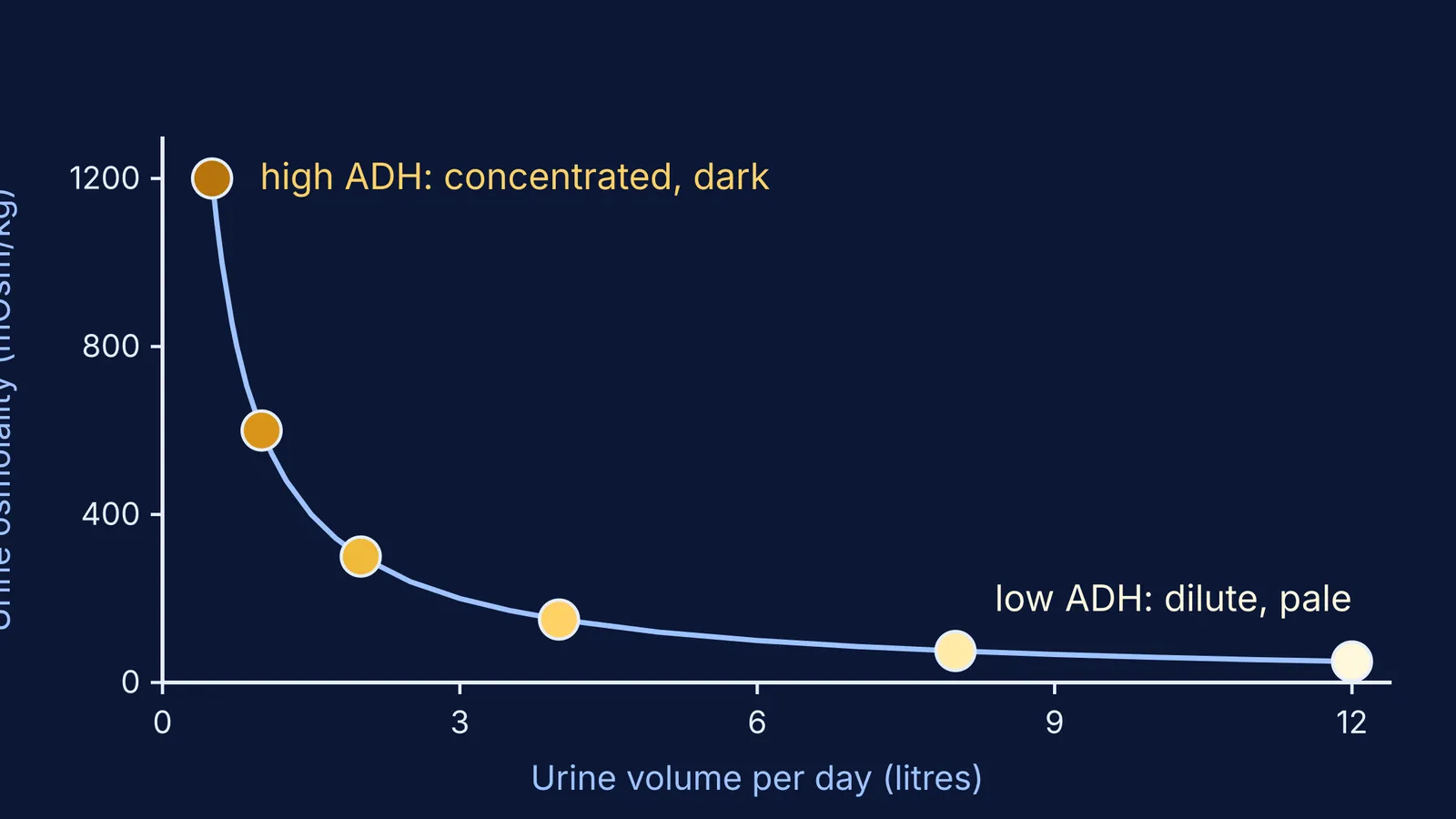
The OHSU clinical laboratory lists a random-urine reference range of 50 to 1,200 mOsm/kg, a 24-fold span.
Worked example: same waste, different water
At maximum ADH: about 0.5 litres a day at 1,200 mOsm/kg, so 0.5 x 1,200 = 600 mOsm of dissolved waste. Keep that load fixed and change only the water:
0.5 L of urine: 600 / 0.5 = 1,200 mOsm/kg, the concentrated limit
2 L: 600 / 2 = 300 mOsm/kg, four times more dilute
12 L: 600 / 12 = 50 mOsm/kg, the dilute limit
The pigment follows the same arithmetic, so colour tracks concentration. Real loads vary with diet, but the curve keeps this shape.
How can you watch ADH at work at home?
Urine colour is a fair rough gauge. Lawrence Armstrong and colleagues found in 1994 that urine colour was strongly correlated with urine osmolality and urine specific gravity, and judged it suitable where an approximate reading is enough.
Try a one-day observation log. Do not cut back on water or force down extra; drink as you normally would and watch.
Make a five-step scale: 1 almost clear, 2 pale straw, 3 yellow, 4 dark yellow, 5 amber.
Each visit, note the time, your score and roughly how many glasses you drank since the last one.
Add one word for what happened in between: sleep, class, sport, sun or meal.
Before each entry, predict the score in ADH terms. Example: after a night's sleep, eight hours without drinking, ADH likely high, predict 4.
In the evening, circle the misses and look for a cause.
MedlinePlus notes that B-complex vitamins, carotene, beetroot and some medicines change colour without changing water, so log those too. The NHS advice is to drink enough during the day so that your pee is a pale colour, and it lists dark yellow, strong-smelling pee as a sign of dehydration.
If the collecting duct still feels abstract, the Fermi Concept Library gives every biology concept its own lesson and its place in the map, so you can see where ADH sits beside the nephron.
Start your log with tomorrow's first trip to the toilet.


