

On this page
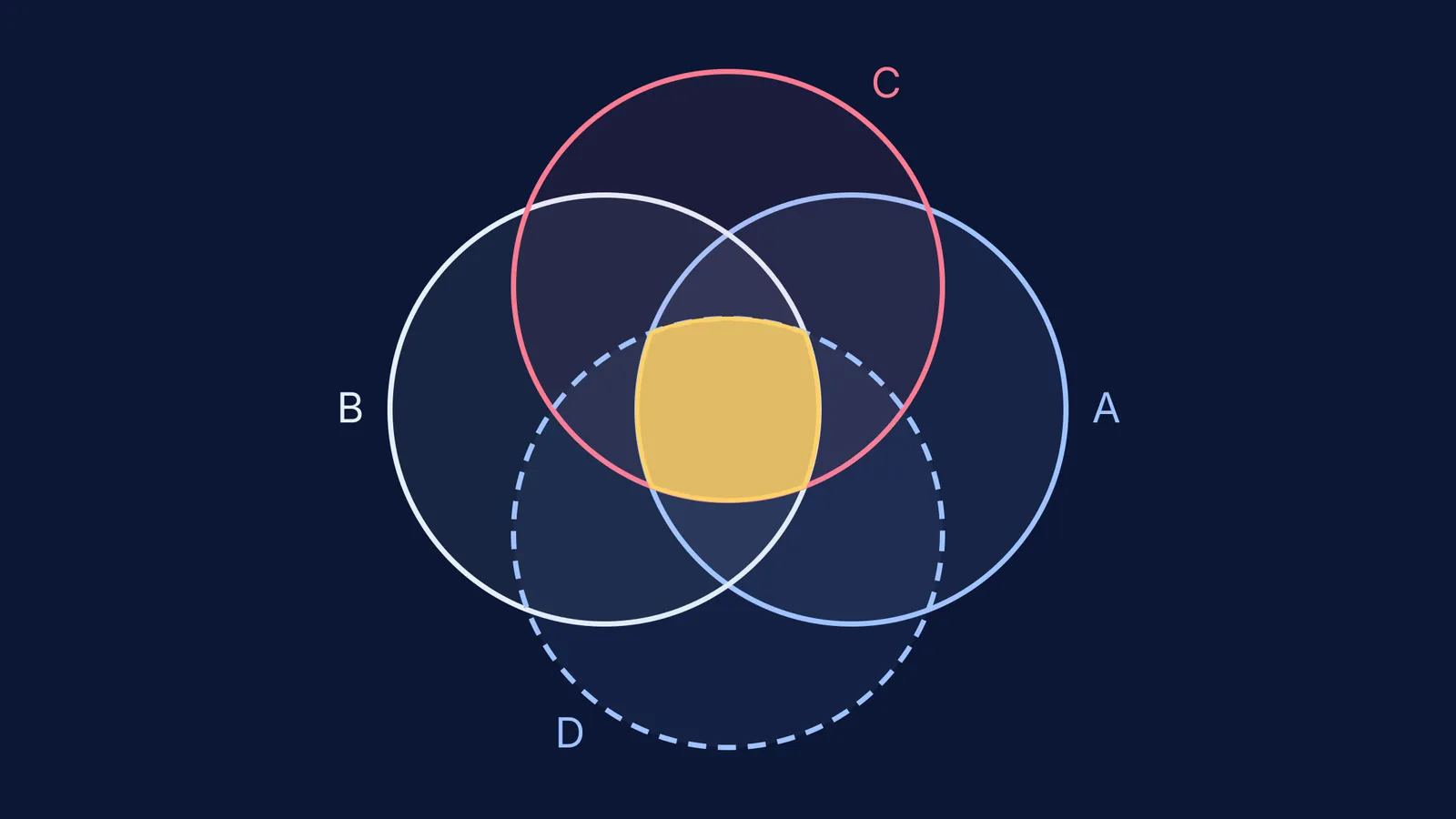
Draw four chalk shapes where every three overlap. Must one spot lie inside all four? If every shape is convex, yes. That is Helly's theorem. Below: the statement, the proof on a number line, a counterexample, and the four-point trick behind the general proof.
What is Helly's theorem?
A set is convex when the segment between any two of its points stays inside it: a disc or a filled triangle is convex, a crescent or a ring is not.
Helly's theorem states that for a finite collection of at least d + 1 convex sets in d-dimensional space, if every d + 1 of them have a point in common, then the whole collection has a point in common (Wikipedia: Helly's theorem). In the plane, d = 2, so the test is every three sets. On a line, d = 1, so every two is enough.
The same article records that Helly discovered the theorem in 1913 but did not publish it until 1923, by which time alternative proofs by Radon (1921) and König (1922) had already appeared. Radon's paper in Mathematische Annalen (doi:10.1007/BF01464231) carries a note explaining the gap: Helly had been held as a prisoner of war in Russia since 1915 and returned to Vienna in mid-November 1920.
Why is the one-dimensional case easy?
On a number line the convex sets are the intervals. Take closed intervals that meet in pairs. Let L be the largest left end and R the smallest right end. The intervals owning L and R overlap, so L is at most R. Every interval starts at or before L and ends at or after R, so the stretch from L to R lies inside all of them.
Worked example: [1, 5], [3, 8], [2, 4.5] and [4, 6] overlap in pairs. L = 4, R = 4.5, and every interval contains [4, 4.5].
Drop convexity and it fails at once: {1, 2}, {2, 3} and {1, 3} meet in pairs, yet no number lies in all three.
Why does Helly's theorem need convex sets?
Take four points in the plane, no three on a line: p1 = (0, 0), p2 = (4, 0), p3 = (0, 4) and p4 = (1, 1). Let S1 be the set {p2, p3, p4}, all the points except p1, and build S2, S3 and S4 the same way. Any three of these sets share one point (S1, S2 and S3 all contain p4), but no point lies in all four. Point sets are not convex, so Helly's theorem makes no promise.
Now replace each set by its convex hull, the filled triangle on its three points. The triangle on p1, p2, p3 contains (1, 1), and the other three have p4 = (1, 1) as a corner. All four now share (1, 1).
How does Radon's lemma prove Helly's theorem?
Radon's theorem states that any d + 2 points in d-dimensional space can be split into two groups whose convex hulls intersect (Wikipedia: Radon's theorem). In the plane, for four points with no three in line: either one lies inside the triangle of the others, or the diagonals of their quadrilateral cross.
Here is the proof for four convex sets X1, X2, X3, X4 in the plane, every three of which meet:
For each i, choose a point pi in the other three sets (they meet, so you can).
Apply Radon's theorem to p1, p2, p3, p4. You get two groups and a point q inside both of their convex hulls.
Fix any set Xi. The point pi sits in one group, so every point of the other group lies in Xi. Xi is convex, so it contains that group's convex hull, and therefore q.
That holds for every i, so q lies in all four sets.
On the triangles above, p4 lies inside the triangle on the other three, so the groups are {p4} and {p1, p2, p3}, and q = (1, 1). The Helly article extends this to any number of sets by induction, and the Radon article notes that this proof is what led Radon to his theorem.
How do you use Helly's theorem in a problem?
Run this checklist first:
Are all the sets convex? Intervals, discs, half-planes and convex polygons are; unions and scattered points usually are not.
What is d? Check every d + 1 sets: two on a line, three in the plane, four in space.
Is the family finite? Infinite families need compact sets, as the Helly's theorem article states.
Show every d + 1 sets meet; the theorem does the rest.
Try it: the half-planes x ≥ 0, y ≥ 0, x + y ≤ 2 and y ≤ x + 1. Show every three share a point, then find one point in all four.
If convex hulls or half-planes feel shaky, the Fermi Concept Library gives each concept in mathematics its own lesson and its place in the map. Convexity also drives Jensen's inequality for convex functions; for another result where structure is guaranteed, read the Erdős–Szekeres theorem on monotone subsequences.


