On this page
A silkworm caterpillar has a problem every growing insect shares: its outer skeleton does not stretch. To get bigger, it has to build a new, larger cuticle underneath and shed the old one, a process we covered in our post on how insects and snakes moult. Two hormones run the whole show. One decides when a moult happens. The other decides what kind of animal comes out of it.
What does ecdysone do in insects?
Ecdysone is the moulting hormone. A review in the Annual Review of Entomology opens with the line that the steroid hormone ecdysone is the central regulator of insect developmental transitions (Yamanaka, Rewitz and O'Connor, 2013).
The signal travels in a chain, as laid out in the Developmental Biology web topic on hormonal control of insect metamorphosis:
The brain releases a neuropeptide called prothoracicotropic hormone (PTTH).
PTTH stimulates the prothoracic gland to make ecdysone.
Tissues such as the fat body convert ecdysone into the active hormone, 20-hydroxyecdysone (20E).
Inside cells, 20E acts through a receptor made of two proteins, EcR and USP, which binds to ecdysone-response elements in DNA. The same web topic notes that each moult is set off by one or more pulses of 20E.
What does juvenile hormone do?
Juvenile hormone (JH) is made by endocrine glands called the corpora allata, according to the same Developmental Biology web topic.
JH does not trigger moults. It sets their outcome. A 2012 silkworm study put it plainly: JH prevents precocious metamorphosis and lets the larva moult again and again until it reaches the right size. A paper on the silkworm Met protein sums up the division of labour in one line: 20E orchestrates the moulting process, whereas JH determines the nature of the moult.
The protein that receives the JH signal is called Methoprene-tolerant, or Met, and it binds JH directly, making it an intracellular hormone receptor (Jindra, Palli and Riddiford, 2013).
How do the two hormones work together in a silkworm?
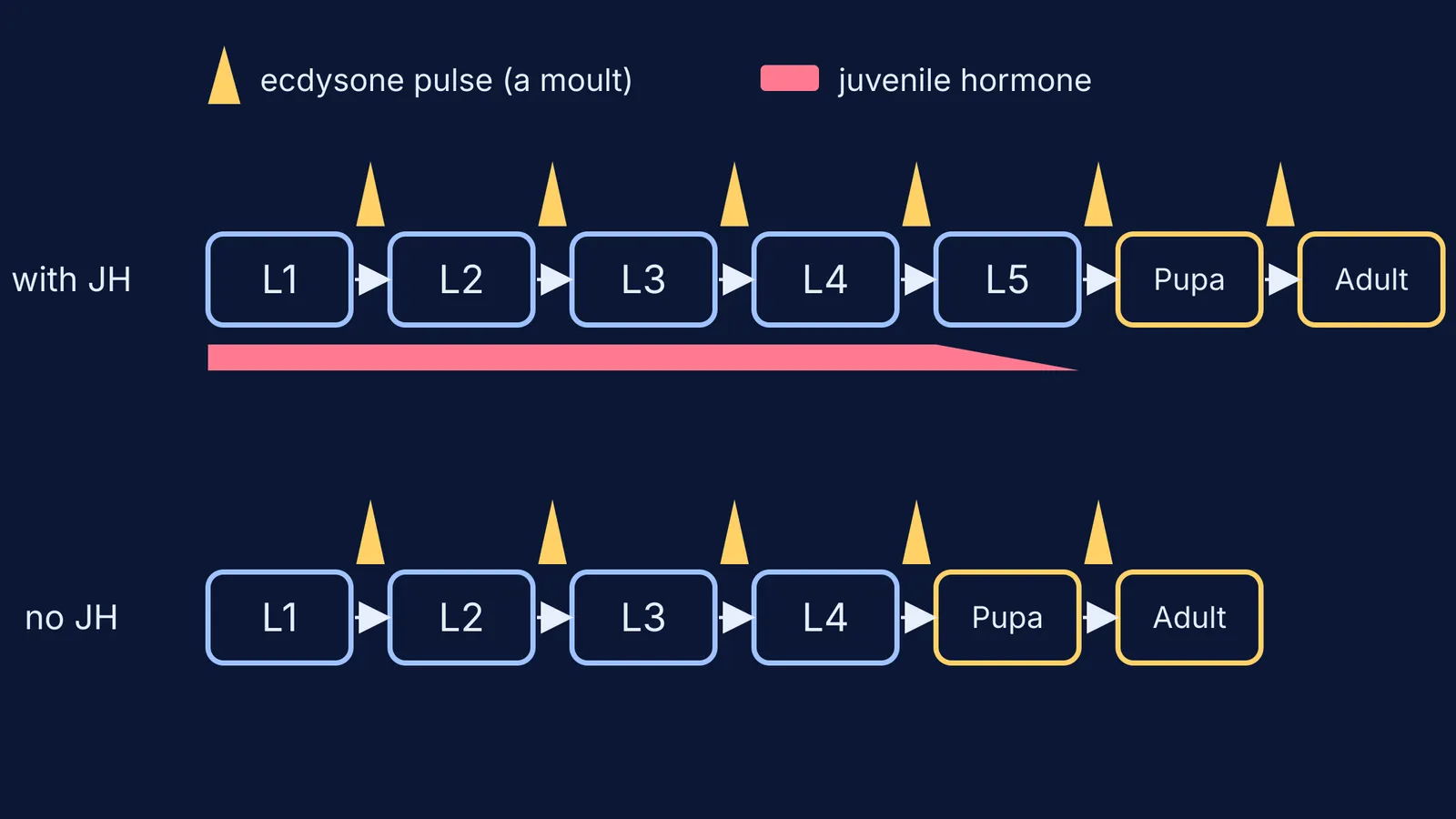
Silkworms typically have five larval stages, called instars, and moult four times between them. Here is the life cycle as a hormone timeline:
Instars 1 to 4. JH is present. Each ecdysone pulse triggers a moult, and out comes a bigger caterpillar.
Instar 5. The larva has reached full size. JH falls away, so the next ecdysone pulse gives a pupa instead of another caterpillar. Our silkworm life cycle explainer covers the cocoon it spins.
Pupa to moth. One more ecdysone pulse, with no JH, and the adult moth emerges.
The textbook model says high JH gives larvae, intermediate JH gives pupae and low JH gives adults. The same source notes that real measurements are messier, so treat this as the exam-level picture.
What happens to a silkworm without juvenile hormone?
Three silkworm studies show what JH is for by taking it away.
In 2005, researchers bred silkworms that overproduce an enzyme which breaks down JH. These larvae turned into pupae after the third larval stage, two stages earlier than normal silkworms (Tan and colleagues, PNAS).
In 2012, a natural mutant called mod was found to make no detectable JH. In tests, all mod larvae metamorphosed in the fourth instar, and treating them with methoprene, a chemical that mimics JH, brought back an extra larval moult (Daimon and colleagues, PLoS Genetics).
In 2015, gene knockouts showed that embryos and very young larvae stay juvenile largely without JH, and hinted that another, still unidentified signal makes a larva ready to metamorphose (Daimon and colleagues, PNAS).
So JH works like a brake on metamorphosis. Take it away and the insect grows up too soon.
How do you answer exam questions on JH and ecdysone?
Run through these checks in order:
What triggers moulting? Ecdysone (20E), released after PTTH from the brain reaches the prothoracic gland.
What decides larva, pupa or adult? Juvenile hormone from the corpora allata.
JH removed or destroyed in a young larva? Early metamorphosis into a pupa, as in the silkworm studies above.
JH or a JH mimic given to a larva that lacks it? An extra larval moult instead of pupation.
Ecdysone or ecdysis? Ecdysone is the hormone. Ecdysis is the act of shedding the old cuticle.
Frogs solve a similar problem with a different hormone. Compare the two in our post on how thyroxine drives frog metamorphosis.
If the chain from brain to gland to hormone still feels hazy, the Fermi Concept Library gives every concept in biology its own lesson and its place in the map. To test yourself, the Fermi Problem Library has worked problems with a step-by-step solver that explains the reasoning rather than printing an answer.
Next time you read about a moult, ask two questions: was there an ecdysone pulse, and was JH there?