

On this page
Spermatogenesis is the making of sperm from spermatogonia inside the seminiferous tubules of the testis. How long it takes is a favourite one-line exam question, and the honest answer is a range rather than one number.
How long does spermatogenesis take in humans?
In 1963, Carl Heller and Yves Clermont estimated that the whole of human spermatogenesis takes about 64 days (Heller and Clermont, Science, 1963). They injected a radioactive DNA label (tritiated thymidine) into the testes of men, took small tissue samples (biopsies) at set intervals, and checked how far the labelled cells had moved along the path to becoming sperm.
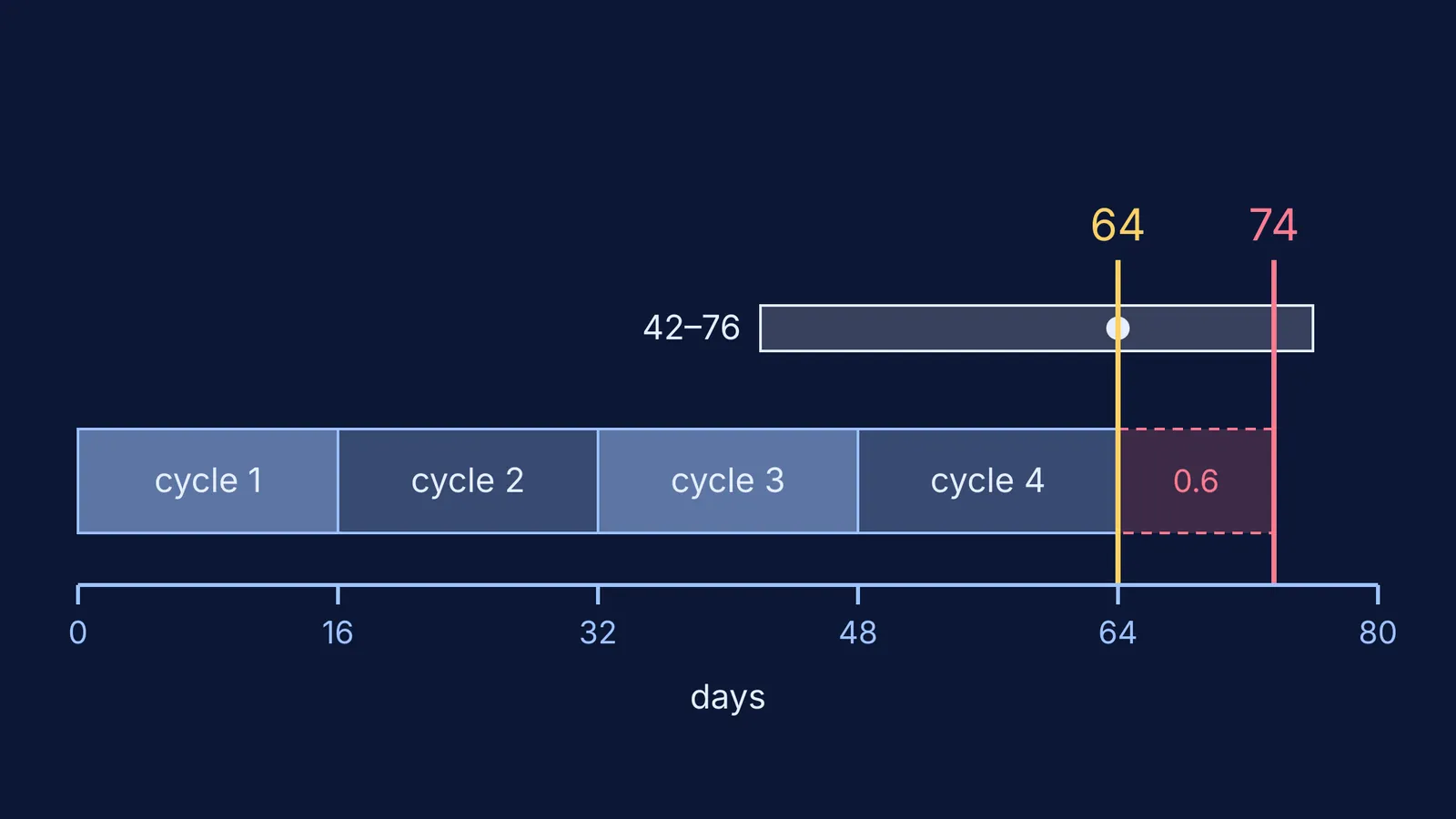
Their unit of time was the cycle of the seminiferous epithelium, and one cycle lasts 16 days, according to the same paper. Spermatogenesis spans about four cycles, and 4 × 16 gives the 64 days that BioNumbers records from that work.
The other common figure counts about 4.6 cycles of 16 days, which gives approximately 74 days (Babakhanzadeh and colleagues, 2020); it is often traced to the same pair's 1964 follow-up in Recent Progress in Hormone Research. A 2016 review from Weill Cornell also gives approximately 74 days for the whole process (Neto and colleagues, 2016).
What happens at each stage, and how long does it take?
The 1963 tracer gives three fixed points on the clock (Heller and Clermont, 1963). The cell types and what they do come from the 2016 review (Neto and colleagues, 2016).
Spermatogonia divide by mitosis. Diploid stem cells at the base of the tubule renew themselves and produce type B spermatogonia, which divide once more to form primary spermatocytes.
Hour 1: preleptotene spermatocytes. One hour after the injection, the most mature labelled cells were preleptotene spermatocytes, the cells copying their DNA just before meiosis.
Day 16: midpachytene spermatocytes. One cycle later, the label had reached the middle of prophase I, the long stage in which crossing over happens.
Day 32: immature spermatids. Two cycles after the label went in, it sat in young spermatids, so both meiotic divisions finish inside this 32-day stretch.
Spermiogenesis and spermiation. Round spermatids reshape into sperm with no further division, then are released into the lumen of the tubule.
So about 32 of the 64 days take a cell from preleptotene to an immature spermatid. The other 32 are shared between the spermatogonial divisions before and the spermatid reshaping after; the 1963 abstract does not split them, so treat exact splits quoted elsewhere with care.
Why do some sources say 64 days and others 74?
Both use the same 16-day clock: 64 days is four cycles and about 74 days is 4.6 cycles.
In 2006, 11 men with normal sperm counts drank heavy (deuterated) water daily for three weeks, and labelled sperm appeared in their semen after a mean of 64 ± 8 days, with a range of 42 to 76 days (Misell and colleagues, Journal of Urology, 2006). That lag covers making the sperm and moving them out to the ejaculate, and the authors note that sperm stored in the epididymis may affect it.
In a 2008 review, Rupert Amann argued that the accepted value might be off by about 6 days and called for the duration to be studied again (Amann, Journal of Andrology, 2008).
How do you write this in an exam answer?
Turn the 16-day cycle into a calendar (Heller and Clermont, 1963; Babakhanzadeh and colleagues, 2020). Suppose a spermatogonium starts on 1 January:
17 January (day 16): cycle 1 ends.
2 February (day 32): cycle 2 ends.
18 February (day 48): cycle 3 ends.
6 March (day 64): cycle 4 ends, the 1963 estimate for the whole process.
16 March (day 74): the 4.6-cycle estimate.
The 10-day gap between the two figures is just 0.6 of a cycle.
A quick checklist before you write:
Name the process correctly: spermatogenesis is the whole path, spermiogenesis only the reshaping of spermatids. Our explainer on spermiogenesis vs spermiation separates the last two steps.
Give the range and the unit: about 64 to 74 days, from 16-day cycles.
Place meiosis inside it: from preleptotene to young spermatid takes about 32 days.
If the question counts cells rather than days, use the method in how many sperm and ova form from one cell.
If it asks what controls the process, turn to FSH and LH in males.
If the stages themselves are blurry, the Fermi Concept Library has every concept in biology with its own lesson and its place in the map, so you can see where pachytene sits before you memorise when it happens. To practise timing and counting questions, the Fermi Problem Library has worked problems with a step-by-step solver that explains the reasoning rather than printing an answer.
Next time you see 74 days, you will know it is 4.6 cycles of 16 days, and that 64 is the same clock counted to four.


