

On this page
The male reproductive system runs on a strict hormonal cycle controlled by the Hypothalamic-Pituitary-Gonadal (HPG) axis. If you are preparing for exams like NEET-UG, understanding this axis is essential because it shows up repeatedly in human physiology questions. The entire system functions like a thermostat, balancing hormone levels to ensure steady sperm production and the maintenance of male characteristics.
What is the role of GnRH in males?
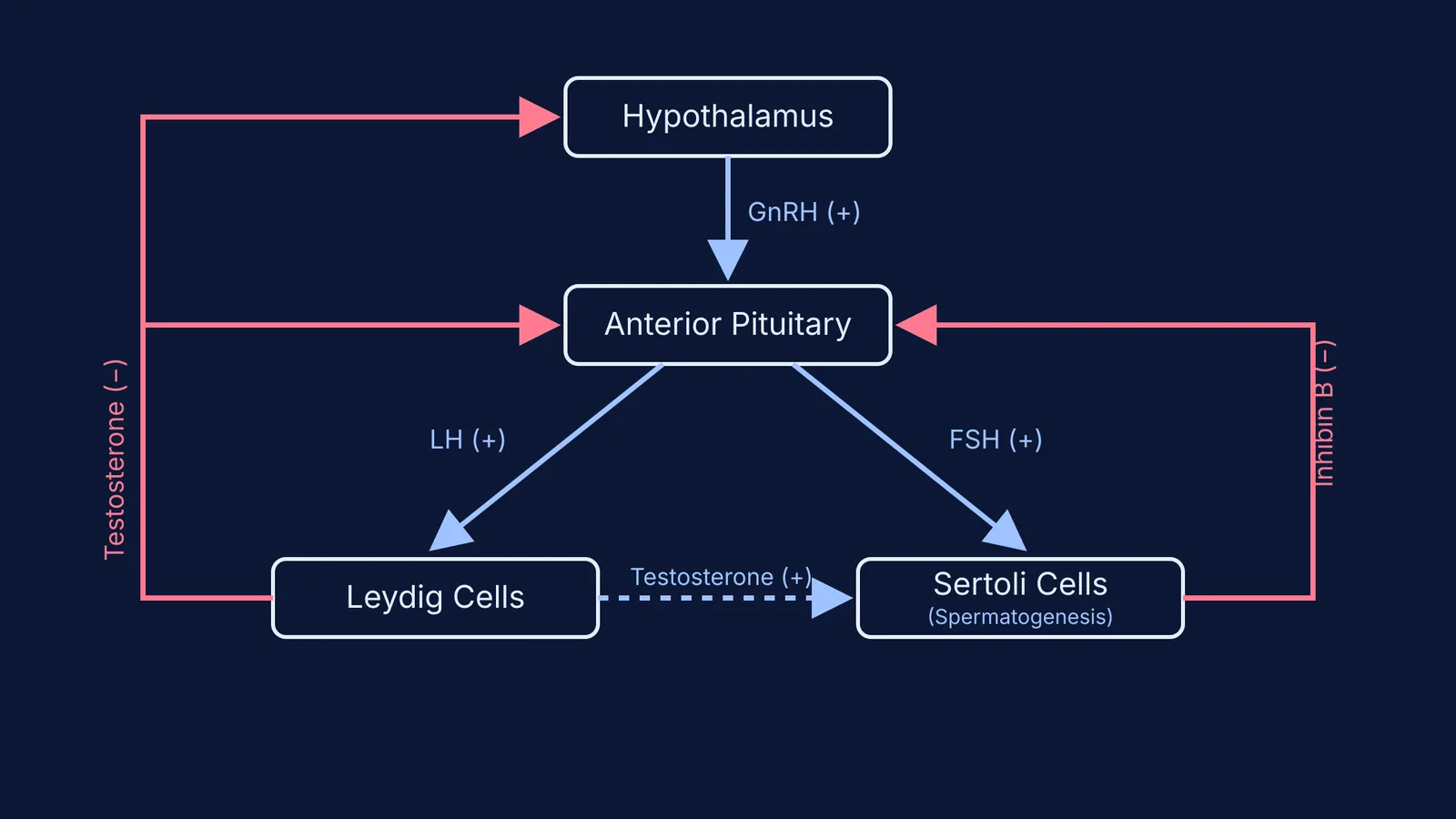
Everything begins in the brain. The hypothalamus acts as the central control unit, releasing Gonadotropin-Releasing Hormone (GnRH) in a pulsatile manner. Starting at puberty, this release happens roughly every 1 to 2 hours 1.
GnRH travels directly down to the anterior pituitary gland. Its binding triggers the anterior pituitary to secrete two critical gonadotropins into the bloodstream: Luteinizing Hormone (LH) and Follicle-Stimulating Hormone (FSH). These two hormones are the primary drivers of testicular function, acting on different specialized cells within the testes to coordinate both testosterone synthesis and the complex stages of spermatogenesis.
How do LH and Leydig cells produce testosterone?
Luteinizing Hormone targets the Leydig cells, which sit in the interstitial tissue between the seminiferous tubules of the testes.
LH binds to receptors on the Leydig cells and stimulates them to produce testosterone from cholesterol 1. The hormone increases the activity of cholesterol desmolase, which is the rate-limiting enzyme in this pathway.
Once released, testosterone has multiple jobs. It travels through the blood to drive the development of secondary sexual characteristics, maintain muscle mass, and support libido. In peripheral tissues like the prostate, an enzyme called 5α-reductase converts testosterone into dihydrotestosterone (DHT), a more potent androgen 1. Meanwhile, a large amount of testosterone stays locally in the testes to help drive sperm maturation.
How do FSH and Sertoli cells support spermatogenesis?
While LH works on the outside of the tubules, Follicle-Stimulating Hormone goes inside. FSH binds to Sertoli cells, which are located along the inner walls of the seminiferous tubules.
Sertoli cells are often called "nurse cells" because they direct the development of germ cells into mature sperm 1. They form tight junctions with each other to create the blood-testis barrier, which protects developing sperm from the immune system and maintains a specialized microenvironment.
FSH stimulates Sertoli cells to drive spermatogenesis. To do this properly, developing sperm need massive local concentrations of testosterone. FSH pushes Sertoli cells to produce Androgen-Binding Protein (ABP), which binds to testosterone and traps it inside the tubules 1.
If remembering these endocrine pathways feels overwhelming when studying from a textbook, you can walk through the entire HPG axis step-by-step in the Fermi Concept Library. The AI tutor teaches through the topic, drawing the figures and checking your understanding as it goes. You can also compare this animal system with microsporogenesis and the structure of a pollen grain in plants, or look deeper at how hormones act via membrane or intracellular receptors.
How does negative feedback keep the balance?
The HPG axis uses negative feedback loops to ensure hormone levels never climb too high.
When testosterone levels rise in the blood, the body senses it. This high circulating testosterone acts on both the hypothalamus and the anterior pituitary, inhibiting the secretion of GnRH, LH, and FSH 1. Without the LH signal, Leydig cells slow down their testosterone production, and the levels drop back to normal.
Sperm production has its own independent feedback loop. When spermatogenesis is active, the FSH-stimulated Sertoli cells release a hormone called inhibin B 1. Inhibin B travels to the anterior pituitary and specifically suppresses the secretion of FSH, without affecting LH. This allows the body to fine-tune sperm production rates without accidentally dropping overall testosterone levels.
Quick summary for exam prep
To keep the pathways straight for your exams, remember this checklist:
GnRH: Secreted by the hypothalamus; targets the anterior pituitary to release LH and FSH.
LH: Targets Leydig cells; triggers testosterone production from cholesterol.
FSH: Targets Sertoli cells; drives spermatogenesis and ABP production.
Testosterone: Provides negative feedback to stop GnRH and LH.
Inhibin B: Produced by Sertoli cells; provides negative feedback to stop FSH.


