

On this page
Both "spermiogenesis" and "spermiation" describe events at the very end of male gamete development. Because they sound almost identical and appear in the same paragraph of standard biology textbooks, examiners frequently use them as traps in multiple-choice questions.
If you are studying Human reproduction for NEET, understanding the distinction is crucial. One term describes a structural transformation, while the other describes a physical release. Here is exactly how to tell them apart.
What is spermatogenesis?
To understand the final steps, we must first look at the whole factory. Spermatogenesis is the overarching process that produces male gametes. It occurs within the seminiferous tubules of the testes. According to NCBI StatPearls, the parenchyma of the human testis is divided into roughly 370 conical lobules, each containing these tightly coiled tubules.
The process begins with diploid stem cells (spermatogonia) dividing via mitosis. Eventually, they form primary spermatocytes. Through the two stages of meiosis, a single diploid spermatocyte divides to produce exactly 4 haploid cells (NCBI StatPearls). These resulting haploid cells are called spermatids. However, this biological factory is surprisingly inefficient; up to 75% of developing germ cells are lost to natural apoptosis before finishing the cycle (NCBI StatPearls).
The spermatids that survive are genetically complete, but physically, they are just ordinary, round cells. They cannot swim, and they cannot penetrate an egg. This is where the final two phases—spermiogenesis and spermiation—take over.
What is spermiogenesis?
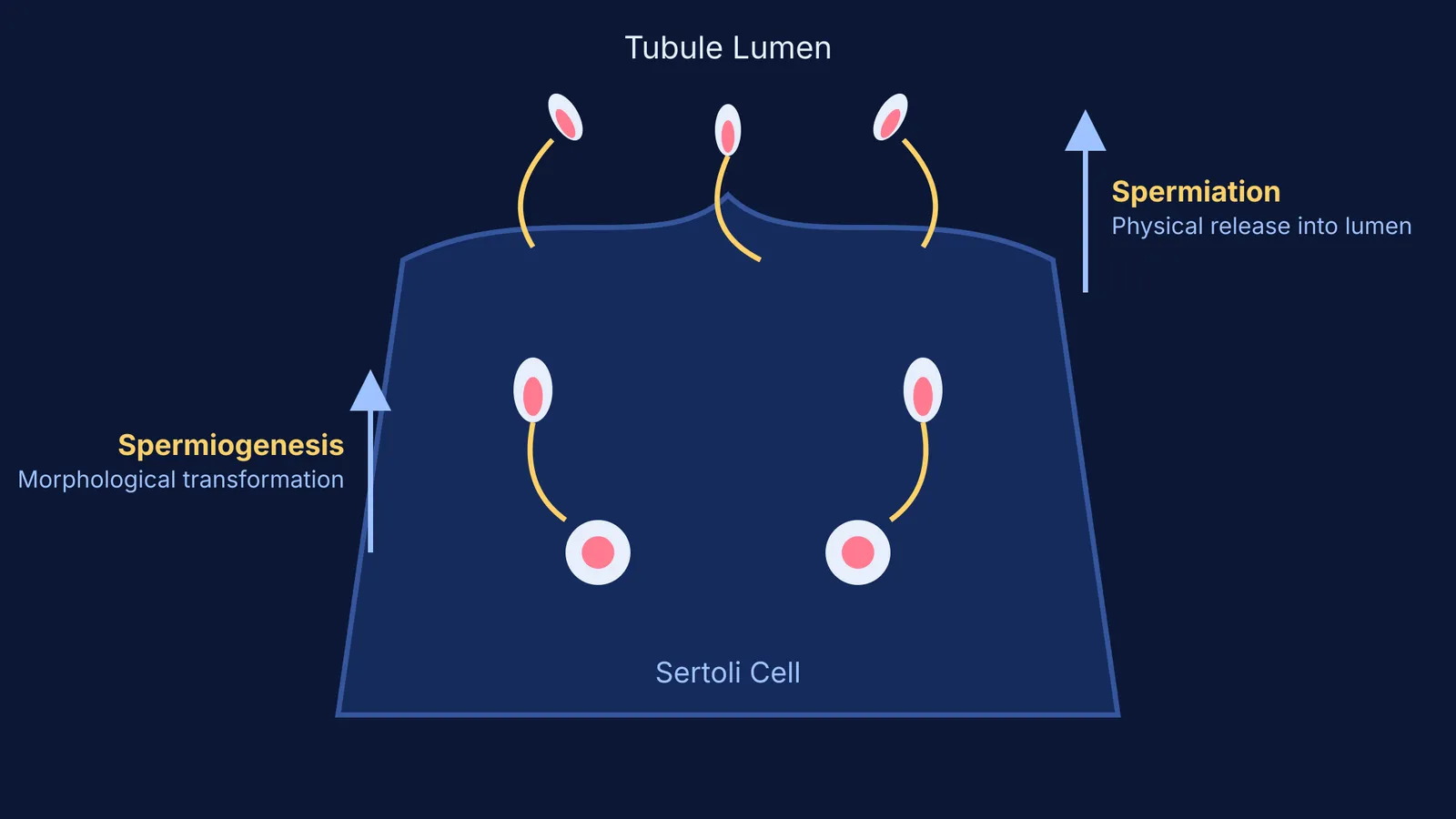
Spermiogenesis is the physical and morphological transformation of a round spermatid into an elongated, highly specialized spermatozoon. Crucially, no cell division occurs during this phase.
Instead, the Cell: the unit of life for NEET undergoes extreme anatomical remodeling while embedded deep within the supportive Sertoli cells. This transformation happens in four distinct steps:
The Golgi Phase: The cell's Golgi apparatus begins synthesizing enzymes and packaging them into a large vesicle at one end of the nucleus.
The Cap Phase: This enzyme-filled vesicle flattens out to form a "cap" over the front half of the nucleus. This is the acrosome, which will later act as a chemical drill to penetrate the female gamete.
The Acrosome and Tail Phase: The nucleus highly condenses its DNA, shutting down gene transcription and shrinking the cell's head. At the opposite end, centrioles migrate and begin assembling microtubules to grow a long flagellum (the tail).
The Maturation Phase: The excess cytoplasm, which would only weigh the swimming cell down, is pushed away from the head and gathered into a "residual body."
By the end of spermiogenesis, the cell looks exactly like a mature sperm. However, it is still physically anchored to the germinal epithelium.
What is spermiation?
Spermiation is a release event. Once the morphological transformation (spermiogenesis) is complete, the fully formed spermatozoa must detach from the Sertoli cells so they can travel out of the testes.
During spermiation, the specialized adhesion junctions (ectoplasmic specializations) that hold the sperm head to the Sertoli cell are carefully broken down. As the sperm pulls away, the Sertoli cell pinches off and phagocytoses (eats) the residual body of excess cytoplasm.
The newly freed sperm is pushed into the fluid-filled center (lumen) of the seminiferous tubule. From there, it is swept into the epididymis, where it will undergo final biochemical maturation to gain the ability to swim.
How to remember the difference?
When faced with a tricky exam question, use the suffixes of the words as your anchor.
Genesis means "creation" or "formation." Spermiogenesis is the *formation* of the actual sperm shape from a round cell.
Ation suggests a physical action, transport, or event (like "evacuation" or "migration"). Spermiation is the *action* of the sperm leaving the Sertoli cell.
If you struggle to picture how these microscopic structures change over time, the Fermi Concept Library contains every concept in physics, chemistry, biology, mathematics and computing. If you find yourself repeatedly confusing similar terms, Fermi's AI tutor teaches rather than answers. It works out what you know, holds a line of reasoning across a session, and builds a plan for the session so you sit down to a clear next step.


