

On this page
When Charles Darwin proposed that all living species descend from common ancestors, he relied on comparative anatomy, embryology, and the fossil record. Today, modern genetics provides an even more direct record written inside living cells. Biochemical similarity refers to the shared molecular architecture, genetic sequences, and metabolic pathways observed across diverse organisms as a consequence of common ancestry.
In the foundational text on genome evolution, Bruce Alberts and colleagues explain that similarities in nucleotide and protein sequences provide the most precise physical records of evolutionary descent (NCBI Bookshelf). While morphological traits can undergo drastic remodeling or complete reduction—such as the loss of limbs in snakes—the foundational molecular machines inside cells remain remarkably stable. Core processes like glycolysis, translation by ribosomes, and ATP synthesis operate identically in human brain cells, baker's yeast, and soil bacteria. As students learn when reviewing core evolutionary concepts for NEET, biochemical evidence directly corroborates anatomical homologies without ambiguity.
Why does cytochrome c provide evidence of common ancestry?
As Richard E. Dickerson detailed in his comparative analysis (Scientific American, 1972), cytochrome c is an essential 104-amino-acid hemeprotein that transfers electrons within the mitochondrial electron transport chain during cellular respiration. Because every aerobic organism requires cytochrome c to generate energy, researchers can compare its primary sequence across distantly related species.
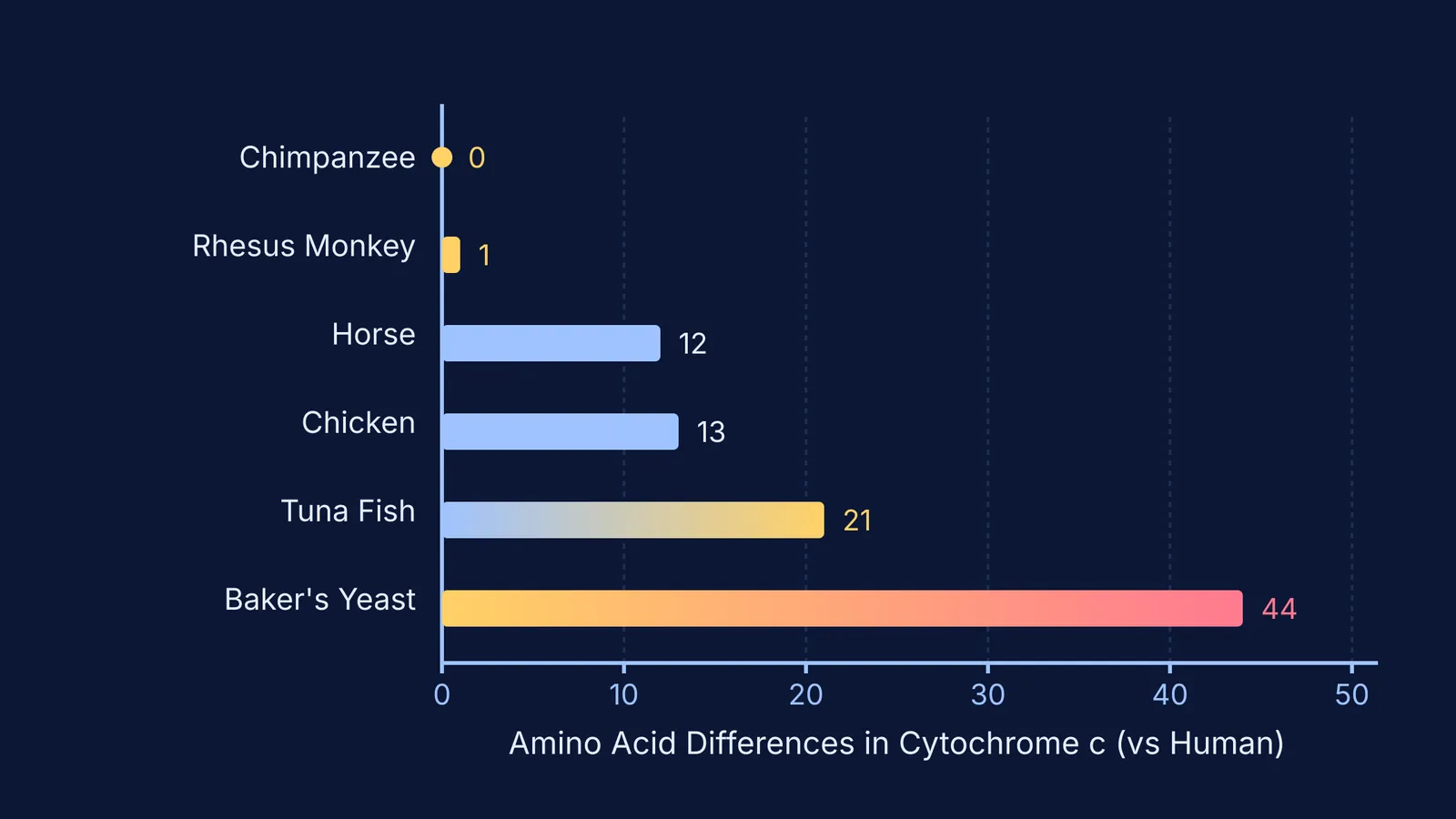
In their landmark paper on phylogenetic trees, Walter M. Fitch and Emanuel Margoliash calculated mutation distances across 20 diverse species and demonstrated that cytochrome c sequences independently reproduce known evolutionary branching (Science, 1967). Sequence comparisons compiled by Dickerson revealed that human cytochrome c has 0 amino acid differences compared to chimpanzees, 1 difference compared to rhesus monkeys, 12 differences compared to horses, and 44 differences compared to baker's yeast.
Emile Zuckerkandl and Linus Pauling established that such substitutions accumulate at a remarkably regular rate over geological time, forming what biologists term a molecular clock (Evolving Genes and Proteins, 1965). The number of substitutions directly reflects the time elapsed since two lineages separated from their common ancestor.
The Fermi Concept Library covers every concept in physics, chemistry, biology, mathematics and computing, each with its own lesson and its place in the map, helping students visualize how biochemical pathways connect to macro-evolutionary patterns.
How do histones and the genetic code prove universal descent?
While respiratory proteins accumulate changes slowly, other cellular proteins are under even stricter functional constraints. Histone proteins, which wrap DNA into nucleosomes, provide a striking demonstration of molecular homology.
Robert J. DeLange and colleagues determined that calf thymus histone IV and pea seedling histone IV each contain 102 amino acid residues and differ by only 2 amino acids out of 102 (Journal of Biological Chemistry, 196963612-9)). That near-total identity across an estimated 1 billion years of plant-animal divergence highlights extreme purifying selection, which you can explore in detail through eukaryotic DNA packaging and histones. Nearly every side chain in histone IV interacts with DNA or other histone subunits, meaning almost any mutation is lethal.
The universal genetic code provides the most compelling evidence of shared ancestry. Across nearly all life forms, 64 triplet codons specify the same 20 amino acids and 3 stop signals (NCBI Bookshelf). Because any arbitrary codon assignment could theoretically function, universal adherence to the same genetic dictionary cannot be coincidental. As catalogued in Margaret Dayhoff's pioneering protein sequence database, quantitative comparison of ancestral sequences proved that all cellular life descends from a Last Universal Common Ancestor.
How should NEET aspirants solve questions on biochemical homology?
NEET-UG biology questions regularly test biochemical similarities, often asking students to distinguish homology from analogy or interpret sequence matrices. Use this three-step diagnostic framework:
Identify the origin of similarity: If two organisms share identical amino acid sequences or metabolic enzymes due to shared ancestry, it represents biochemical homology (divergent evolution). If two molecules perform a similar task through distinct catalytic mechanisms, it reflects biochemical analogy (convergent evolution).
Rank divergence from sequence differences: The fewer the amino acid or nucleotide differences between two species, the more recent their common ancestor.
Check functional conservation: Active sites and catalytic residues remain invariant, whereas surface residues tolerate neutral drift.
Worked example: Consider a 146-amino-acid hemoglobin beta-chain compared across vertebrates against the human sequence (NCBI Bookshelf): Species W has 0 amino acid differences, Species X has 8 differences, Species Y has 45 differences, and Species Z has 125 differences.
To determine the phylogenetic branching order, arrange the species by increasing substitution counts:
Species W (0 differences) shared a common ancestor most recently (chimpanzee, ~6 million years ago).
Species X (8 differences) diverged earlier (rhesus monkey, ~25 million years ago).
Species Y (45 differences) diverged before primates (bird/chicken, ~310 million years ago).
Species Z (125 differences) diverged earliest among vertebrates (jawless fish, ~450 million years ago).
The correct evolutionary sequence from closest to most distant relative is W -> X -> Y -> Z.
The Fermi Problem Library has worked problems with a step-by-step solver that explains the reasoning rather than printing an answer, helping students practice genetics and molecular evolution questions.


