

On this page
When you study the animal kingdom for exams like NEET or board finals, the body cavity is one of the most reliable ways to classify phyla. Understanding how the embryo's layers fold and separate saves you from blindly memorizing lists of animals.
Here is exactly how to tell the difference between the three cavity types, how they form, and where each phylum fits.
What is a coelom?
A coelom is the fluid-filled body cavity located between the outer body wall and the inner digestive tract.
During embryonic development, triploblastic animals form three primary germ layers: the ectoderm (which becomes skin and nerves), the endoderm (which becomes the gut), and the mesoderm (which becomes muscle and bone). The nature of the coelom depends entirely on what this middle layer, the mesoderm, does. To have a true coelom, the cavity must be completely lined by mesoderm tissue on all sides.
What are acoelomate, pseudocoelomate, and coelomate examples?
Animals are divided into three major categories based on this cavity:
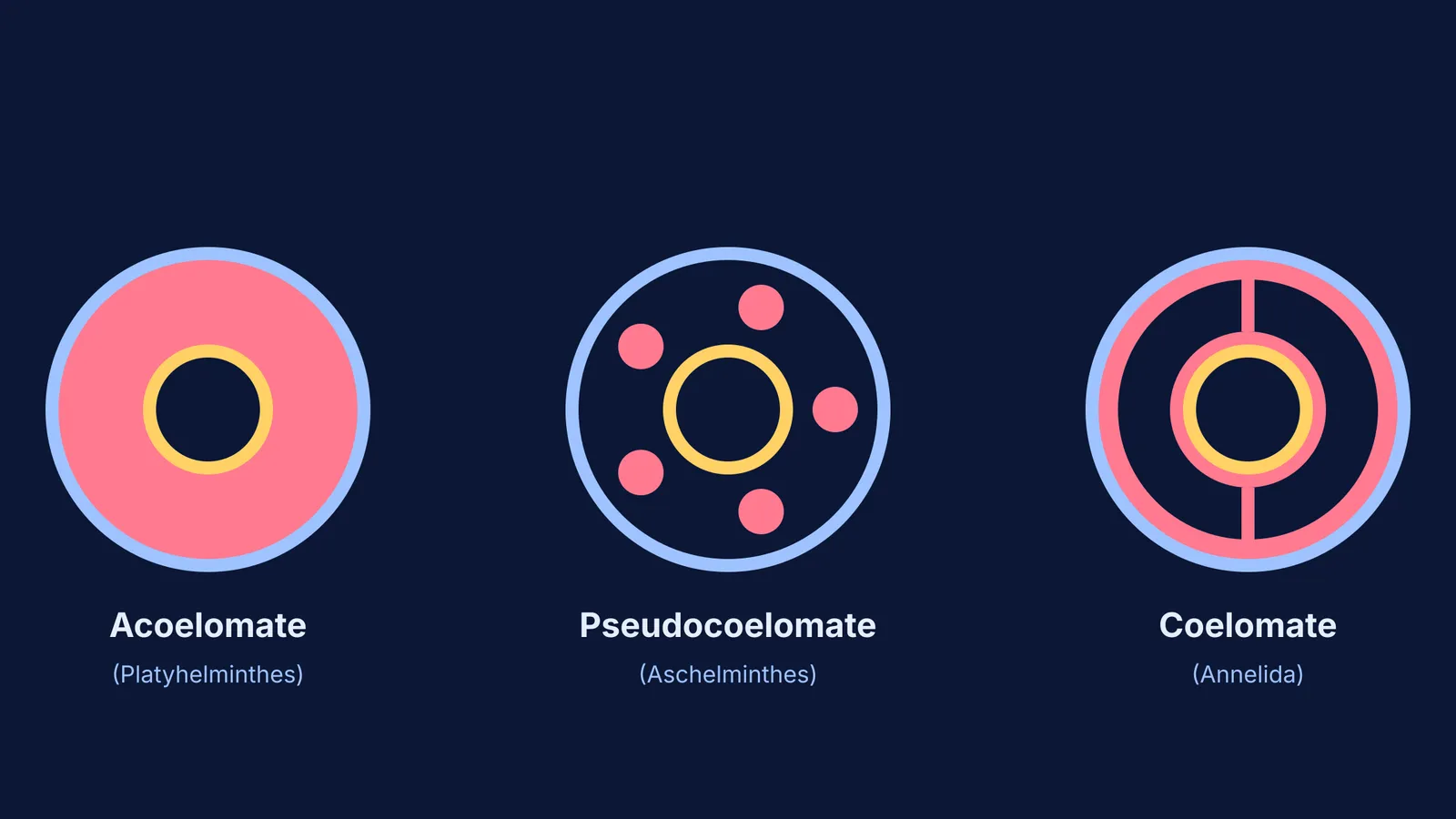
Acoelomates: These animals have no body cavity. The space between the body wall and the gut is packed solid with semi-solid mesodermal tissues known as parenchyma. Because fluid compression is negligible in these solid bodies, their organs are not well protected against crushing forces.
Examples: Platyhelminthes (flatworms).
Pseudocoelomates: These animals have a "false" cavity. The cavity exists, but it is not completely lined by mesoderm. Instead, the mesoderm appears as scattered pouches between the ectoderm and the endoderm.
Examples: Aschelminthes (roundworms).
Coelomates (Eucoelomates): These animals possess a true coelom, meaning the cavity is fully lined by mesoderm. This complete lining, often called the peritoneum, holds organs in place while still allowing them to move and grow independently. True coelomates are further divided into two groups based on how the cavity forms during embryonic development:
Schizocoelomates: The coelom forms when a solid mass of mesoderm splits open to create the cavity. This is characteristic of protostomes. Examples include Annelida (earthworms), Arthropoda (insects, spiders), and Mollusca (snails, octopuses).
Enterocoelomates: The coelom forms from pouches that "bud" or pinch off from the embryonic gut (archenteron). This is characteristic of deuterostomes. Examples include Echinodermata (starfish), Hemichordata, and Chordata (vertebrates, including humans).
Why did a true coelom evolve?
Having a true, mesoderm-lined coelom provides several massive evolutionary advantages for an animal.
First, the coelomic fluid inside acts as a hydrostatic skeleton. This gives muscles a firm but flexible structure to pull against, which is why an earthworm can burrow through dense soil without a bony skeleton.
Second, the coelom acts as a shock absorber. When a physical force strikes the outside of the animal, the fluid distributes the pressure, preventing the delicate internal organs from being crushed. Acoelomates like flatworms do not have this protection, which physically restricts how large and complex they can grow.
Third, a lined cavity allows the digestive tract to move independently of the outer body wall. Because of this, food can be pushed through the gut via muscular contractions (peristalsis) without the entire animal having to wiggle. Finally, the coelomic fluid serves as a transport medium for gases, nutrients, and waste products, and provides a safe space for eggs and sperm to mature before being released.
How can you visualize the body cavity?
The hardest part of animal classification is picturing a 3D cross-section from a flat textbook description. If you struggle to imagine how scattered pouches look compared to a fully lined cavity, the Fermi Concept Library gives you a clear, visual map of every biological system and its place in the map.
Here is a practical framework to learn the sequence:
Zero cavity: Flatworms are flat because they are packed solid (acoelomate). The surface area to volume ratio is large enough that they can exchange gases entirely by diffusion across their skin.
False cavity (scattered): Roundworms are tubular but internally simple (pseudocoelomate). They rely on hydrostatic pressure to hold their shape, lacking a true vascular system.
True cavity (lined): Complex animals, starting with segmented worms up to humans, need a fully lined cavity to support complex, independent organ systems (coelomate).
Once you connect the internal anatomy to the animal's physical complexity, classifying them becomes logical rather than a rote memory test. If you are comparing evolutionary traits across the animal kingdom, you might also find our guides on ammonotelic, ureotelic and uricotelic animals and the misfits of the five-kingdom system helpful for building a complete picture.


