

On this page
Most Hardy-Weinberg questions use two alleles and p + q = 1. ABO blood groups need three. The fix is small, and it turns a whole family of exam numericals into a four-line calculation.
What are p, q and r in the ABO blood group?
NCERT's Class 12 chapter on inheritance states that the ABO gene I has three alleles, IA, IB and i; IA and IB are each completely dominant over i, and when both are present both are expressed, which is co-dominance (NCERT Biology Class 12, Chapter 4). Each person carries any two of the three, which gives six genotypes and four blood groups.
Give each allele a frequency:
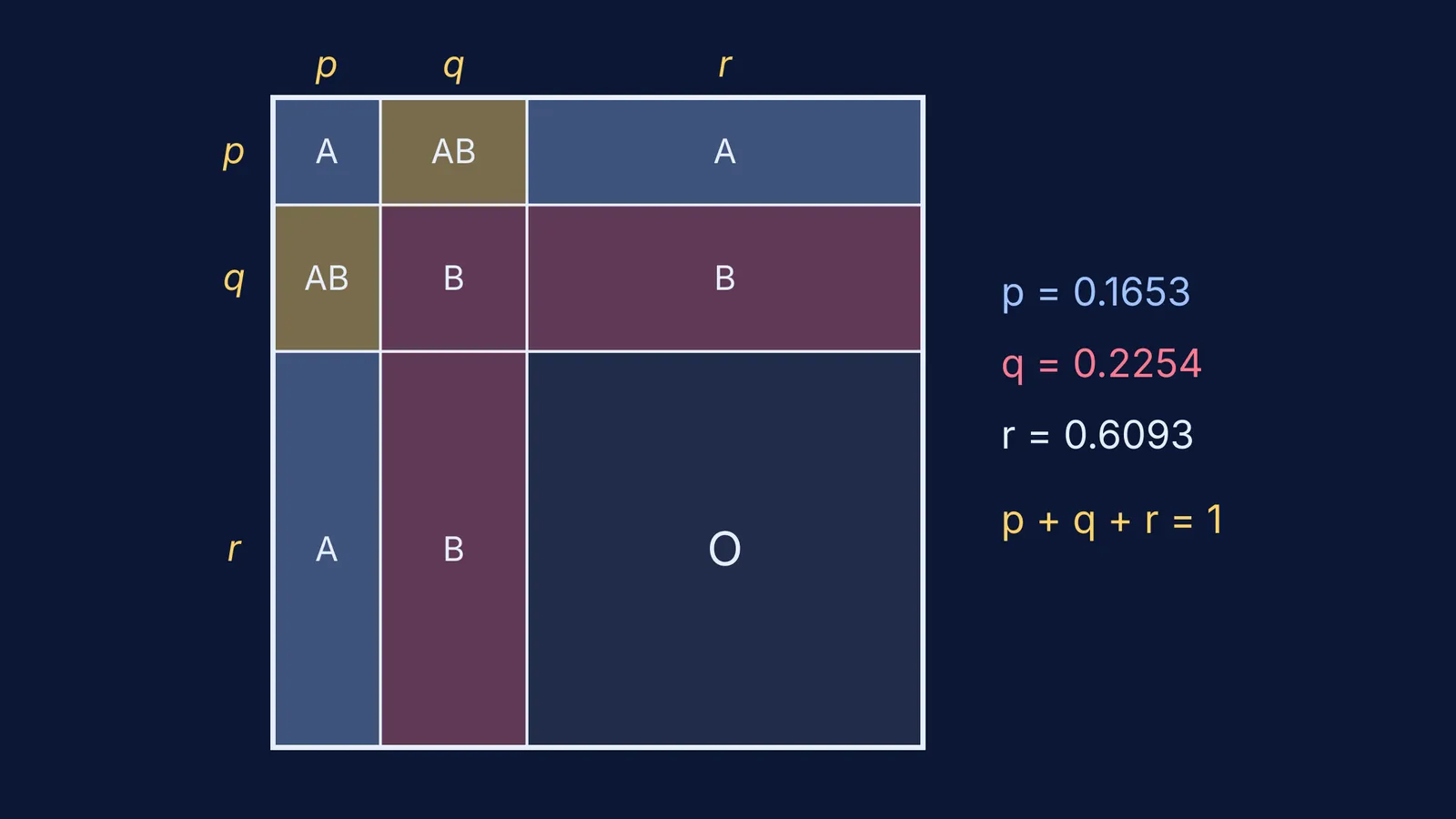
p = frequency of IA
q = frequency of IB
r = frequency of i
Every allele in the gene pool is one of these three, so p + q + r = 1. It is the same rule NCERT states for any gene: the sum total of all the allelic frequencies is 1 (NCERT Biology Class 12, Chapter 6).
How do you expand (p + q + r)²?
For two alleles, NCERT writes p² + 2pq + q² = 1 and calls it the binomial expansion of (p + q)² (NCERT Biology Class 12, Chapter 6). With three alleles you square a trinomial instead:
(p + q + r)² = p² + q² + r² + 2pq + 2pr + 2qr = 1
Each term is one genotype:
p² is IAIA and 2pr is IAi, both group A
q² is IBIB and 2qr is IBi, both group B
2pq is IAIB, group AB
r² is ii, group O
So the four blood-group frequencies are A = p² + 2pr, B = q² + 2qr, AB = 2pq and O = r².
How do you find p, q and r from blood group percentages?
You cannot take √A directly, because A mixes two terms. Combine groups instead.
Find r from O. Since O = r², r = √O.
Find p from A + O. A + O = p² + 2pr + r² = (p + r)², so p = √(A + O) − r.
Find q from B + O in the same way, q = √(B + O) − r, or simply q = 1 − p − r.
Step 2 is the easy one to miss. Adding O to A turns an awkward sum into a perfect square.
Worked example: what do Indian blood donors show?
A multicentre study that enrolled 10,000 healthy blood donors across India (9,686 samples were evaluated) found group O in 37.12%, B in 32.26%, A in 22.88% and AB in 7.74% (Agrawal et al., Asian Journal of Transfusion Science, 2014). Run the three steps.
r = √0.3712 = 0.6093
p = √(0.2288 + 0.3712) − 0.6093 = √0.6000 − 0.6093 = 0.7746 − 0.6093 = 0.1653
q = √(0.3226 + 0.3712) − 0.6093 = √0.6938 − 0.6093 = 0.8329 − 0.6093 = 0.2237
The study reported 0.1653 for IA, 0.2254 for IB and 0.6093 for i. Our p and r match. Our q is slightly lower, so p + q + r = 0.9983, not 1: real counts never fit the model perfectly, and the authors used an iterative maximum likelihood method rather than square roots. If you take q = 1 − p − r instead, you get 0.2254, the study's value.
Now plug back. Expected AB = 2pq = 2 × 0.1653 × 0.2254 = 0.0745, or 7.45%, against 7.74% observed: close, not identical.
Group A people are either IAIA (p² = 0.0273) or IAi (2pr = 0.2014), so under the model about 88% of group A donors (0.2014 ÷ 0.2288) carry an i allele. Because i hides inside so many group A people, two group A parents can have a group O child; see ABO blood group inheritance and multiple alleles for the crosses.
What mistakes cost marks in three-allele numericals?
Taking √A to get p. A is p² + 2pr, not p².
Forgetting the 2 in 2pq when predicting AB.
Putting percentages inside square roots: turn 37.12% into 0.3712 first.
Rounding r early. Keep four decimals until the last line.
Assuming equilibrium without saying so. NCERT lists five factors that affect it: gene migration or gene flow, genetic drift, mutation, genetic recombination and natural selection (NCERT Biology Class 12, Chapter 6).
Where should you practise next?
If two-allele problems still feel shaky, start with how to solve a Hardy-Weinberg numerical for p and q. To watch allele frequencies move when a condition fails, try the Hardy-Weinberg simulation where you predict, then break each condition.
When a variant trips you up, the Fermi Problem Library has worked problems with a step-by-step solver that explains the reasoning rather than printing an answer. If allele frequency itself is the gap, the Fermi Concept Library gives each concept its own lesson.


