

On this page
If you study NEET-UG Biology, you learn where fertilisation happens. NCERT says little about how sperm get there. Lab studies from the last 30 years point to three guidance cues, each working on a different stretch of the fallopian tube. This post links them to the textbook line you must know and gives you a route map to redraw in an exam.
This is biology for exams, not fertility advice. Questions about fertility belong with a doctor.
Where does NCERT say fertilisation happens?
The NCERT Class 12 Biology chapter Human Reproduction says semen is released into the vagina, and the motile sperms "pass through the cervix, enter into the uterus and finally reach the ampullary region of the fallopian tube." It adds: "Fertilisation can only occur if the ovum and sperms are transported simultaneously to the ampullary region." The same chapter gives each fallopian tube a length of about 10-12 cm, with the narrow isthmus joining the uterus. If the parts are hazy, read our guide to the four parts of the fallopian tube first.
The textbook does not explain the steering. A review by Michael Eisenbach and Laura Giojalas in Nature Reviews Molecular Cell Biology argues that there is no mass race: only small numbers of sperm enter the fallopian tube, and these few must be guided along "the remaining long, obstructed way to the egg."
How do sperm find the egg in the fallopian tube?
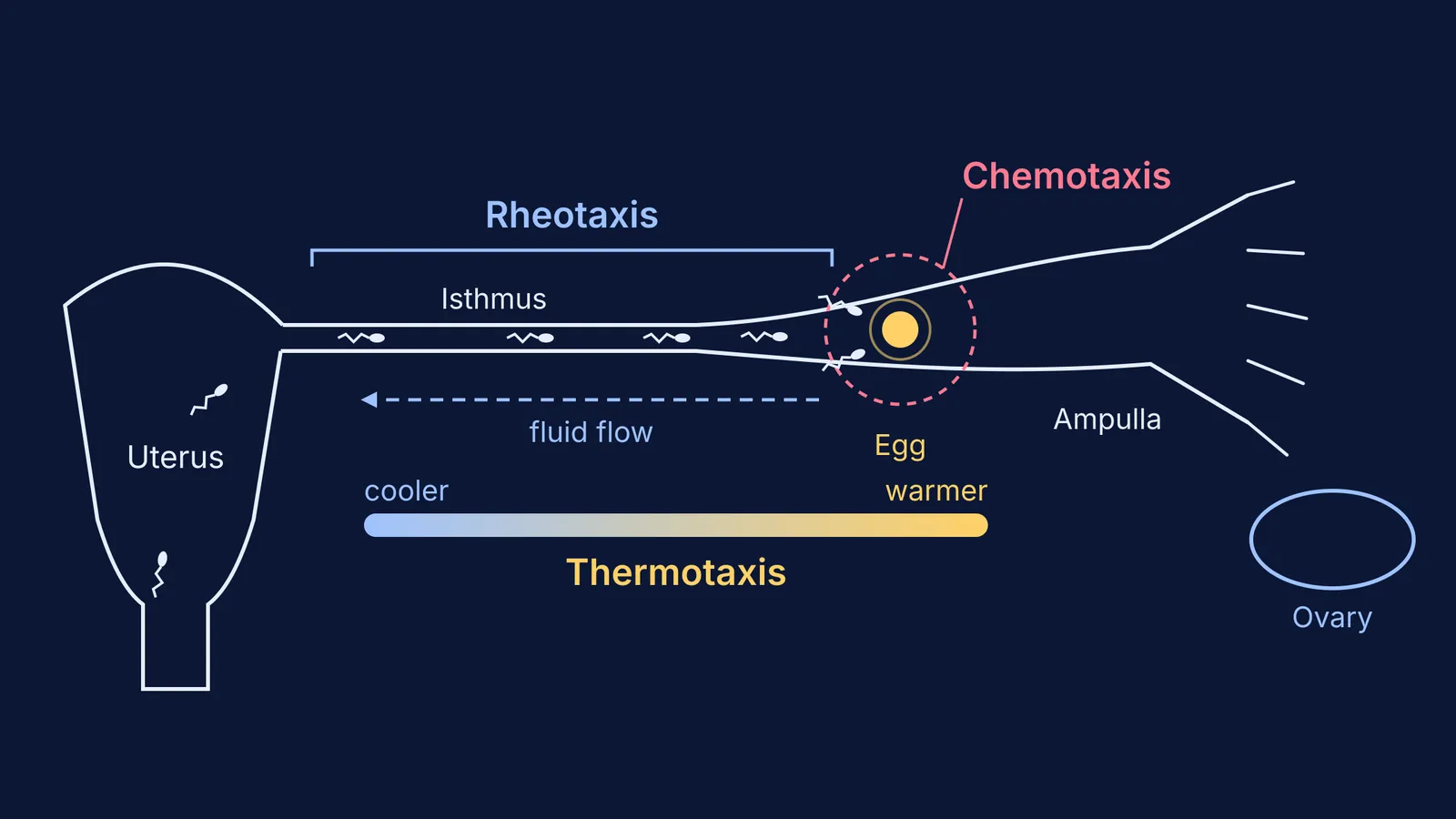
A 2025 review by Eisenbach in Communications Biology groups the cues into two long-range ones (rheotaxis and thermotaxis) and one short-range one (chemotaxis).
Rheotaxis: swim upstream. Rheotaxis is orienting and swimming against a flow of fluid. Kiyoshi Miki and David Clapham reported in Current Biology that in female mice, mating generates a flow of oviduct fluid towards the uterus within 4 hours; in the ampulla it ran at about 18 micrometres per second. In a lab flow chamber in the same study, 51% of actively swimming human sperm turned to swim against the flow. The 2025 review describes rheotaxis as passive, driven by hydrodynamic forces, while thermotaxis and chemotaxis are active.
Thermotaxis: head for warmth. Thermotaxis is swimming up a temperature gradient. In rabbits and pigs, the fertilisation site is about 2°C warmer than the sperm storage site in the isthmus at ovulation, says a 2022 review in Molecular Human Reproduction, which also notes that human data are not available. In the lab, human sperm responded to gradients as shallow as 0.014°C per millimetre, anywhere between 29 and 41°C (Bahat and colleagues, PLoS ONE 2012).
Chemotaxis: follow the chemical trail. Chemotaxis is swimming up a gradient of a chemical. Cumulus cells around the egg release progesterone, which activates CatSper, the main calcium channel of human sperm, found in the tail (Lishko, Botchkina and Kirichok, Nature 2011). The 2025 review says progesterone attracts sperm at very low concentrations and that chemotaxis works over just a few millimetres.
Why are only a few sperm guided?
Only capacitated sperm, the ones that have finished maturing inside the female tract, respond to warmth and chemicals. In a 1995 PNAS study, only 2-14% of human sperm in the lab were capacitated at any moment, and each stayed that way for between 50 and 240 minutes. The 2025 review puts the responsive share at about 10%. Our explainer on what sperm capacitation is covers the steps. Once a sperm reaches the egg, the acrosome reaction lets it through the egg's coats.
How do you use this in a NEET-UG or board answer?
Learn the NCERT line first; the cues help you remember it. Here is a route map you can redraw in under a minute:
Draw the uterus and one tube. Label the isthmus (narrow, near the uterus) and the ampulla (wide, near the ovary).
Draw an arrow inside the tube pointing towards the uterus and label it fluid flow. Sperm swim the other way: rheotaxis.
Shade the tube from cool at the isthmus to warm at the ampulla: thermotaxis.
Ring the egg in the ampulla with a small circle: chemotaxis, the last few millimetres.
Write beside it: fertilisation in the ampullary region; ovum and sperm must arrive together.
Before the exam, check yourself against these common slips:
Fertilisation site is the ampullary region, not the uterus or the infundibulum.
Fluid flows towards the uterus; sperm swim against it.
The fertilisation site is the warmer end.
Chemotaxis is short-range; it does not pull sperm all the way from the uterus.
Only capacitated sperm respond to temperature and chemical cues.
If fertilisation still feels like a list rather than a picture, the Fermi Concept Library has every biology concept with its own lesson and its place in the map, so you can see how it connects to gametogenesis and the menstrual cycle. For practice, Fermi's AI tutor can draw the figure with you and check your understanding as it goes.
Redraw the route map once today, from memory, and compare it with the five steps above.


