

On this page
If you are revising Human Reproduction for NEET-UG or Class 12 boards, the acrosome reaction is often one line in your notes: the acrosome releases enzymes. That is true, but it skips which membranes fuse, what gets exposed, and what the sperm can do afterwards. Here is the sequence, with the research behind each step.
What is the acrosome reaction?
The acrosome is a membranous sac over the sperm nucleus, filled with many kinds of hydrolytic enzymes, according to a review in the Journal of Clinical Investigation by Ikawa and colleagues. The same review calls the acrosome reaction acrosomal exocytosis, and says it happens only in capacitated sperm and is a prerequisite for the sperm to fuse with an egg.
In one sentence: the acrosome reaction is the sperm emptying its acrosome by exocytosis, so that it can get through the egg's coats and fuse with the egg.
What happens in the acrosome reaction, step by step?
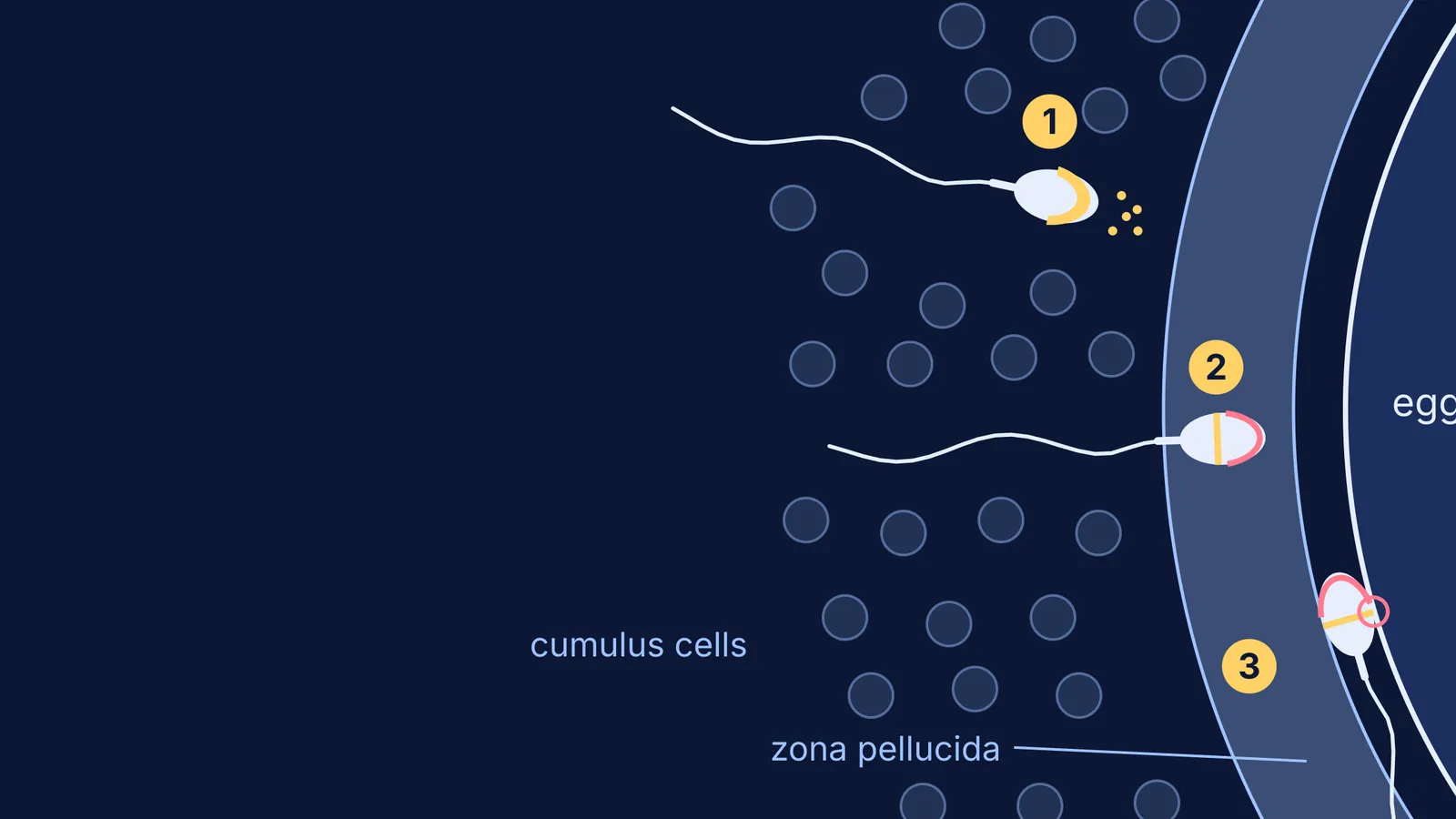
The trigger. It was generally believed that contact with the zona pellucida, the glycoprotein coat around the egg, sets the reaction off. A 2011 PNAS study by Jin and colleagues used fluorescent mouse sperm in in vitro fertilisation and found that most fertilising sperm began the reaction before reaching the zona of cumulus-enclosed eggs. In the mouse oviduct, a 2016 study by La Spina and colleagues found about 38% of sperm in the upper isthmus had already reacted, and only 5% were still acrosome-intact in the ampulla.
Membrane fusion and enzyme release. The sperm's plasma membrane fuses and vesiculates with the outer acrosomal membrane, and the acrosome's contents are released. Of its hydrolysing enzymes, hyaluronidase and acrosin are the most studied, according to a 2022 review by Ryuzo Yanagimachi. The same review notes that a reacted sperm passing through the zona has the front half of its head covered by the inner acrosomal membrane.
Zona binding and crossing. The human zona contains four glycoproteins (ZP1 to ZP4) and the mouse zona three, and a 2014 study by Avella, Baibakov and Dean in transgenic mice showed that one region of ZP2 (residues 51 to 149) is needed for mouse and human sperm to recognise the zona and pass through it. Enzymes help, but they are not the whole story: the Ikawa review notes that mouse sperm lacking acrosin can still fertilise eggs, with a slight delay.
Fusion with the egg membrane. During the reaction, the sperm protein IZUMO1 moves from the outer acrosomal membrane to the plasma membrane of the equatorial segment, which makes the sperm able to fuse, according to the Yanagimachi review. In a 2005 Nature study by Inoue and colleagues, male mice without Izumo were sterile: their sperm crossed the zona but could not fuse. The egg's partner protein, Juno, was identified in a 2014 Nature study by Bianchi and colleagues; eggs lacking it did not fuse with normal sperm.
How is it different from capacitation and the cortical reaction?
Three events, two cells, one fixed order: sperm, sperm, egg.
Capacitation (sperm, first): the process by which sperm become competent to fertilise an egg, in the Ikawa review's words. It happens in the female tract, and only capacitated sperm can undergo the acrosome reaction. For the details, read our guide to what sperm capacitation is and how long it takes.
Acrosome reaction (sperm, second): exocytosis of the acrosome. Enzymes come out, the inner acrosomal membrane is exposed, and IZUMO1 moves to the equatorial segment so the sperm can fuse.
Cortical reaction (egg, third): after fertilisation, cortical granules in the egg undergo calcium-dependent exocytosis into the perivitelline space, and their proteins modify the zona to block polyspermy, according to a review by Liu in Reproductive Biology and Endocrinology. Our explainer on how the zona pellucida stops polyspermy covers this step.
How do you write the acrosome reaction in an exam answer?
For a three-mark "Describe the acrosome reaction", aim for four short points:
Define it: exocytosis of the acrosome, a cap of hydrolytic enzymes over the sperm nucleus, in a capacitated sperm.
Name the event: the plasma membrane and outer acrosomal membrane fuse, and enzymes such as hyaluronidase and acrosin are released.
State the function: it helps the sperm pass the cumulus and zona pellucida and exposes the inner acrosomal membrane.
State the outcome: the equatorial segment of the sperm fuses with the egg membrane.
Before you submit, check for these four traps:
Placing capacitation after the acrosome reaction.
Calling the cortical reaction a change in the sperm.
Saying enzymes alone dissolve the zona.
Mixing up the acrosome reaction (helps a sperm get in) with the polyspermy block (keeps the rest out).
Arrange-in-order questions test exactly this sequence; practise with our set of human reproduction sequence questions for NEET.
If the three reactions still blur together, the Fermi Concept Library gives each biology concept its own lesson and its place in the map, so you can look up capacitation, the acrosome reaction and the cortical reaction one after another.


