On this page
As England's industrial towns burned coal through the 1800s, a speckled moth changed colour as a population. In some industrial areas the original pale form was almost lost by the end of the century (Cook and Saccheri, Heredity). It is evolution you can measure, and one students often explain the wrong way.
What is industrial melanism in the peppered moth?
Industrial melanism is the rise of dark (melanic) forms of an animal in areas blackened by industrial pollution. The peppered moth, *Biston betularia*, has a pale speckled form called typica and a black form called carbonaria, and the black form replaced the pale one during the Industrial Revolution (van't Hof et al., Nature, 2016).
The colour is inherited simply: melanic forms are determined by dominant alleles at a single locus (Cook and Saccheri, 2013). The first documented black peppered moth was seen in Manchester in 1848 (University of Liverpool).
How did soot change the numbers of white and dark moths?
The moths rest on trees by day, and birds hunt them by sight. A learning unit from the Homi Bhabha Centre for Science Education sets out the chain of events:
Before industry, bark and the lichens on it were pale, so pale moths were hidden and dark ones stood out.
Coal smoke killed the lichens and darkened the trees with soot.
Now the pale moths stood out, and birds ate more of them.
More dark moths lived long enough to breed, so each generation carried a larger share of the dark allele.
The change was fast. In 1924, J. B. S. Haldane estimated that the selection needed was much stronger than anyone had linked to evolution before (Cook and Saccheri, 2013). For the field experiments that tested the bird explanation, see our post on Bernard Kettlewell's peppered moth numbers.
Did pollution cause the mutation that made moths dark?
No. In 2016, Arjen van't Hof, Ilik Saccheri and colleagues found that the carbonaria mutation is a transposable element (a jumping gene) inserted into the first intron of a gene called cortex, and dated it to around 1819 (van't Hof et al., Nature, 2016). The Liverpool team said it took around 30 years for the mutation to become common enough to be noticed (University of Liverpool).
So soot did not write a new gene into any moth. The dark variant arose by chance, and soot changed which colour survived.
The reverse happened too. Since 1970, as bark became less sooty, melanic moths have declined rapidly (Cook et al., Biology Letters, 2012). If "the environment makes the trait" sounds familiar, compare how Darwin and Lamarck explain the giraffe's neck.
What do the predation experiments show?
Try the numbers yourself. In Kettlewell's release in a polluted wood near Birmingham, 18 of 137 marked pale moths and 136 of 493 marked dark moths were recaptured (HBCSE learning unit; Kettlewell's original report is in Heredity, 1955).
Pale: 18 ÷ 137 = 13.1% recaptured
Dark: 136 ÷ 493 = 27.6% recaptured
Ratio: 27.6 ÷ 13.1 ≈ 2.1, so dark moths were about twice as likely to be recaptured, which Kettlewell read as better survival
Now the modern test. Michael Majerus released 4,864 moths over six years in a garden near Cambridge (Cook et al., 2012). Adding up the paper's Table 2:
Pale: 963 eaten of 4,522 released = 21.3%
Dark: 100 eaten of 342 released = 29.2%
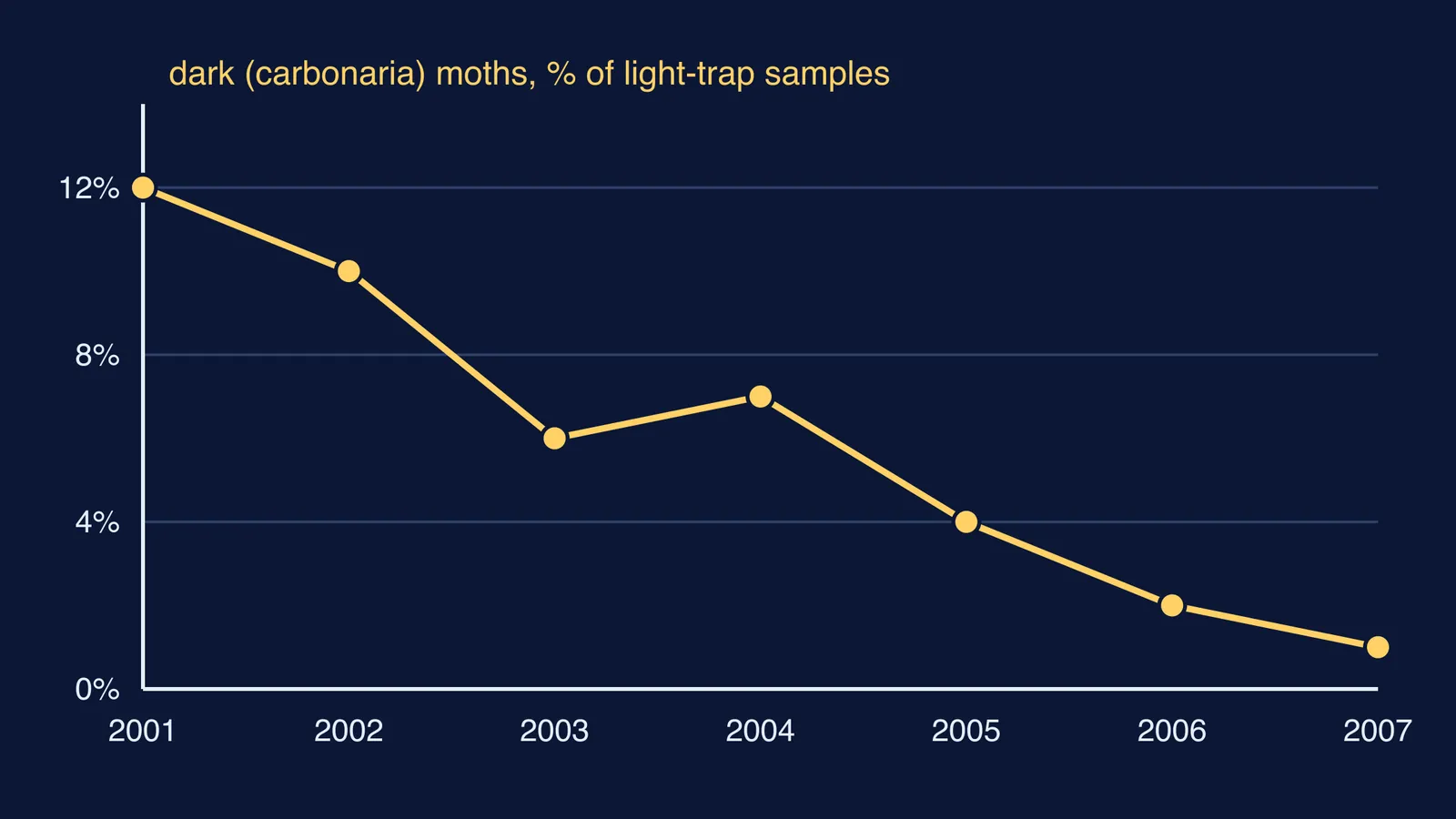
With cleaner bark, the advantage had flipped. The same table shows dark moths in light-trap samples at nearby Madingley falling from 12% in 2001 to 1% in 2007, and the authors estimated daily selection against melanics of about 0.1.
How do you write this as an exam answer?
Use this five-point frame for any natural selection question:
Variation already exists (pale and dark forms, from a random mutation).
The environment changes (soot kills lichens, bark darkens).
A selecting agent acts (birds eat the moths they can see).
Survival and breeding differ, so the allele frequency shifts over generations.
Reverse the environment and the trend reverses.
Avoid two phrases that cost marks: "the moths became black to camouflage" and "pollution caused the mutation". Write instead: "dark moths survived and reproduced more on soot-covered bark, so their proportion increased."
If terms like allele frequency or locus are shaky, the Fermi Concept Library gives each biology concept its own lesson and its place in the map. To see selection run over many generations, try our natural selection simulation post, then practise percentages like these in the Fermi Problem Library, where a step-by-step solver explains the reasoning.