

On this page
The NCERT Class 12 chapter on evolution tells a short story: before industrialisation, collections in England held more pale moths; after it, more dark ones. The story is true, but it rests on experiments with real numbers that most students never see. This post walks through Bernard Kettlewell's data, shows you how to calculate his results, and explains what later scientists added.
Who was Bernard Kettlewell?
H. B. D. Kettlewell (1907-1979), known as Bernard, studied moths for decades. Who Was Who records him as Senior Research Officer in the Genetics Unit of the Department of Zoology, University of Oxford, from 1954 to 1974. In his 1955 paper he thanks the geneticist E. B. Ford for advice and criticism.
What does NCERT say, and what was the question?
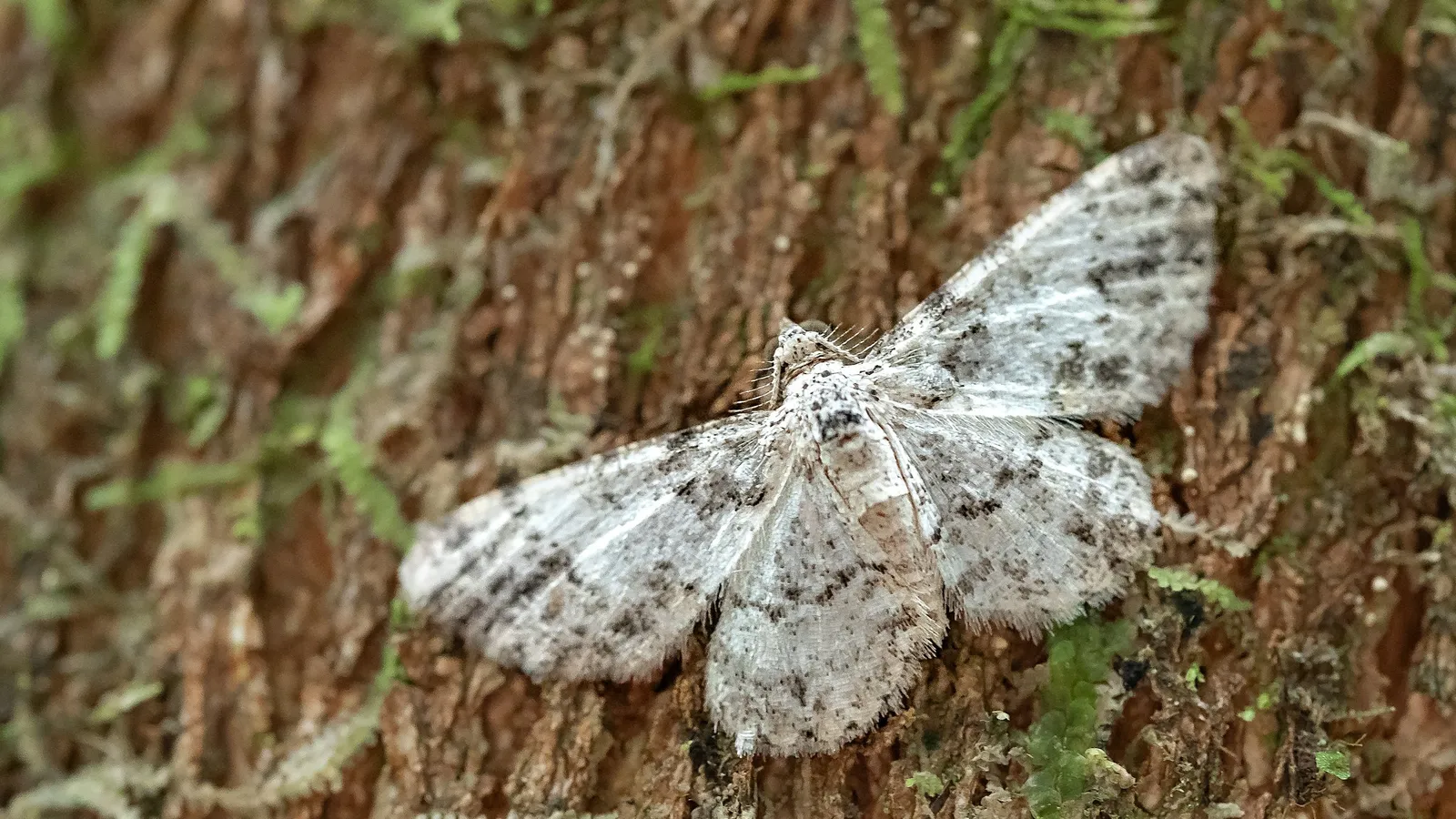
The NCERT Class 12 evolution chapter (2026-27 reprint) explains that soot darkened tree trunks and killed the pale lichens, so pale moths stood out to predators while dark ones were hidden. It adds that "no variant is completely wiped out".
Kettlewell wanted to test that explanation directly. In his 1955 paper in Heredity, he wrote that after more than twenty-five years of enquiry he had found no single case in Britain of anyone seeing a bird detect and eat a camouflaged moth resting on its correct background. The theory assumed predation; nobody had shown it.
A worked example: the 1953 Birmingham experiment
Kettlewell worked in the Christopher Cadbury Bird Reserve near Birmingham, where the wild population was about 85% dark (form carbonaria), 10% pale (typical) and 5% intermediate (insularia). He marked and released males, then recaptured them at light traps and with caged females.
His numbers for two forms:
Dark carbonaria: 447 released, 123 recaptured.
Pale typical: 137 released, 18 recaptured.
Now calculate:
Dark: 123 ÷ 447 = 0.275, so 27.5% came back.
Pale: 18 ÷ 137 = 0.131, so about 13% came back. The paper rounds this as 13.0%.
Ratio: 27.5 ÷ 13.1 ≈ 2.1.
Kettlewell's summary: more than twice as many dark moths as pale ones were recaptured, relative to the numbers released. He also watched robins and hedge sparrows take resting moths from tree trunks.
What happened in clean woodland?
A good experiment needs a control. In his 1956 paper, Kettlewell repeated the work near Birmingham and also worked in Deanend Wood in rural Dorset, a heavily lichened wood where dark moths are rare.
Dark: 473 released, 30 recaptured, so 30 ÷ 473 = 6.3%.
Pale: 496 released, 62 recaptured, so 62 ÷ 496 = 12.5%.
The advantage flipped. In each place, the form that was more conspicuous on the local bark came back less often. He concluded that birds act as selective agents in both polluted and unpolluted countryside.
Was the experiment criticised?
Yes. The classic explanation was attacked in later years, and some scientists doubted that birds were the selective agents at all. Michael Majerus ran a much larger experiment to address the perceived weaknesses of the earlier work, but died before publishing it. Colleagues analysed his data in a 2012 paper in Biology Letters: he had released 4,864 moths over six years, and found strong bird predation against dark moths on today's cleaner bark, with daily selection of about 0.1, enough to explain the recent decline of dark moths in Britain.
A 2012 review in Heredity by Laurence Cook and Ilik Saccheri concluded that selective predation is "undoubtedly the major factor", while noting that migration or non-visual selection may also play a part. And in 2016 a team identified the mutation itself: a transposable element inserted into the gene cortex, estimated to have arisen around 1819.
Common mistakes in exam answers
Saying the soot turned the moths black. Dark moths already existed; selection changed how common they were.
Saying pale moths disappeared. NCERT says no variant is completely wiped out.
Forgetting the reverse case. The Dorset result is what makes this evidence of selection rather than chance.
For the whole chapter, see our guide to evolution for NEET.
What can a student take from Kettlewell?
He noticed that a famous explanation had never been tested, designed a test with a control, and reported numbers others could check. You can apply the same habit to your own revision: for each textbook example, ask what the evidence was and what would have disproved it. If percentage and ratio steps trip you up in biology numericals, the Fermi Problem Library has a step-by-step solver that explains the reasoning rather than printing an answer.
Try it now: recalculate the Dorset percentages without looking, then explain in one sentence why they matter.


