

On this page
Imagine walking through a rainforest and spotting a brilliant neon-yellow frog resting openly on a green leaf. In a world where being seen usually means being eaten, why would any animal draw so much attention to itself?
The answer is a survival strategy called aposematism. Warning colouration, or aposematism, is the use of conspicuous signals to advertise toxicity or unpalatability to predators Wikipedia. Coined in 1890 by the British biologist Edward Bagnall Poulton, the term translates from Greek as "away-sign" Wikipedia. Warning colouration in animals uses bright colours to honestly advertise poison, venom, or a bad taste.
What is warning colouration?
To understand aposematism, it helps to contrast it with its opposite: camouflage, or crypsis. Camouflage aims for concealment, relying on low visual contrast so the animal blends into its background. It is an evolutionary game of hide and seek.
Aposematism, on the other hand, aims for maximum visibility Wikipedia. Animals with warning colouration intentionally stand out using high-contrast patterns, often relying on red, yellow, orange, and black. This display is considered an "honest signal" because the severe metabolic risk of being so conspicuous is only offset if the animal genuinely possesses a dangerous defence mechanism. Predators that experience this danger quickly learn to associate the bright pattern with a bad outcome, leaving the species alone in the future.
How do poison dart frogs use bright colours?
The golden poison frog (*Phyllobates terribilis*) of Colombia is one of the most toxic animals on Earth, and its striking yellow skin is a universal warning sign.
These frogs defend themselves with batrachotoxin, an extremely potent steroidal alkaloid. A single adult golden poison frog contains about 1 milligram (1,000 micrograms) of batrachotoxin in its skin glands Wikipedia. This single milligram is estimated to be enough to kill between 10 and 20 humans Wikipedia.
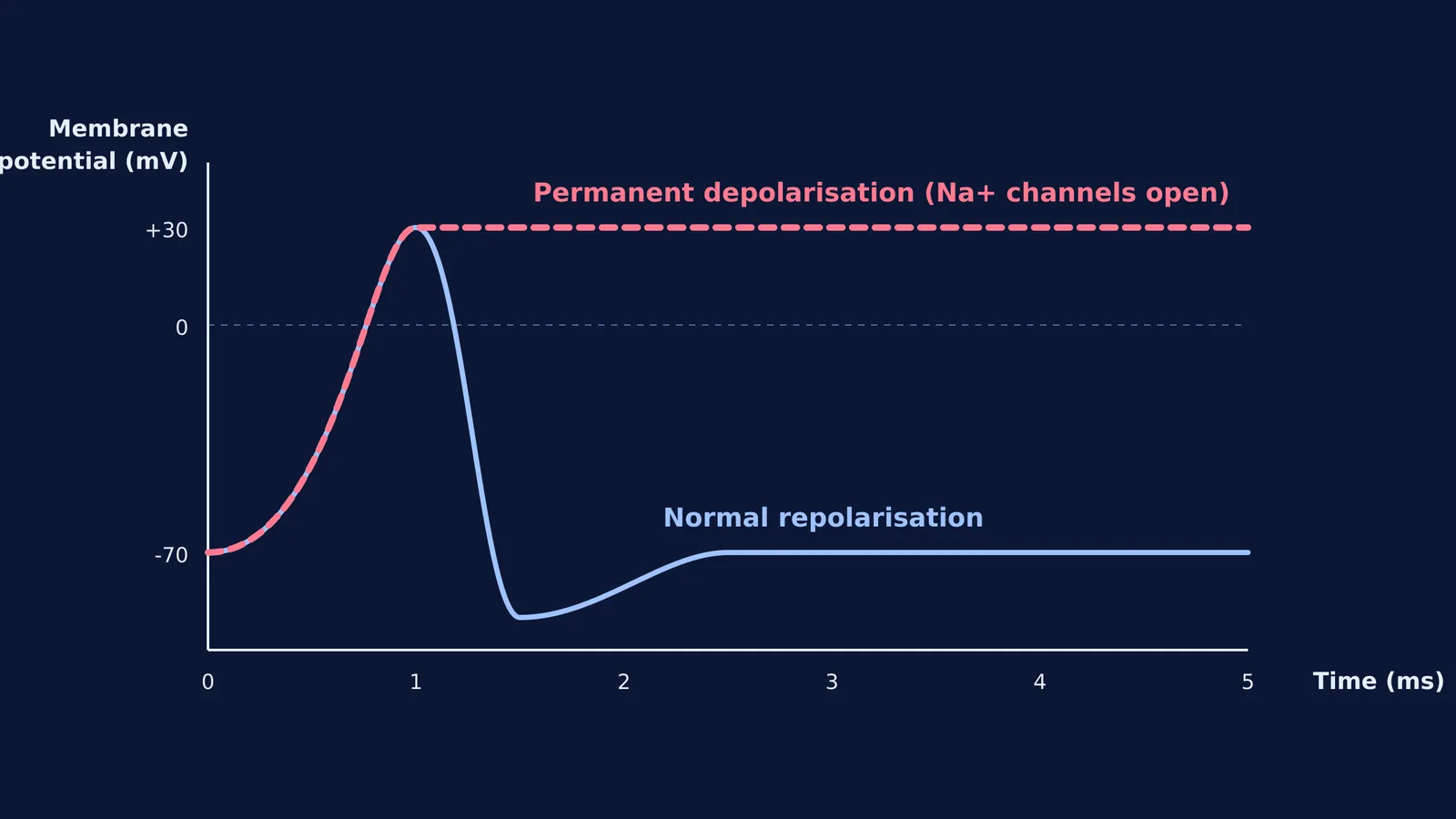
Batrachotoxin is a neurotoxin that targets the voltage-gated sodium channels in nerve and muscle cells. It binds to the inner cavity of the channel and forces it to remain permanently open Wikipedia. Because sodium ions flow uncontrollably into the cell, the nerve cannot repolarize, leading to intense electrical hyperactivity, paralysis, and ultimately respiratory failure. Because the consequence of a predator making a mistake is fatal, the high-contrast bright yellow colour acts as an unambiguous warning that saves both the predator and the frog.
Why do wasps have yellow and black stripes?
The classic yellow and black stripes of a wasp (from the family Vespidae) are another prime example of warning colouration. However, if you look closely at different stinging insects, you will notice that many distinct, unrelated species of wasps and bees share this exact same pattern.
This shared signalling is called Müllerian mimicry Wikipedia. When multiple dangerous species evolve the exact same warning colours, they simplify the learning curve for local predators. If a young bird is stung by a yellow-and-black wasp, it immediately learns to avoid all yellow-and-black insects. Sometimes, completely harmless insects take advantage of this by copying the warning colours of dangerous ones—a distinct strategy known as Batesian mimicry, famously observed by Henry Walter Bates and the butterflies that copy others.
How can distinct patterns help you study?
Aposematism relies heavily on predator psychology. High-contrast, bright patterns are vastly easier for a brain to memorise than muted, camouflaged ones Wikipedia. When an item stands out dramatically from its environment, it is more likely to be encoded into long-term memory.
You can apply this biological principle to your own study habits. When reviewing dense NEET biology notes, do not highlight every sentence in one colour (which effectively turns your highlights into camouflage). Instead, use distinct, bright highlighters specifically to flag the most critical "danger zones"—like the fact that batrachotoxin targets *sodium* channels, not potassium ones. If you want to understand how evolutionary pressures push populations towards these extreme traits, you can trace the data in Stabilising, directional and disruptive selection: reading curves.
When preparing for exams, memorising isolated facts is rarely enough; you need to understand the underlying mechanisms. You can map out the physiology of nerve impulses and the evolutionary logic of warning colouration using the Fermi Concept Library. Fermi's AI tutor can work out what you already know about nerve conduction and build a plan for the session, so you sit down to a clear next step instead of a blank page.


