On this page
Pick up a pen, then a full bucket of water. The same muscles close your fingers both times. What changes is how many motor units your nervous system switches on, and how fast they fire. For NEET-UG, it all starts from one NCERT definition.
What is a motor unit?
A motor unit is one motor neuron together with the muscle fibres connected to it, as defined in the NCERT Class 11 Biology chapter on Locomotion and Movement. The chapter then traces the signal: acetylcholine released at the neuromuscular junction triggers an action potential in the sarcolemma, and calcium released into the sarcoplasm lets myosin heads bind actin.
Motor units in one muscle are not all the same size. In a 2011 review of human hand motor units, physiologist Andrew Fuglevand wrote that the forces of the motor units in a muscle “vary over an extremely wide range, usually 100-fold or greater” (Fuglevand, Journal of Physiology, 2011). The same review notes that small hand muscles are supplied by about 50 to 200 motor neurons, while the biceps and triceps are each supplied by more than 1,000.
Because a unit's fibres respond together, the muscle has to grade force another way. For the nerve side, read how Edgar Adrian showed the nerve impulse is all-or-none.
How does a muscle control how much force it produces?
Your nervous system has two dials.
Recruitment: switch on more motor units.
Rate coding: make the units already working fire more often, so their twitches add up.
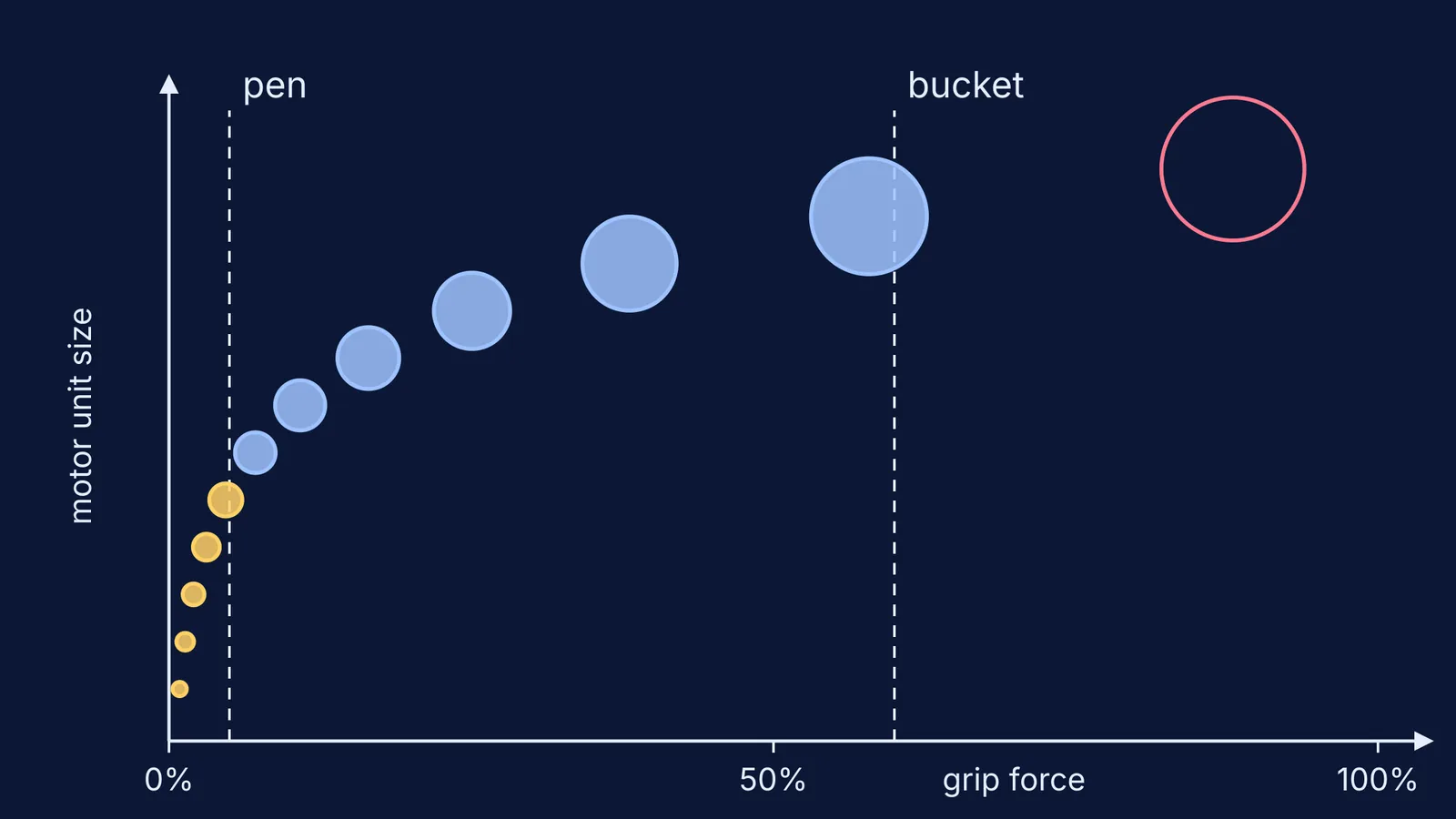
Recruitment follows an order. In a 1957 paper in Science titled “Relation between size of neurons and their susceptibility to discharge”, Elwood Henneman of Harvard Medical School tied a neuron's size to how easily it fires (Henneman, Science, 1957). The rule that grew from his work is called the size principle: Fuglevand's review describes motor units being “activated in an orderly sequence, from those that exert the lowest forces towards those that produce the greatest”.
Recording from the first dorsal interosseous, a small hand muscle, H. S. Milner-Brown, R. B. Stein and R. Yemm found that each unit's twitch tension varied nearly linearly with the voluntary force at which it was recruited, across forces from 0 to 2 kg (Milner-Brown, Stein and Yemm, Journal of Physiology, 1973). Their units ranged from about 0.1 g to 10 g of twitch tension.
Muscles mix the two dials differently, as Carl Kukulka and Peter Clamann found (Kukulka and Clamann, Brain Research, 1981). In the biceps, new units were still being recruited up to 88% of maximum voluntary force. In adductor pollicis, a small hand muscle, no unit was recruited above 50% of maximum and most joined below 30%; the authors concluded firing rate matters more there.
Why do a pen and a bucket use the same muscle differently?
Pen, light grip: only the smallest units are on. Each adds little force, so tiny corrections are possible; Fuglevand writes that with this order “fine resolution of force is an in-built control feature”.
Full bucket, heavy grip: the small units stay on, larger units join in size order, and all of them fire faster.
Hardest squeeze: the largest units join last. Fuglevand expects hand units to be recruited from “the weakest and most fatigue resistant toward the strongest and most fatigable”, one likely reason a maximum grip is hard to hold.
For a short written answer, use four lines:
Define a motor unit in NCERT's words.
Name the two dials: recruitment and firing rate.
State the order: small units first, large last (the size principle).
Apply it to the question's example.
Opening your hand again needs muscles that pull the other way, as in how biceps and triceps work as antagonistic muscles.
NEET-style questions on motor units
A motor unit consists of: (a) one muscle fibre and many motor neurons (b) one motor neuron and the muscle fibres connected to it (c) the sarcomere between two Z lines (d) a fascicle and its fascia.
The neurotransmitter released at the neuromuscular junction of skeletal muscle is: (a) adrenaline (b) dopamine (c) acetylcholine (d) serotonin.
As you slowly tighten your grip, which motor units are recruited first? (a) the largest, strongest units (b) the smallest, lowest-force units (c) units in random order (d) all units at once.
Assertion: Lifting a pen and lifting a bucket can use the same muscle. Reason: A muscle grades its force by recruiting more motor units and increasing their firing rate.
Answers: 1 (b), the NCERT definition; 2 (c); 3 (b), the size principle; 4 both true, and the reason explains the assertion.
To see what happens when that junction is blocked, read how curare paralyses muscles at the neuromuscular junction.
If the chain from nerve signal to cross bridge feels shaky, the Fermi Concept Library gives every biology concept its own lesson. For more practice, the Fermi Problem Library has worked problems with a step-by-step solver that explains the reasoning rather than printing an answer.
Next time you pick up a pen, notice how little effort it takes: that is your smallest motor units at work.