On this page
Curare is a good poison to learn from because it does one precise thing. It doesn't stop the nerve or damage the muscle; it blocks the junction between them. If you can explain why a curare-treated muscle stays limp while its nerve keeps firing, you understand the neuromuscular junction.
What is curare?
Curare is an arrow poison that Indigenous peoples of South America used for centuries to hunt game. Samples of it were identified as coming from plants of the Menispermaceae family, including the genus *Chondrodendron*, and the Loganiaceae family, including the genus *Strychnos* (Raghavendra, Journal of the Royal Society of Medicine, 2002). The same review describes how Harold King isolated d-tubocurarine from a museum sample of curare, and how on 23 January 1942 Montreal anaesthetist Harold Griffith and his resident Enid Johnson gave curare to a young man having his appendix removed.
How does a nerve make a muscle contract?
The neuromuscular junction is the synapse where a motor neuron meets a skeletal muscle fibre, and every skeletal muscle fibre has one (OpenStax Anatomy and Physiology). The signal crosses it in five steps, as set out in a 2023 review by Kouyoumdjian and Estephan:
The nerve fires. An action potential travels down the motor axon to its terminal.
Calcium enters. The action potential opens voltage-gated calcium channels in the terminal, and calcium flows in.
Acetylcholine is released. Calcium triggers vesicles to release acetylcholine (ACh), which diffuses across the synaptic cleft.
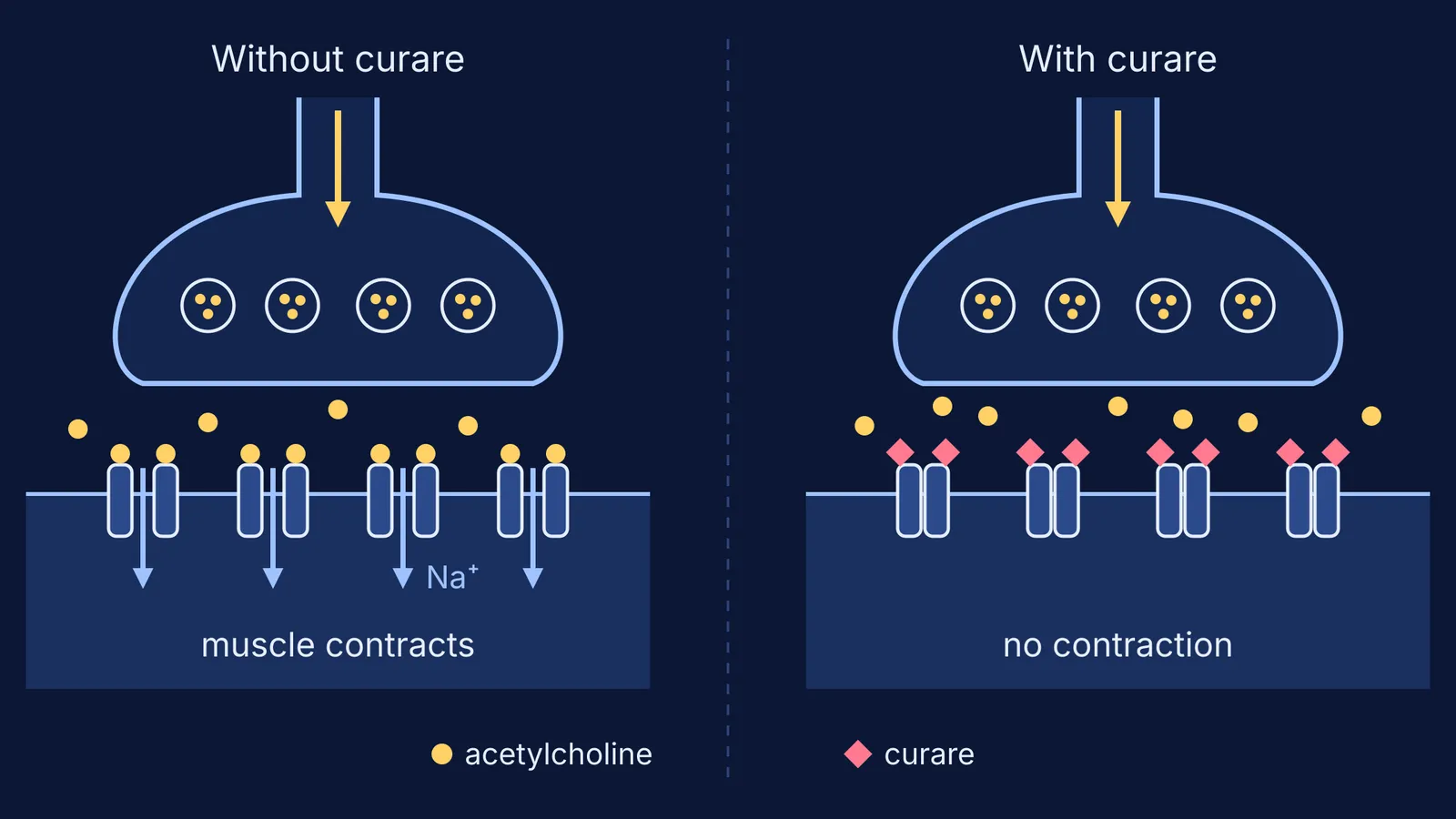
ACh binds its receptor. Two ACh molecules bind each nicotinic acetylcholine receptor on the muscle membrane. The receptor's channel opens, sodium rushes in, and the membrane under the nerve depolarises. This end-plate potential rises to a peak of 25 to 45 mV in about 1 ms.
The muscle fires. The end-plate potential opens voltage-gated sodium channels in the muscle fibre, and a muscle action potential spreads out to start contraction.
Then the enzyme acetylcholinesterase breaks ACh down so that it cannot bind a receptor again (OpenStax). A nerve normally releases four to five times more ACh than it needs to make an end-plate potential, a margin called the safety factor (Kouyoumdjian and Estephan, 2023).
What happens after step 5 is covered in our step-by-step guide to muscle contraction; for the parts of the junction, see our labelled synapse structure diagram.
How does curare paralyse muscles?
Curare works at step 4. Its main toxin, d-tubocurarine, is a classic non-depolarising agent that competitively blocks the action of acetylcholine on nicotinic receptors (Küpeli Akkol and colleagues, 2022). The muscle receptor has its two ACh binding sites on its outer surface, where its alpha subunits meet the subunits next to them (Cetin and colleagues, 2020). Because the block is competitive, curare takes up the receptors ACh needs without opening the channel. ACh is still there in the cleft, but it finds the seats taken.
Steps 1 to 3 happen before the block, so the nerve still fires: the message is sent but never received. With no end-plate potential, there is no muscle action potential and no contraction.
How did scientists prove where curare acts?
In 1846 Claude Bernard published experiments on frogs. When he injected curare into a limb, stimulating the nerve no longer made the muscle contract, but the muscle still contracted when he stimulated it directly (Raghavendra, 2002). The review adds that curare applied directly to the nerve did not stop contraction either. Nerve and muscle both worked, so the block had to sit between nerve and muscle.
You can use the same logic as a test to find where any block is:
Nerve stimulated: no contraction. Muscle stimulated directly: contraction. The block is at the junction (curare).
Nerve stimulated: no contraction. Muscle stimulated directly: no contraction. The muscle itself has failed.
Nerve stimulated: contraction. The pathway from nerve to muscle is working.
How do you answer a curare question in an exam?
Say what happens at each step, and say what still works. Here is a model answer to “Explain why curare causes paralysis”:
The nerve impulse still reaches the axon terminal, and calcium entry still releases acetylcholine.
Curare binds the nicotinic ACh receptors on the motor end plate and competes with ACh for them.
The receptor channels stay closed, so sodium cannot enter and no end-plate potential forms.
No muscle action potential is generated, so the muscle does not contract even though the nerve is firing.
Don't skip point 1: saying that curare “blocks the nerve” is wrong, as Bernard's experiment shows. To see how disease can disturb the same junction, read our explainer on myasthenia gravis and other muscle disorders.
If the steps still feel shaky, the Fermi Concept Library gives every biology concept its own lesson and its place in the map, so you can go back to synapses or action potentials. To practise questions like this one, the Fermi Problem Library has worked problems with a step-by-step solver that explains the reasoning rather than printing an answer.