On this page
In dengue, the platelet count on the daily blood report becomes the number everyone watches. A healthy adult has 150–400 × 10⁹ platelets per litre of blood, which is 1.5 to 4 lakh per microlitre, according to a 2015 review in Mediators of Inflammation. Dengue pushes that count down from both ends: fewer platelets are made, and more are removed.
Why does platelet count decrease in dengue?
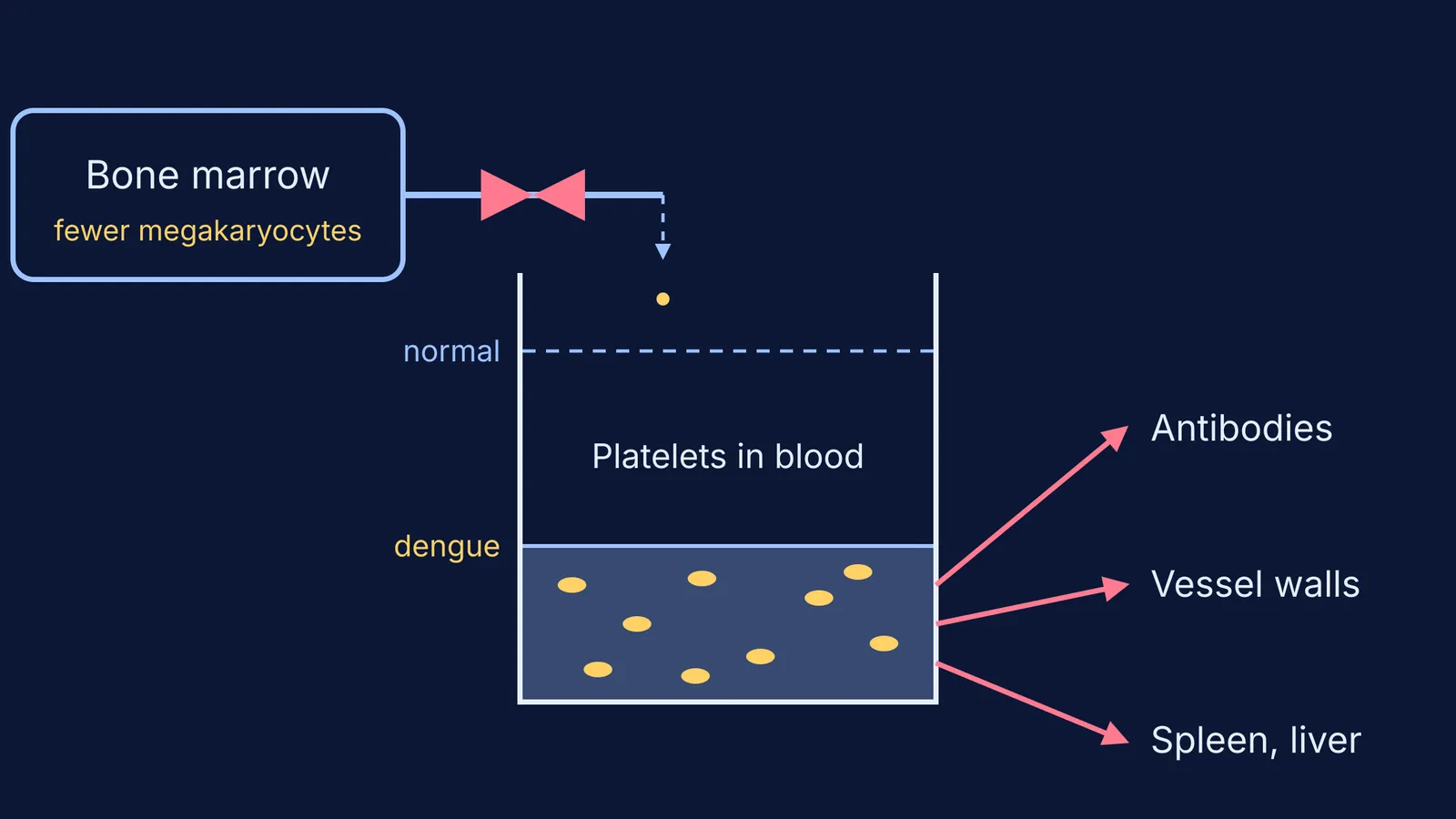
Think of blood platelets as water in a tank. The bone marrow is the tap; antibodies, the spleen and the walls of blood vessels are the drains. The level drops if the tap slows, the drains widen, or both.
India's National Guidelines for Clinical Management of Dengue Fever 2023 state plainly that "the precise mechanism of thrombocytopenia in dengue fever is not known." Bone marrow suppression "is thought to play a pivotal role", they say, but destruction of platelets "too has a significant role". Most of the eight mechanisms they list fall into three groups:
The marrow makes fewer platelets.
Antibodies and complement mark platelets for destruction, and the liver and spleen remove them.
Platelets get used up in abnormal clotting and by sticking to cells, processes linked to inflamed blood vessels.
What does dengue do to the bone marrow?
Platelets are fragments pinched off giant marrow cells called megakaryocytes; our posts on red and yellow bone marrow and the formed elements of blood cover the basics. In early dengue, the 2015 review reports, the "bone marrow displays hypocellularity and attenuation of megakaryocyte maturation": fewer cells, and megakaryocytes that do not mature properly.
A 2013 study in the Journal of Virology gave mice human blood-forming cells, then infected them with dengue. Their loss of human platelets was not caused by antibodies or by a fall in thrombopoietin, the hormone that drives platelet production, but by fewer megakaryocytes and their precursors in the marrow. So marrow suppression can be enough to lower platelets in this mouse model, though that does not make it the only cause in people.
How do antibodies destroy platelets in dengue?
The dengue virus makes a protein called NS1. The national guidelines explain that antibodies against NS1 act as autoantibodies: they cross-react with platelets and with cells lining blood vessels. The guidelines say molecular mimicry, a resemblance between viral proteins (NS1 or pre-M) and proteins on those cells, may explain this.
The 2015 review adds that patients "develop anti-platelet antibodies of the IgM isotype", and that in lab tests the killing of platelets by such antibodies "was much higher in the presence of complement", the blood proteins that punch holes in marked cells.
What happens to platelets at inflamed blood vessels?
Two lab studies from the ICMR-National Institute of Virology, Pune, point to platelet activation. In a 2008 study in the Journal of Electron Microscopy, donor platelets exposed to dengue 2 virus became activated: more P-selectin on the surface, spiky filopodia, emptied granules. Japanese encephalitis virus at the same dose did none of this. The authors suggest this direct contact "might be important in the origin of dengue-associated thrombocytopenia".
In a 2019 study in the Indian Journal of Hematology and Blood Transfusion, cultured blood-vessel cells exposed to NS1 had more von Willebrand factor, a protein that helps platelets stick to vessel walls, in the surrounding fluid 6 and 24 hours later, and showed increased platelet activation. The authors link these changes to bleeding complications in severe dengue.
The national guidelines say 5–10% of patients may progress to a critical "leakage phase", which usually begins after the 3rd or 4th day of fever and may last about 24 to 48 hours. One warning sign they list is a "progressive increase in haematocrit with a rapid decrease in platelet count": plasma leaks out, the blood thickens, and the platelet count falls at the same time.
How can you use this when you read a report or revise?
If you are a parent, here are three questions to ask the doctor:
"Which phase of dengue do you think we are in?"
"Is the haematocrit changing along with the platelets?"
"Which warning signs should we watch for at home, and when should we call you?"
The 2015 review notes that in one study, counts fell mildly to moderately from about the 3rd to the 7th day of illness and were normal again by the 8th or 9th day. That is one study's pattern, not a promise; the doctor reads the trend.
For NEET-UG biology, this one disease ties three topics together:
Body fluids and circulation: megakaryocytes, platelets and clotting.
Human health and disease: antibodies, complement, and how Aedes mosquitoes spread dengue.
Capillary exchange: why plasma leaking out of vessels raises haematocrit.
If a term such as megakaryocyte or complement is the gap, the Fermi Concept Library gives every biology concept its own lesson and its place in the map. For sequence-style questions, the Fermi Problem Library has worked problems with a step-by-step solver that explains the reasoning.