On this page
Criss-cross inheritance is the pattern in which a gene on the X chromosome passes from a man to his grandson through his daughter, while his sons never get it. In Class 12 biology it sits under sex-linked inheritance, and you may be asked to define it or trace it through a pedigree.
What is criss-cross inheritance?
Criss-cross inheritance is the passing of an X-linked gene from father to daughter to grandson, so the trait seems to cross between the sexes and skip a generation. A father gives his X chromosome to every daughter and his Y chromosome to every son, which is why, as MedlinePlus Genetics puts it, "fathers cannot pass X-linked traits to their sons."
Some sources use the same name for the mirror pattern, mother to son. A Kenyon College genetics course page says a female with two recessive X-linked alleles crossed with a normal male "will produce criss-cross inheritance". Both versions share one rule: an X-linked gene in one sex shows up in the opposite sex in the next generation.
If you are unsure what makes a trait sex-linked rather than sex-limited, our post on sex-linked, sex-limited and sex-influenced traits sorts out the three terms.
Why does colour blindness skip a generation?
Red-green colour blindness is caused by variants in the OPN1LW and OPN1MW genes, which sit on the X chromosome, according to MedlinePlus Genetics. The same page says one altered copy is enough to cause it in males, who have one X, while females need two altered copies.
That difference explains the skip. A daughter who gets her father's altered X usually also gets a normal X from her mother, so she sees colours normally but carries the gene. She is a carrier, and each of her sons has a 50:50 chance of getting that X.
It also explains why far more men than women are colour-blind. Among people of Northern European ancestry, red-green colour vision deficiency affects about 1 in 12 men and 1 in 200 women, according to MedlinePlus Genetics.
How does colour blindness pass from grandfather to grandson?
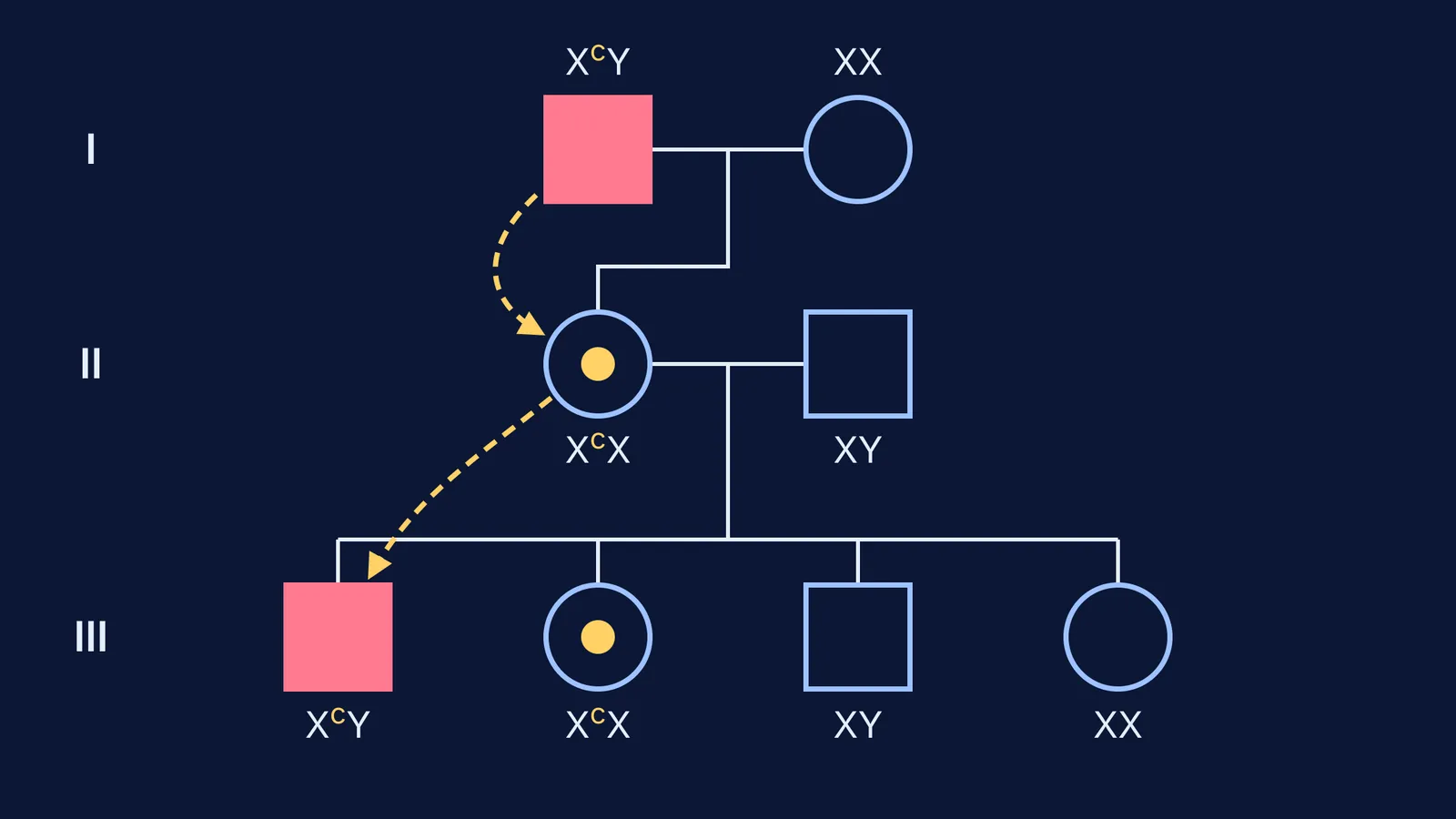
Write the normal X chromosome as X and the one carrying the colour-blindness variant as Xc. The Y chromosome carries no copy of this gene.
Generation I. Ramesh is colour-blind (XcY). His wife Sunita has normal vision and is not a carrier (XX).
Daughters get Ramesh's Xc and one of Sunita's X: all are XcX, carriers with normal vision.
Sons get Ramesh's Y and one of Sunita's X: all are XY, with normal vision, and cannot pass the gene on.
Generation II. Their daughter Meera (XcX) marries Arjun, who has normal vision (XY).
Half of Meera's eggs carry Xc and half carry X.
Half of Arjun's sperm carry X and half carry Y.
Generation III. Each child of Meera and Arjun has these chances:
XcY, a colour-blind son: 1 in 4 of all children, or 1 in 2 of the sons.
XY, a son with normal vision: 1 in 4.
XcX, a carrier daughter with normal vision: 1 in 4.
XX, a daughter who is neither: 1 in 4.
No daughter in this family can be colour-blind, because every daughter gets Arjun's normal X. The trait went from Ramesh, through Meera who shows no sign of it, to Meera's son: male to female to male. Wikipedia's article on X-linked recessive inheritance describes the same chain: an affected grandfather "could have an affected grandson through his daughter".
What changes if the mother is colour-blind instead?
Swap the parents. A colour-blind woman (XcXc) and a man with normal vision (XY) have:
every son XcY and colour-blind, because his only X comes from her;
every daughter XcX, a carrier with normal vision.
This is the mother-to-son version of criss-cross inheritance. A daughter can be colour-blind only if her father is colour-blind and her mother also passes her an Xc. For more practice, including haemophilia, see our guide on how to solve X-linked crosses.
How do you spot criss-cross inheritance in a pedigree?
Run through this checklist on any pedigree question:
Are the affected people mostly males (shaded squares)? That points to X-linked recessive.
Does an affected father have only unaffected sons? Criss-cross needs this.
Are his daughters unaffected but with affected sons? They are carriers.
Does the trait reach a grandson through an unaffected mother? That is the skipped generation.
Is there father-to-son transmission anywhere? If yes, the trait is not X-linked recessive.
If squares, circles and half-shaded symbols still slow you down, our explainer on pedigree chart symbols walks through them.
When a cross goes wrong, the fix is usually to redo it one gamete at a time. The Fermi Problem Library has worked problems with a step-by-step solver that explains the reasoning rather than printing an answer. To revisit sex chromosomes first, the Fermi Concept Library gives each biology concept its own lesson.