On this page
These three terms sound almost identical and often turn up in the same MCQ. The fix is to ask two questions in order: where does the gene sit, and who shows the trait?
What is the difference between sex-linked, sex-limited and sex-influenced traits?
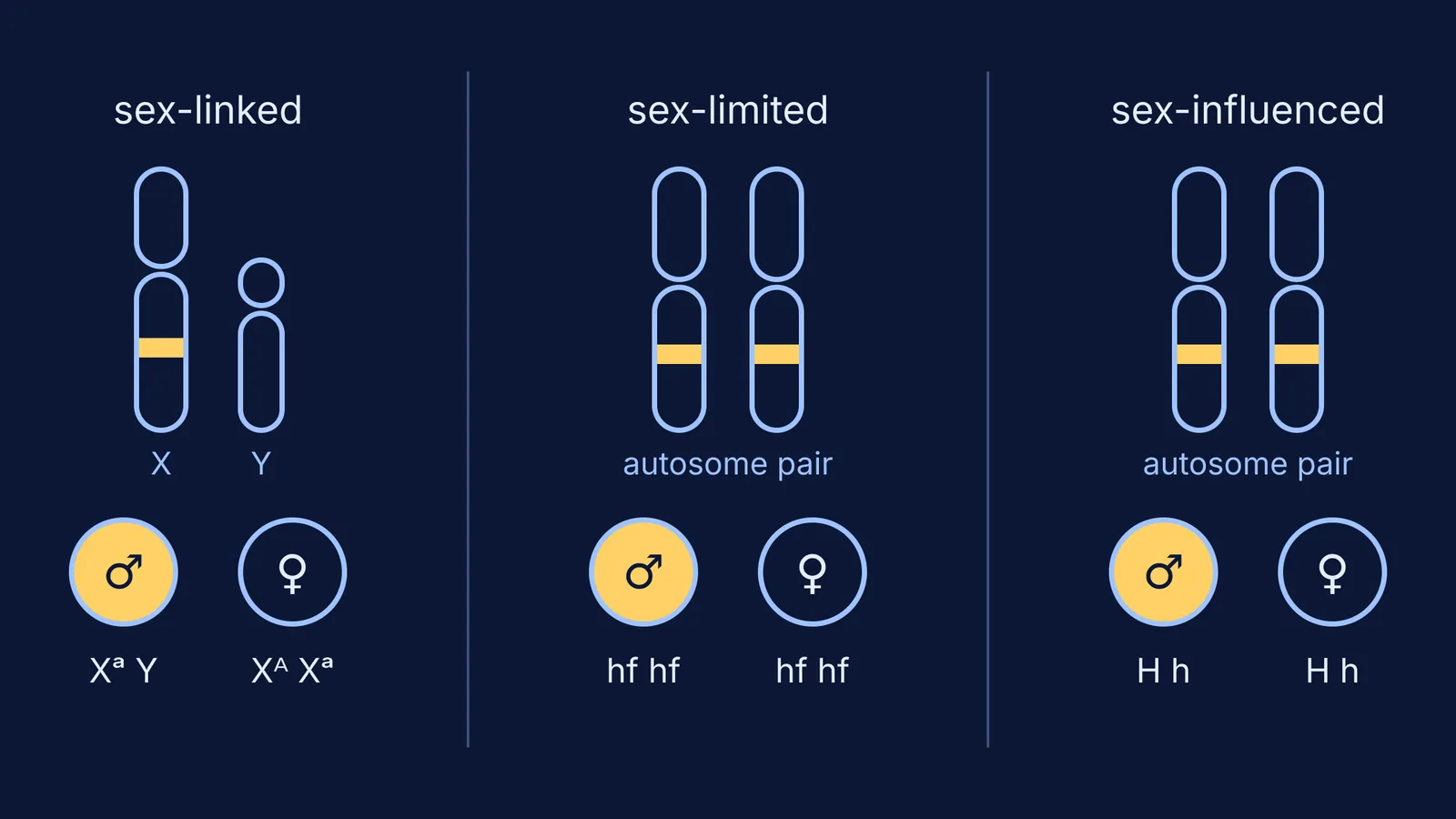
Start with location. A sex-linked trait is one influenced by genes carried on the sex chromosomes, as the NHGRI genetics glossary defines it. Sex-limited and sex-influenced traits come from genes on autosomes, the chromosomes both sexes carry in matching pairs (see autosomes vs sex chromosomes in human karyotypes).
Then look at expression:
Sex-linked: the gene is on the X (or Y). A male has one X, so a single recessive allele is enough to show the trait.
Sex-limited: the gene is on an autosome and both sexes carry it, but only one sex ever shows the trait.
Sex-influenced: the gene is on an autosome and both sexes can show the trait, but the same allele behaves as dominant in one sex and recessive in the other.
What is an example of a sex-linked trait?
Red-green colour blindness is the classic case. MedlinePlus Genetics explains that the genes are on the X chromosome, so males need one altered copy and females need two. It affects about 1 in 12 men and 1 in 200 women of Northern European ancestry, according to the same page. It also gives a key pedigree clue: fathers cannot pass X-linked traits to their sons, because a father gives his son a Y.
Write a colour-blind man as XᵃY and a carrier woman as XᴬXᵃ. To practise crosses, including haemophilia, work through how to solve X-linked crosses for colour blindness and haemophilia. Genes on the Y follow their own rule, covered in Y-linked (holandric) genes.
What is an example of a sex-limited trait?
Feather pattern in chickens. In breeds such as the Sebright Bantam, a dominant allele called henny feathering (Hf) makes the plumage of males resemble that of females. A 2019 study in Mobile DNA characterised the retrovirus insertion in the gene CYP19A1 linked to henny feathering. As earlier studies had shown, the allele switches on aromatase in skin, an enzyme that converts androgens to oestrogen, which blocks male-type plumage. The authors call henny feathering a male-limited trait: a hen's genotype cannot be read from her feathers.
In exam terms: a rooster with hf hf shows cock feathering; Hf hf or Hf Hf roosters are hen-feathered. A hen with hf hf has the same alleles as the cock-feathered rooster and still looks like a hen. The hen feathering entry on Wikipedia describes it as a simple autosomal dominant gene whose expression is limited to males: same genotype, trait limited to one sex.
What is an example of a sex-influenced trait?
Horns in sheep. A 2016 paper in Genetics Selection Evolution restates the early conclusion that horns are dominant in male sheep and recessive in female sheep. In breeds where the authors' marker tracked horn status, heterozygous males were horned and heterozygous females polled (hornless).
Write the horn allele as H:
HH: horned ram, horned ewe
Hh: horned ram, polled ewe
hh: polled ram, polled ewe
A caveat: the same paper warns that horn inheritance is far more complex than a superficial analysis might suggest. Many books also use human pattern baldness here, but MedlinePlus Genetics on androgenetic alopecia says its inheritance pattern is unclear because many genetic and environmental factors are involved. Learn the one-gene model for exams, and know that it is a model.
How do you tell them apart in an exam question?
Run these checks in order and stop at the first yes:
Is the gene on the X or Y? Then it is sex-linked.
Is the gene on an autosome, and does the trait never appear in one sex, whatever the genotype? Then it is sex-limited.
Is the gene on an autosome, and does the heterozygote look different in males and females? Then it is sex-influenced.
One trap: more affected males does not by itself mean sex-linked, because sex-influenced traits can also show up more in males. Father-to-son transmission in a pedigree rules out X-linkage.
Can you pass a three-question self-test?
A trait passes from a father to his son, and the gene is mapped to chromosome 5. Could it be sex-linked?
A gene sits on an autosome. Bb males show the trait, Bb females do not, and BB females do. Which type is it?
A trait never appears in females of any genotype, yet unaffected mothers can pass it to their sons. Which type is it?
Answers: (1) No. Chromosome 5 is an autosome. (2) Sex-influenced: dominant in males, recessive in females. (3) Sex-limited: an autosomal gene the mother carries but never expresses. An X-linked recessive trait would not fit, because a homozygous female would show it.
If terms like these keep blurring together, the Fermi Concept Library gives every biology concept its own lesson and its place in the map. For crosses, the Fermi Problem Library has worked problems with a step-by-step solver that explains the reasoning rather than printing an answer.