

On this page
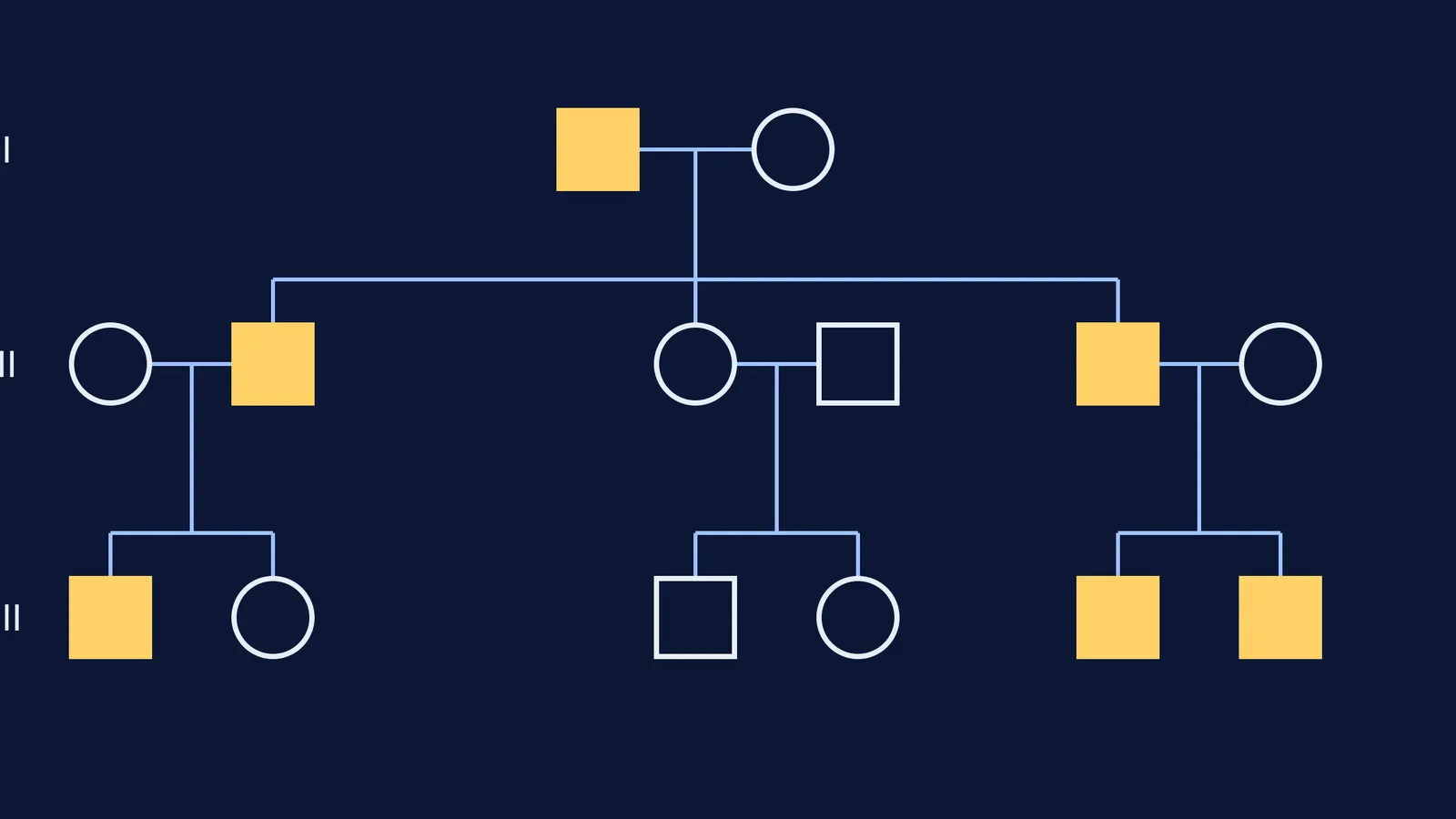
A trait that runs from grandfather to father to son, and skips every woman in the family, is the signature of a Y-linked gene. Biology textbooks call this holandric inheritance, and pedigree questions in school and entrance exams test whether you can recognise it, and rule it out.
What are Y-linked (holandric) genes?
Y-linked inheritance is the inheritance of genes on the Y chromosome. The RxList medical dictionary notes that it is also called holandric inheritance, and that because only males normally have a Y chromosome, Y-linked genes can only be transmitted from father to son.
The Y chromosome is small. According to MedlinePlus Genetics, it spans more than 59 million base pairs, represents almost 2 percent of the total DNA in cells, and likely holds 70 to 200 protein-coding genes. The same page notes that the SRY gene on the Y chromosome makes a fetus develop as male, and that other Y genes matter for male fertility.
If the difference between sex chromosomes and the other 22 pairs is still hazy, start with our post on autosomes vs sex chromosomes in a human karyotype.
Why do Y-linked traits never appear in females?
A father gives each son his Y chromosome and each daughter his X chromosome. That one fact explains the whole pattern.
Every son of an affected man gets his Y, so every son inherits the variant.
No daughter gets a Y, so no daughter can show the trait, or carry it.
A woman can never pass a Y-linked trait on, even if her father and brothers have it.
MedlinePlus puts it plainly: because only males have a Y chromosome, in Y-linked inheritance a variant can only be passed from father to son. There are no carrier women. Compare X-linked recessive traits such as haemophilia, where a mother with one copy can pass it to her sons, each with a one-in-two chance. Our guide to solving X-linked crosses for colour blindness and haemophilia shows that contrast cross by cross.
A real example is Y chromosome infertility. MedlinePlus reports that when men with this condition do father children, naturally or through assisted reproduction, they pass the Y chromosome changes to all their sons. It occurs in about 1 in 2,000 to 1 in 3,000 males. Because it makes fathering children hard, it is usually not inherited: most cases come from new deletions that arise while sperm cells form, in a father who is not himself infertile.
Is hairy ears really a Y-linked trait?
Hairy ear rims (hypertrichosis of the pinna) still appear in many textbooks as the classic holandric trait; a 2004 study in the European Journal of Human Genetics describes it as traditionally regarded as the only Y-linked heritable trait. The case for it rested on family pedigrees, including work by K. R. Dronamraju, whose 1964 article in Nature was titled "Y-linkage in Man".
That 2004 study, by Andrew Lee, Mark Jobling and colleagues, tested the idea with DNA. They found that hairy-eared men in southern India carried Y chromosomes from many different branches of the Y family tree, and that their mix of branches did not differ significantly from that of unaffected men from the same region. They concluded the trait cannot be Y-linked in southern Indians and is unlikely to be so in any population. In an exam, answer as your syllabus expects, but know the textbook example failed a DNA test.
How are Y-linked pedigree questions framed?
Most questions give a pedigree and ask which mode of inheritance fits, or which can be ruled out. Y-linkage is the easiest to test because its rules are absolute. Run this checklist in order:
Are any females affected? If yes, it is not Y-linked. Stop.
Does every affected male have an affected father? An affected son of an unaffected father points away from Y-linkage, unless the variant is new.
Are all sons of every affected man affected? One unaffected son rules it out.
Do daughters of affected men have affected sons? They should not, because those grandsons got their Y from a different man.
Worked example: a man with a trait has three children, two sons and a daughter. Both sons are affected; the daughter is not. The daughter's son is unaffected, while each affected son's sons are affected. All four checks pass, so Y-linkage fits. Now change one detail: the daughter's son is affected. Check 4 fails, and you should look at X-linked or autosomal explanations instead. Our post on telling whether a pedigree is dominant or recessive covers that next step.
If the vocabulary of loci, alleles and sex chromosomes needs a refresher, the Fermi Concept Library covers every concept in biology. For more practice, the Fermi Problem Library has worked problems with a step-by-step solver that explains the reasoning rather than printing an answer.
Try the four checks on the next pedigree in your question bank before you pick an option.


