On this page
You might expect the lens to do most of the eye's focusing. It doesn't. Here is how to work out both powers from refractive indices, and why the weaker part is the one that focuses.
Does the cornea or the lens bend more light?
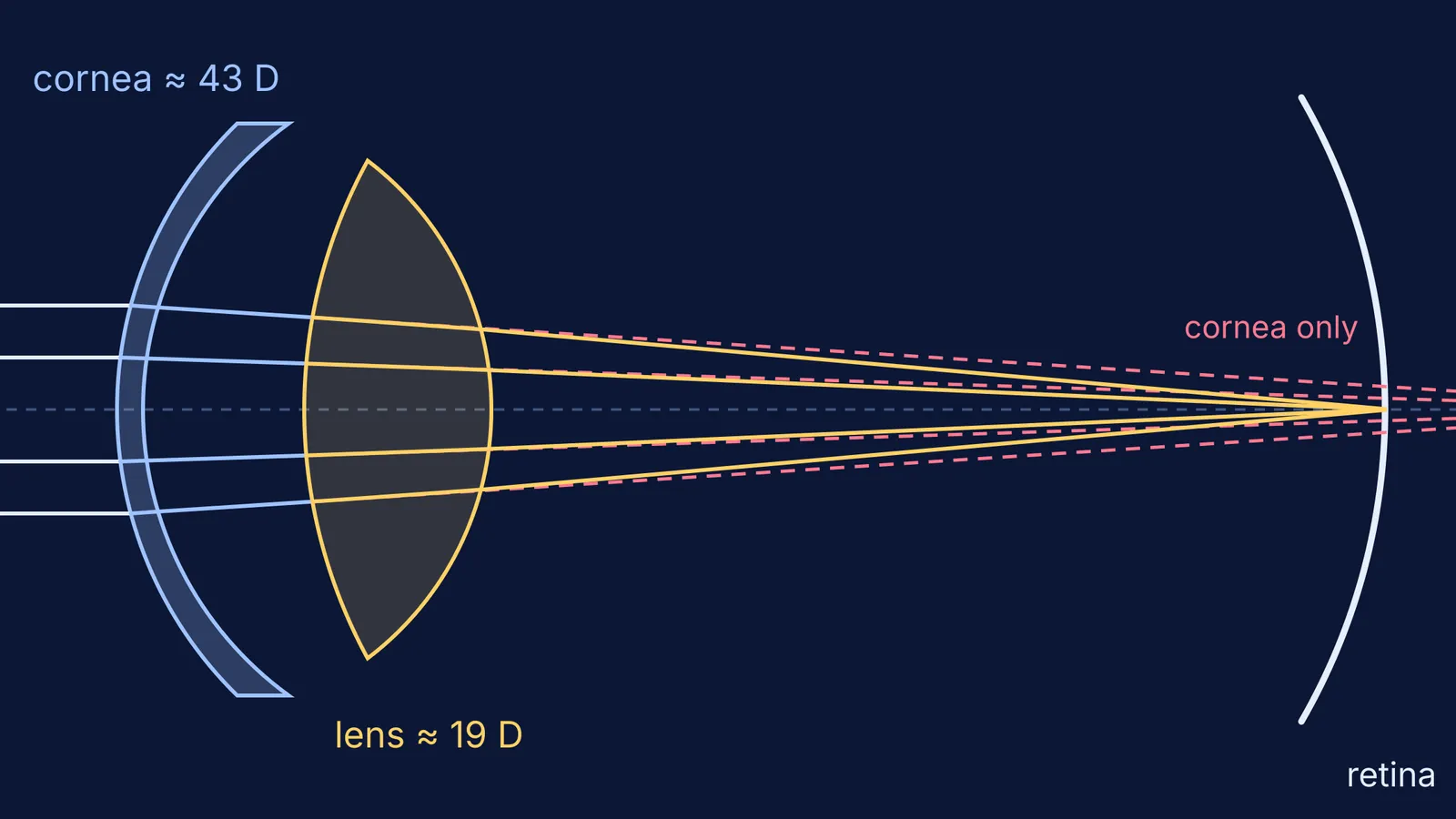
The cornea does. An optics textbook by Kaschke, Donnerhacke and Rill gives the air-to-cornea surface alone about 42 dioptres (D), and the lens at most 20 D, no more than 30% of the eye's total.
The sums below use Gullstrand's schematic eye, the classic model of an average adult eye, as set out by Vojniković and Tamajo (2013) (PubMed). In Gullstrand's model the refractive indices are 1.376 for the cornea, 1.336 for both the aqueous and vitreous humours, 1.386 for the lens's outer layers and 1.406 for its core. The whole eye has a power of 58.64 D.
How do you work out the cornea's power from refractive indices?
Each curved surface has a power P = (n2 − n1)/R, where light passes from index n1 into n2 and R is the radius of curvature in metres. R is positive when the centre of curvature lies beyond the surface. The radii come from Gullstrand's model.
Front of the cornea, air (1.000) into cornea (1.376), R = 7.7 mm = 0.0077 m: P = 0.376/0.0077 = +48.8 D.
Back of the cornea, cornea (1.376) into aqueous (1.336), R = 6.8 mm: P = −0.040/0.0068 = −5.9 D. It is negative because light moves into a lower index.
Add them: 48.8 − 5.9 = 42.9 D. The cornea's 0.5 mm thickness adds about 0.1 D, giving roughly 43 D.
Almost all of that comes from step 1. Air to cornea is a jump of 0.376 in refractive index, the biggest light meets anywhere in the eye.
If radius signs trip you up, see our guide to signs in the lens maker's formula.
Why is the lens weaker if it is denser than the cornea?
Because it sits in fluid. Its outer layers (1.386) are only 0.05 above the humours around them (1.336), so each surface bends light gently. Kaschke and colleagues give the same reason: the index difference at the lens's surfaces is small.
The four surfaces of Gullstrand's layered lens:
Front of the lens, 1.336 into 1.386, R = 10.0 mm: +5.0 D
Into the denser core, 1.386 into 1.406, R = 7.91 mm: +2.5 D
Out of the core, 1.406 into 1.386, R = −5.76 mm: +3.5 D
Back of the lens, 1.386 into 1.336, R = −6.0 mm: +8.3 D
The sum is 19.3 D; a ray trace that includes the gaps between surfaces gives about 19.1 D. The steep back surface does the most, and the two surfaces of the denser core add about 6 D between them.
Why is 43 + 19 not 58.64? Separated lenses combine to less than their simple sum.
Test the idea under water. Water's refractive index is about 1.33, close to the cornea's (Underwater vision, Wikipedia). Redo step 1 with 1.33 instead of 1.000 and the front surface drops from 48.8 D to about 6 D, roughly cancelling the back surface. That is why you can't see clearly with your eyes open under water.
If the cornea does most of the work, why does the lens matter?
Because only the lens can change. The cornea's shape, and so its 43 D, is fixed. To focus on something close, the ciliary muscle contracts, the lens takes a more rounded, more strongly curved shape and its power rises. This is accommodation, as Kaschke and colleagues describe it.
The range of that change shrinks with age as the lens loses its elasticity. The same chapter's chart starts at about 14 D for an 8-year-old, and the authors note that people usually need glasses for near vision at about age 50. This age-related loss is called presbyopia.
A worked example: reading a book 25 cm away needs 1/0.25 = 4 D more than looking at the horizon, as our post on why the eye's power changes by 4 D from far to near shows. That is a small slice of 58.64 D, but without it the page blurs. In camera terms, the cornea is the big fixed glass and the lens is the focus ring.
A quick checklist for exam questions on eye power
Convert radii to metres before dividing.
Use n2 − n1 in the direction light travels.
Give R its sign from where the centre of curvature lies.
Expect large power where the index jump is large: air to cornea.
Don't simply add the powers of separated parts.
"Which part bends most?" The cornea. "Which part changes focus?" The lens.
If a step goes wrong, the Fermi Problem Library has a step-by-step solver that explains the reasoning. To revisit refraction at a curved surface, try the Fermi Concept Library, which covers concepts across physics, chemistry, biology, mathematics and computing.
Next time, find the biggest index jump first: that is where the bending happens.