On this page
Your bones are not solid all the way through. Inside many of them is bone marrow, and it comes in two kinds that look and behave differently. Knowing which is which, and where each one sits, answers a common biology exam question and explains why the skeleton of a child is not the same as an adult's on the inside.
What is the difference between red and yellow bone marrow?
Red marrow is where blood cells are made. After birth, most blood formation (haemopoiesis) happens in red marrow, a connective tissue in the spaces of spongy bone, according to the open textbook OpenStax Anatomy and Physiology 2e. Red cells, white cells and platelets all start here.
Yellow marrow is mostly fat. The hollow medullary cavity in the shaft of a long bone is filled with yellow marrow, while red marrow fills the spaces in spongy bone (OpenStax, bone structure).
The difference is one of proportion, not a clean split. Red marrow is about 40% fat cells, 40% water and 20% blood-forming cells, while yellow marrow is about 80% fat cells, 15% water and 5% blood-forming cells, according to a 2024 review in Quantitative Imaging in Medicine and Surgery (Vilanova et al., 2024).
Bone marrow also matters for immunity. NCERT's Class 12 Biology chapter on human health and disease names bone marrow and thymus as the primary lymphoid organs (NCERT, Human Health and Disease). If lymphocytes confuse you, our explainer on B cells vs T cells and where they mature picks up from here.
Where is red bone marrow found in adults?
In adults, blood formation is largely restricted to the skull and pelvic bones, the vertebrae, the sternum, and the upper (proximal) ends of the femur and humerus (OpenStax). Children can still make blood in the medullary cavity of their long bones; adults mostly cannot.
Notice the pattern: red marrow stays in the trunk, close to the body's centre, and in spongy bone. For the structure behind that, our post on compact bone vs spongy bone shows where the bony struts (trabeculae) and the spaces between them sit.
How does bone marrow change with age?
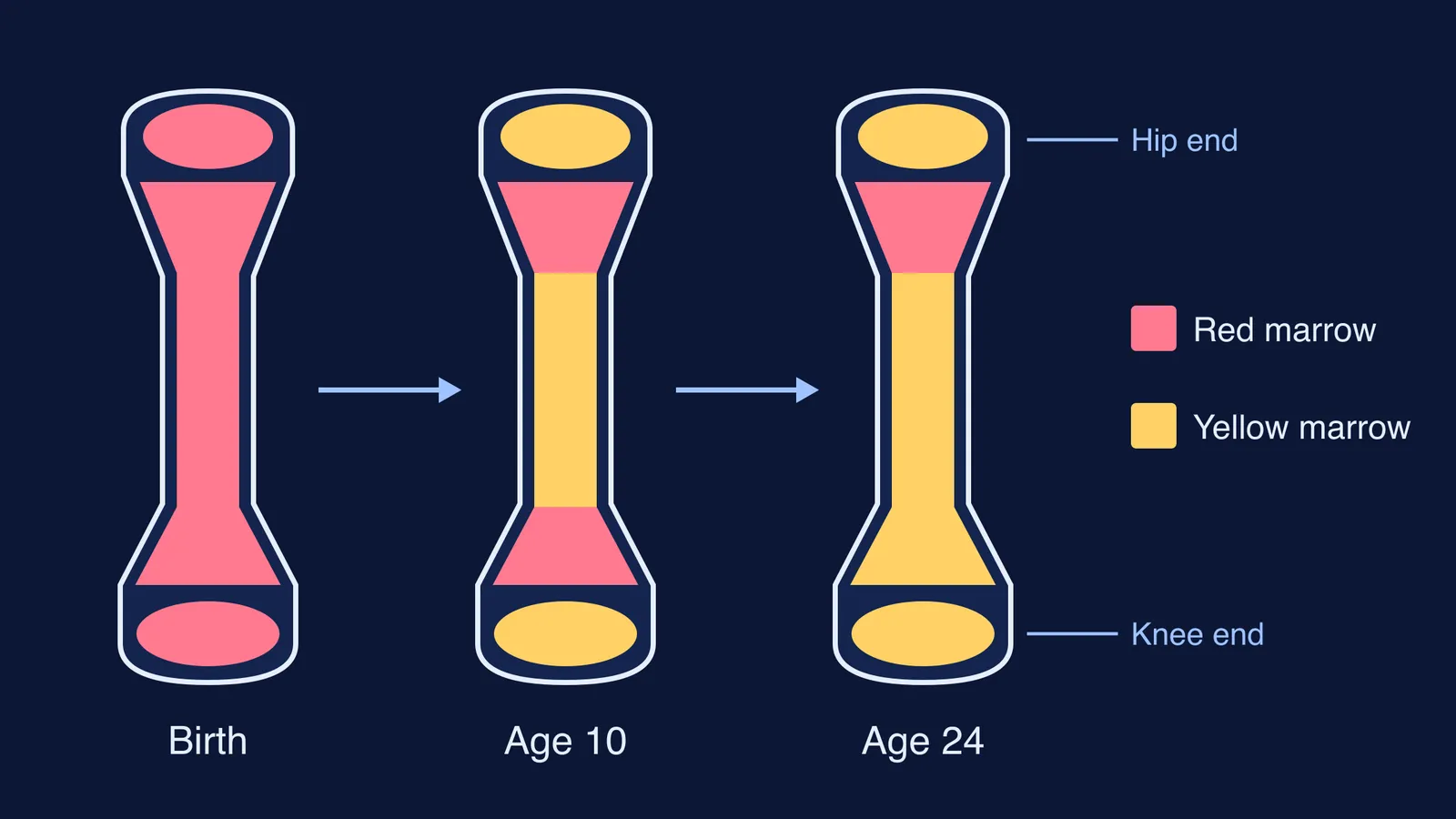
At birth, almost all marrow is red. Newborns show "an almost full totality of red bone marrow", and fatty marrow takes up more than 70% of the marrow space by age 25, according to a 2024 review in the journal Cells (Busilacchi et al., 2024). The same review says red marrow keeps shrinking until, around age 40, it is found only in the ribs, sternum, some vertebrae, sacrum and coccyx.
The change follows an order. It runs from the limbs towards the trunk, and within a long bone from the ends (epiphyses) to the shaft and last to the metaphysis nearest the trunk (Vilanova et al., 2024). An MRI study of the femur in 77 people aged 1 month to 24 years found conversion first in the shaft (ages 1 to 10), then in the lower metaphysis near the knee (ages 10 to 20), with an adult pattern by age 24 (Moore and Dawson, Radiology, 1990).
This reversal, called reconversion, starts in the trunk and moves out to the limbs, the opposite direction to the original change (Vilanova et al., 2024). Reading marrow on a scan is a doctor's job, so if a report mentions it, ask the doctor who ordered the scan rather than searching for an answer.
How do you remember red vs yellow marrow for exams?
Use three anchors:
Job: red makes blood cells; yellow stores fat.
Place: red lives in the spongy bone of the trunk and the upper ends of the femur and humerus; yellow fills the shaft of long bones.
Time: red turns yellow with age, limbs first and trunk last, and can turn back to red when the body needs more blood.
Now test yourself. Cover the answers and say true or false.
"An adult's tibia shaft is a major site of blood formation." False: the shaft of an adult long bone holds yellow marrow.
"The sternum still has red marrow at 40." True: the Cells review lists it among the last red sites.
"A newborn's marrow is mostly yellow." False: it is almost all red.
"Yellow marrow can never make blood again." False: it can reconvert, for example in severe anaemia.
"In the femur, the shaft turns yellow before the lower metaphysis." True, according to the 1990 MRI study.
If a statement trips you, write one line on why before moving on. Knowing the reason is what protects you when a question rewords the same fact.
Where should you go next?
If words like haemopoiesis, metaphysis or epiphysis still feel shaky, the Fermi Concept Library gives every biology concept its own lesson and its place in the map, so you can see how marrow connects to bone structure and immunity.