

On this page
If you are preparing for NEET-UG, B and T lymphocytes come from one short section of NCERT Class 12 Biology, Chapter 7, Human Health and Disease. A statement about them can hinge on a single word: antibody, thymus, helper or graft. Here is what each cell does, where it matures, and how the two compare.
What is the difference between B lymphocytes and T lymphocytes?
NCERT says acquired immunity is carried out by two special types of lymphocytes in the blood, B-lymphocytes and T-lymphocytes (NCERT Class 12 Biology, Chapter 7).
B lymphocytes produce antibodies, proteins released into the blood to fight pathogens, so their response is called the humoral immune response (NCERT Chapter 7).
T lymphocytes do not secrete antibodies but help B cells produce them, and they mediate cell-mediated immunity, or CMI (NCERT Chapter 7).
The university textbook Immunobiology (Janeway and colleagues, 5th edition, 2001) puts the split more sharply: "Antibodies are the sole contribution of B cells to the adaptive immune response" (Immunobiology, NCBI Bookshelf). Once activated, B cells secrete antibody, which works in the blood plasma and the fluid outside cells. T cells act on cells instead: cytotoxic T cells, which usually carry CD8, kill virus-infected cells, while helper T cells, which carry CD4, activate macrophages and B cells.
They also see different things. B cells recognise antigen present outside the body's cells, whereas T cells recognise peptide fragments of foreign proteins displayed on a host cell's surface by MHC molecules (Immunobiology, NCBI Bookshelf).
Where do B cells and T cells mature?
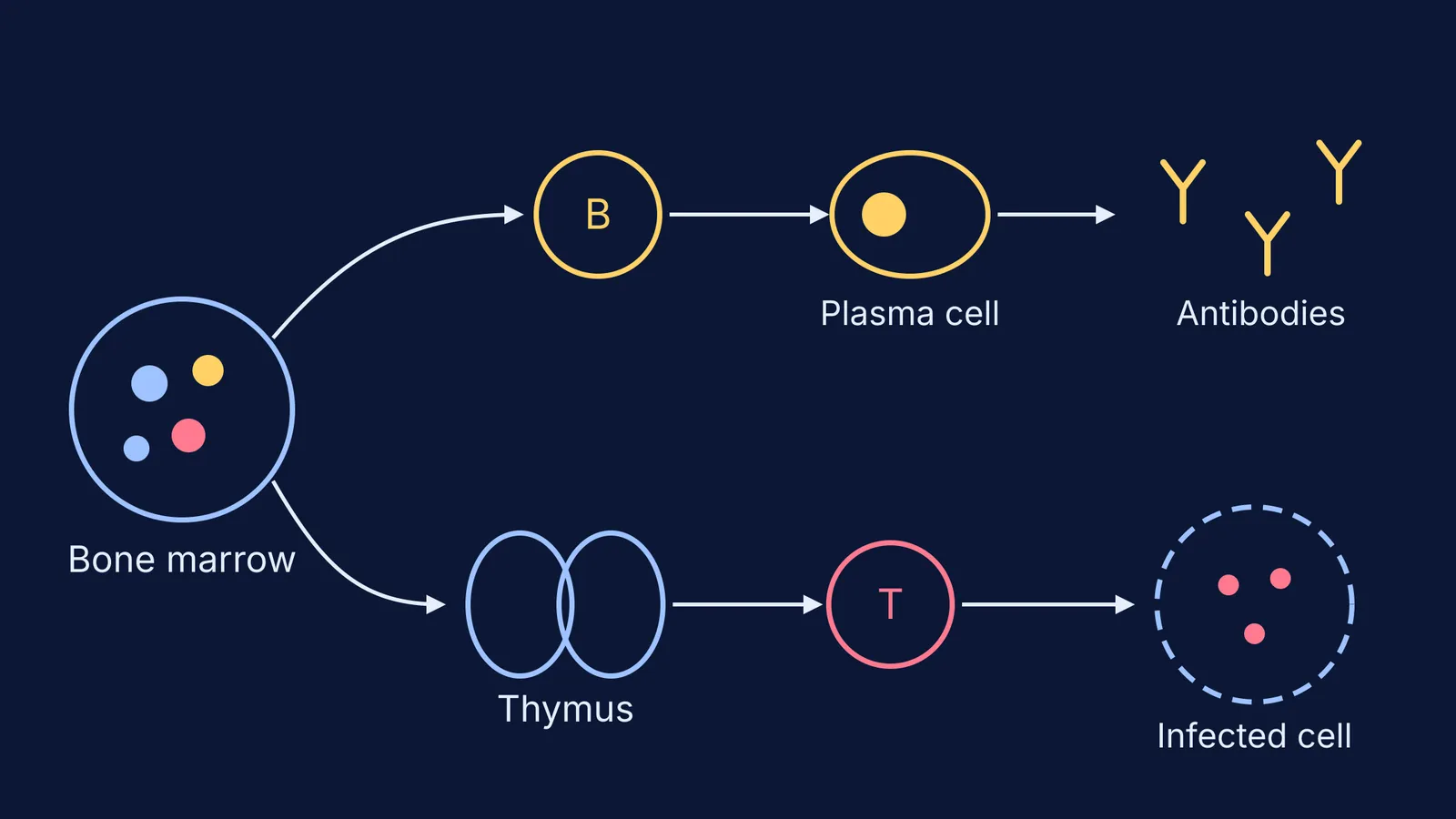
Both start in the bone marrow. They part ways when it is time to mature.
B cells develop in the bone marrow (and the liver in the fetus), and new B cells keep coming from the marrow even in adults (Immunobiology, Generation of lymphocytes in bone marrow and thymus).
T cells come from a lymphoid progenitor in the bone marrow, but the cells destined to become T cells leave and migrate to the thymus to develop (Immunobiology).
NCERT calls the bone marrow and thymus the primary lymphoid organs, where immature lymphocytes become antigen-sensitive; mature lymphocytes then move to secondary lymphoid organs such as the spleen, lymph nodes, tonsils, Peyer's patches and appendix (NCERT Chapter 7).
B cells vs T cells: a side-by-side comparison for NEET
Each line gives the B cell first, then the T cell. Everything here comes from the NCERT chapter and the Immunobiology pages linked above.
Where they mature: bone marrow / thymus, after starting in the bone marrow
Type of immunity: humoral (antibody-mediated) / cell-mediated
Main output: antibodies, secreted by plasma cells / no antibodies; they help B cells and macrophages and kill infected cells
What they recognise: antigen outside the body's cells / peptide fragments held by MHC molecules on a cell surface
Kinds to know: plasma cells and memory B cells / helper (CD4) T cells, cytotoxic (CD8) T cells and memory T cells
To see how these two arms fit into the bigger picture, read our explainer on humoral vs cell-mediated immunity and our guide to the antibody classes IgA, IgM, IgE and IgG.
Which statements about B and T cells are false?
Each of these is false, and each correction is a line from NCERT Chapter 7.
"T cells secrete antibodies." T cells do not secrete antibodies; they help B cells produce them.
"Graft rejection is a humoral response." NCERT says the cell-mediated immune response is responsible for graft rejection.
"HIV mainly destroys B cells." HIV enters helper T-lymphocytes, replicates, and causes a progressive decrease in their number.
"An antibody has two peptide chains." It has four: two light and two heavy, so it is written H2L2.
"The spleen is a primary lymphoid organ." The spleen, lymph nodes and tonsils are secondary; the bone marrow and thymus are primary.
Memory B and T cells also matter for vaccination: NCERT says vaccines generate memory B and T cells that recognise the pathogen quickly on later exposure. Our post on active vs passive immunity takes that thread further.
How can you revise B and T cells in one sitting?
Read NCERT sections 7.2.2 (Acquired Immunity) and 7.2.7 (Immune System in the Body) once, slowly.
Close the book and draw two lanes from memory: bone marrow to B cell to plasma cell to antibodies, and bone marrow to thymus to T cell to infected cell.
Write the comparison list from memory, then check it.
Say aloud why each of the five statements is wrong.
If a term such as MHC or plasma cell stops you, the Fermi Concept Library gives every concept in biology its own lesson and its place in the map. If you are not sure where to start in immunity, Fermi's AI tutor can work out what you already know and build a plan for the session.
In the next mock test, pick out every immunity question and check which lane of the drawing it belongs to.


