On this page
In Class 11 you learn that breathing in starts when the diaphragm contracts and flattens, so it is natural to assume every animal with lungs works that way. It doesn't, which makes this a good test of whether you understand the mechanism. A 2013 review by Hirasawa and Kuratani in the Journal of Anatomy calls the diaphragm a 'uniquely mammalian structure' and notes the lack of a comparable structure in other living animals.
Do birds and reptiles have a diaphragm?
Not a true diaphragm like yours. Every animal with lungs has to change the pressure around its lungs so that air flows in. Mammals use a dome of muscle between chest and belly; other groups use a different part of the body as the pump.
Elizabeth Brainerd and Tomasz Owerkowicz traced this history in a 2006 review in Respiratory Physiology and Neurobiology. In early land vertebrates the throat did the pumping. Trunk muscles then took over breathing out, at the base of the tetrapods, and breathing in too, at the base of the amniotes (reptiles, birds and mammals). The same review lists extra breathing muscles in mammals, crocodylians and turtles among the solutions it describes.
How do frogs, lizards, crocodiles and birds breathe without a diaphragm?
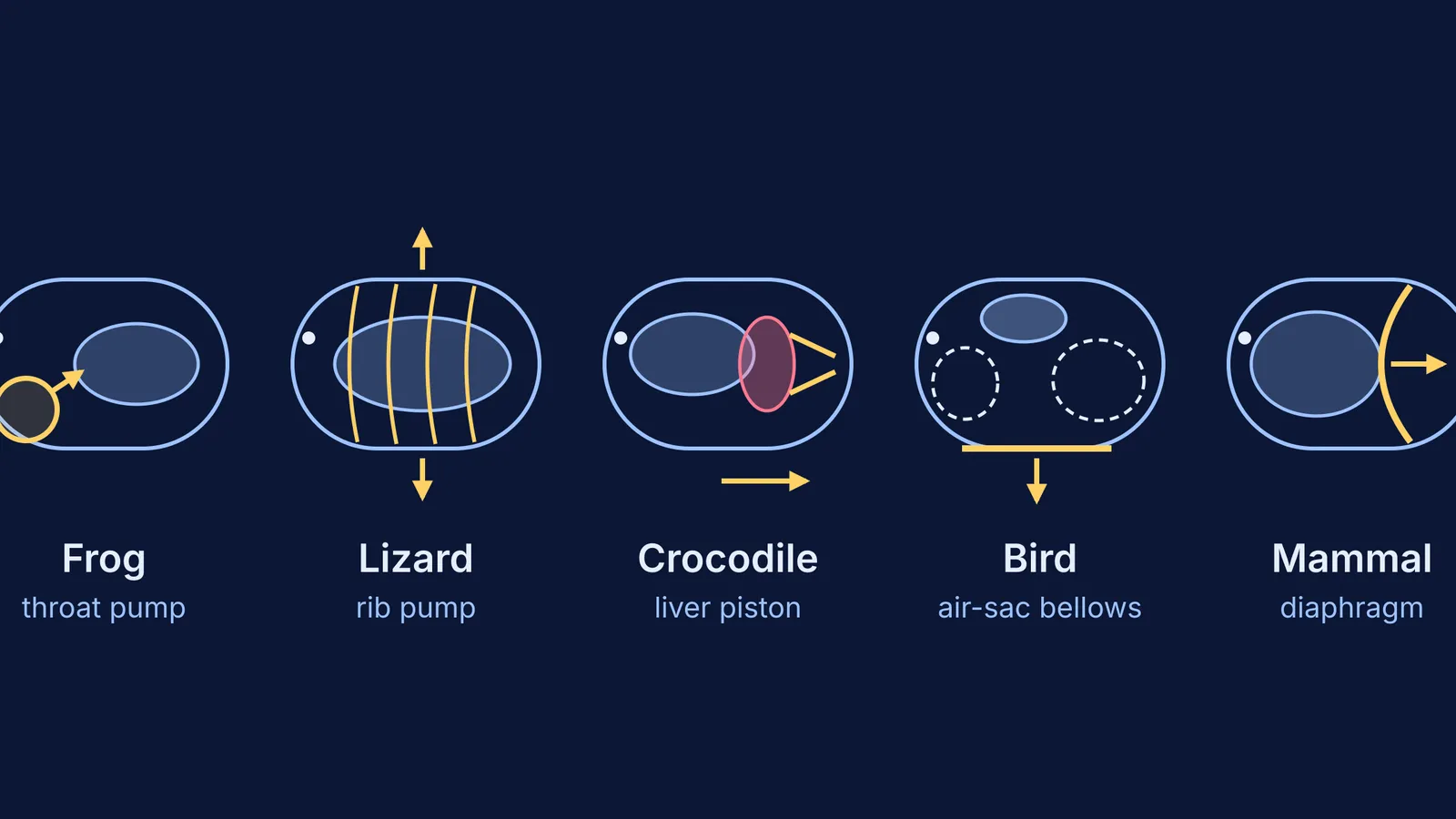
Frog (amphibian): throat pump. With the mouth and glottis closed, the floor of the mouth drops and air enters through the nostrils. Then the nostrils close, the glottis opens and the throat rises, pressing air into the lungs, as described in a review in Biological Reviews.
Lizard (reptile): rib pump. Rib muscles expand the trunk and suck air in. Many lizards also pump air in with the throat: the 2006 survey saw this gular (throat) pumping in 32 of the 40 lizards studied.
Crocodile (reptile): ribs plus a liver piston. A muscle called the diaphragmaticus runs from the pelvis to the liver. When it contracts, it pulls the liver backwards, pressure around the lungs falls and the lungs inflate, according to a 2023 study of the American alligator in PeerJ.
Bird: ribs and breastbone working air sacs. X-ray films of emus, tinamous and guinea fowl show the ribs swinging forward and pushing the breastbone down; pressure differences between front and back air sacs drive air through the lungs (Claessens, Journal of Experimental Zoology).
Mammal: diaphragm. A muscular wall separating the chest cavity from the abdominal cavity, which can actively control how far the lungs inflate (Klein and Owerkowicz 2006).
In a 2012 study of young estuarine crocodiles, cutting the diaphragmaticus made only a limited difference at rest; it mattered mainly for drawing air in faster after exercise.
If you want to follow air through a bird's lungs breath by breath, read our explainer on why bird lungs move air one way. For the rest of the frog's biology, see how frogs live a dual life.
Why did only mammals evolve a diaphragm?
Hirasawa and Kuratani point out that the diaphragm and the forelimb muscles develop from a shared population of cells. Their 2013 review proposes that the diaphragm began as a muscle on the inner side of the shoulder girdle, and was gained in two steps: first in the stem synapsids (the early ancestors of mammals), then reshaped in the cynodonts. They present this as a hypothesis, not a settled fact.
Why is a muscular wall useful? Klein and Owerkowicz explain that a wall between chest and belly stops the gut sliding forward onto the lungs during a breath in, and a muscular one can also control how far the lungs inflate. Some lizards have non-muscular sheets (septa) that also matter for breathing in.
How should you answer this in an exam?
When a question names an animal and asks how it breathes:
Is it a mammal? Only then write 'diaphragm'.
Name the pump: throat (frog), ribs (lizard), ribs plus liver piston (crocodile), ribs and breastbone with air sacs (bird).
Say which way the pressure changes: lower pressure around the lungs pulls air in; the frog instead pushes air in with positive pressure from the throat.
Add one distinguishing detail, such as the closed nostrils in the frog or the air sacs in the bird.
Worked example (3 marks): 'How does a frog fill its lungs without a diaphragm?'
Model answer: A frog uses a buccal (throat) pump. With the mouth closed, it lowers the floor of the mouth so air enters through the nostrils. It then closes the nostrils and raises the floor of the mouth, forcing air through the glottis into the lungs.
To see breathing next to circulation and gas exchange, the Fermi Concept Library gives every biology concept its own lesson and its place in the map. For practice, the Fermi Problem Library has worked problems with a step-by-step solver that explains the reasoning rather than printing an answer.
Next, revise the human side of the chapter with our Breathing and Exchange of Gases Class 11 notes.