

On this page
Your lungs fill and empty through the same tubes, so every fresh breath mixes with stale air left from the last one. A bird does something stranger: the air it breathes in takes two full breaths to pass through, and it crosses the lung in one direction only.
How does air move through a bird's lungs over two breaths?
A bird has a small, stiff lung plus thin-walled air sacs in front of and behind it. A 2013 study of Nile crocodile lungs summed up the bird's air sacs as "ventilatory bellows and storage reservoirs" (PeerJ, 2013): the sacs pump, the lung exchanges gas.
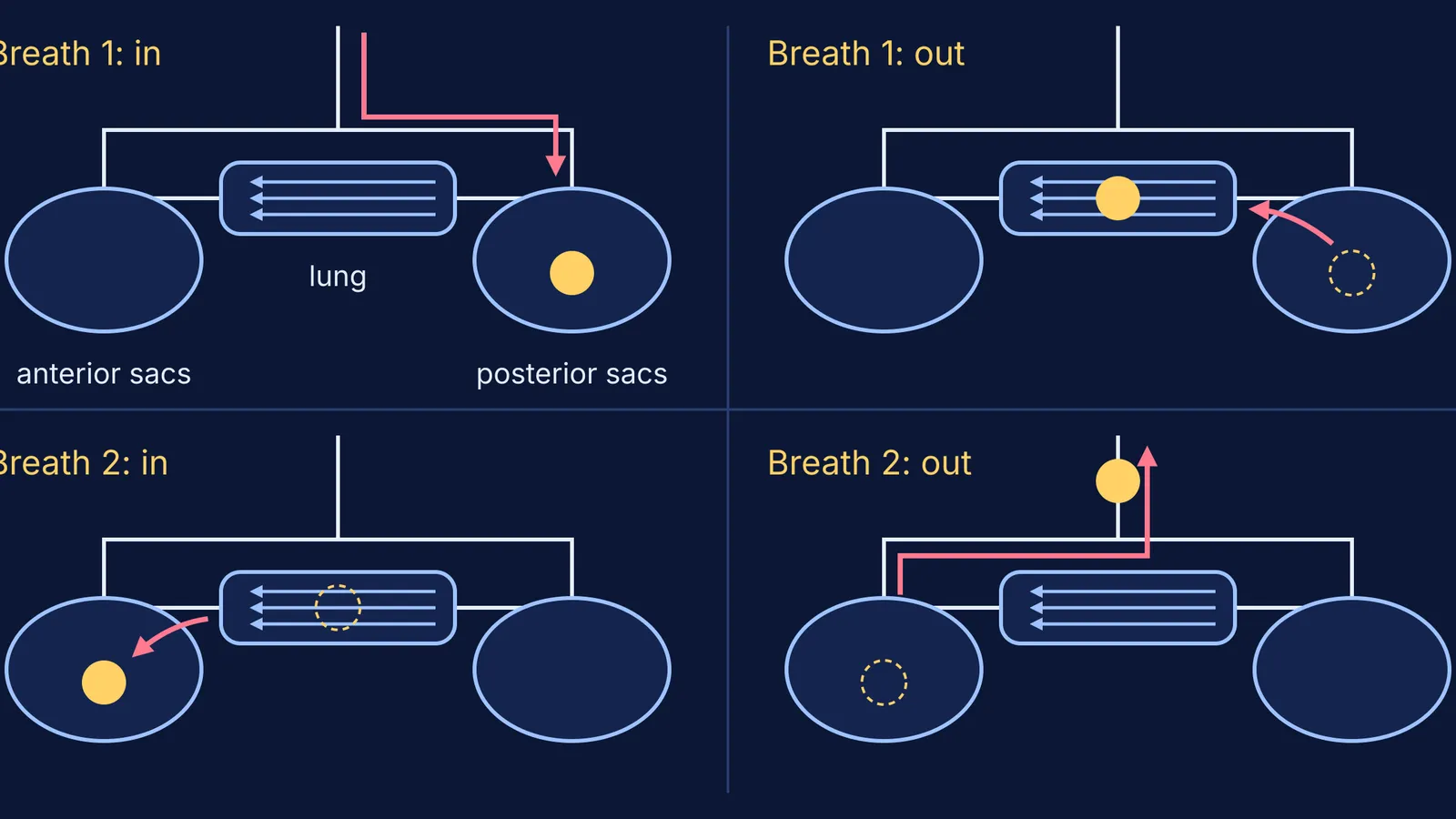
William Bretz and Knut Schmidt-Nielsen gave ducks one breath containing argon as a marker and tracked it through the air sacs with a mass spectrometer (Journal of Experimental Biology, 1972). They proposed that the breath takes four steps:
Breath 1, inhale: down the trachea into the posterior (rear) air sacs.
Breath 1, exhale: the rear sacs squeeze it forward through the lung's fine tubes, the parabronchi.
Breath 2, inhale: it moves from the lung into the anterior (front) air sacs.
Breath 2, exhale: the front sacs empty it out through the trachea.
In steps 2 and 3 the lung gets air whether the bird breathes out or in. The same pair had earlier found that flow in the tertiary bronchi, the older name for parabronchi, "appeared to be in the same direction during both inspiration and expiration" (Bretz and Schmidt-Nielsen, 1971).
What keeps the air flowing one way?
Not flaps. No mechanical valves have been found; the branching angles of the bronchi steer the air, acting as aerodynamic valves (PeerJ, 2013). Colleen Farmer and Kent Sanders found one-way airflow in alligator lungs too, which suggests the pattern goes back to early archosaurs, before the crocodile and bird lines split (Science, 2010). It is not only a trick for flight.
Why are bird lungs more efficient than human lungs?
John West and colleagues compared the two designs in a 2007 review (European Respiratory Journal, 2007). Their abstract makes three points:
Birds ventilate the lung in a flow-through pattern and mammals in and out, so mammals end up with lower oxygen pressure in the alveoli and arteries.
Mammals' large terminal air spaces leave their lung capillaries poorly supported, while bird lung capillaries have "much thinner and more uniform walls".
Birds use cross-current gas exchange and separate pumping from gas exchange.
Johannes Piiper and Peter Scheid classed bird lungs as a cross-current system and mammal lungs as a ventilated pool (Respiration Physiology, 197590061-4)). In a cross-current lung, capillaries cross the parabronchus all along its length, so the moving air keeps meeting new blood; in ours, all the blood meets the same mixed alveolar air. The honest catch: they found the efficiency animals actually reach differs much less than the theoretical maximums do.
Bar-headed geese that winter in India show what the design supports: they can cross the Himalaya in a single day, typically climbing 4,000 to 6,000 m in 7 to 8 hours (PNAS, 2011). That study measured flight, not lungs.
How do you draw and explain it in an exam?
A quick sketch earns marks when a question compares bird and human breathing:
Draw the lung as a box in the middle, rear sacs on one side, front sacs on the other, trachea above.
Draw arrows inside the lung all pointing one way, from rear to front.
Number the four steps from the duck tracer study: rear sacs, lung, front sacs, out.
Write one line beneath: sacs pump, lung exchanges, flow is one-way.
Three mistakes to avoid:
Saying gas exchange happens in the air sacs. It happens in the lung.
Giving the bird lung alveoli. It has parabronchi.
Drawing the airflow in the parabronchi reversing on exhale. It does not.
A model answer for "Why is the bird lung more efficient?": "Air flows one way through the parabronchi during both inhalation and exhalation, so the lung keeps receiving fresh air. Exchange is cross-current, and there are no dead-end air spaces like our alveoli, where each new breath mixes with stale air."
For the human side, our Class 11 notes on breathing and exchange of gases cover alveoli and partial pressures, and our explainer on why tiny alveoli need lung surfactant shows a problem dead-end alveoli create. For the rest of the flight story, read how hummingbirds hover.
If words like parabronchus, partial pressure or diffusion still feel shaky, the Fermi Concept Library has every concept in biology, physics and chemistry, each with its own lesson and its place in the map, so you can fill the gap before the next chapter.
Next time you see a pigeon on a ledge, count two of its breaths: that is how long one gulp of air spends inside it.


