

On this page
Your lungs hold hundreds of millions of tiny air sacs called alveoli. Each one is lined with a thin film of liquid, so each one behaves like a small wet bubble. Bubble physics says a small bubble needs a large pressure to stay open. The lungs avoid this with a coating called surfactant.
How big is an alveolus?
A careful count of adult human lungs by Ochs and colleagues found about 480 million alveoli in a pair of lungs, with a mean volume of about 4.2 × 10⁶ µm³ each (Ochs et al., American Journal of Respiratory and Critical Care Medicine, 2004). If you treat one as a sphere, V = (4/3)πr³ gives r ≈ 100 µm, that is 0.1 mm, and a diameter of about 0.2 mm.
Real alveoli are not spheres. So r = 0.1 mm is a round model value, good for an estimate, not a measurement of any single sac.
Why does an alveolus need 2T/r and not 4T/r?
A soap bubble has two surfaces, the outside of the film and the inside, so its excess pressure is 4T/r. An alveolus has only one liquid–air surface: the liquid lining faces the air inside, and the tissue lies behind it. It is like an air bubble inside a liquid, which has excess pressure 2T/r. The two cases are compared in pressure inside an air bubble under water, so here we only use the result:
ΔP = 2T/r
where T is the surface tension of the lining and r the radius. Using 4T/r would double every number below.
What pressure would plain water need?
The surface tension of a clean air–water surface at body temperature is about 70 mN/m, or 0.070 N/m (Zasadzinski et al., Biochimica et Biophysica Acta, 2010). The same review says lung surfactant can bring the tension down to near zero when the surface is compressed, and that healthy lungs need tensions below about 10 mN/m.
Here is the full worked example.
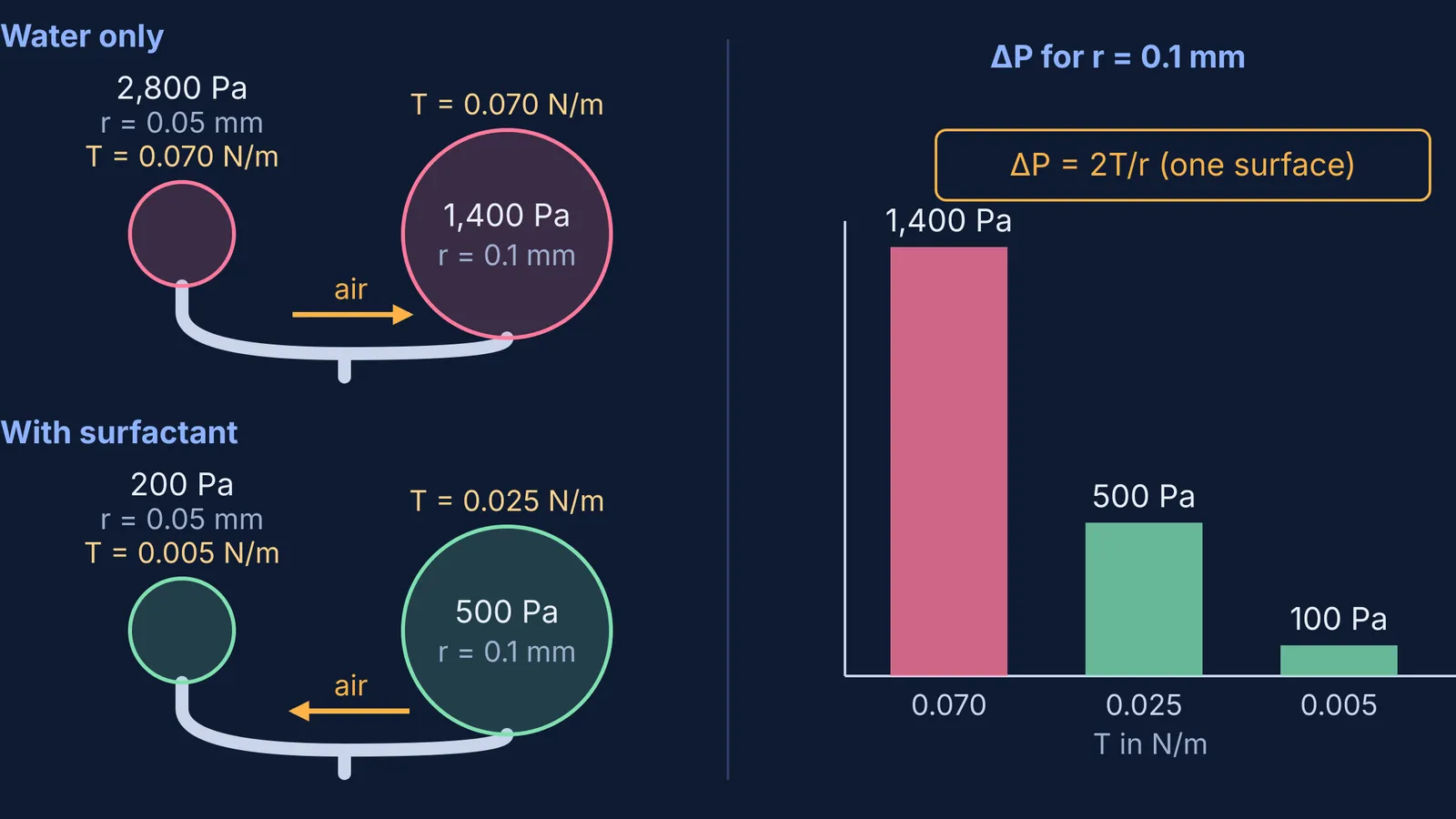
Large alveolus, water only. T = 0.070 N/m, r = 1.0 × 10⁻⁴ m. ΔP = 2 × 0.070 / 1.0 × 10⁻⁴ = 1,400 Pa.
Convert to centimetres of water, the unit used for lung pressures. h = ΔP/ρg = 1,400 / (1,000 × 9.81) = 0.143 m, about 14.3 cm of water.
Small alveolus, water only. r = 0.5 × 10⁻⁴ m. ΔP = 2 × 0.070 / 0.5 × 10⁻⁴ = 2,800 Pa, about 28.5 cm of water. Halve the radius and the pressure doubles.
Large alveolus with surfactant at T = 0.025 N/m. ΔP = 2 × 0.025 / 1.0 × 10⁻⁴ = 500 Pa, about 5.1 cm of water.
Compressed lining at T = 0.005 N/m. ΔP = 2 × 0.005 / 1.0 × 10⁻⁴ = 100 Pa, about 1.0 cm of water.
Check the units: N/m divided by m gives N/m², which is Pa. Note that 1,400 Pa is only about 1.4% of atmospheric pressure, but your breathing muscles must supply it on top of everything else, breath after breath.
The values 0.025 and 0.005 N/m are round illustrative values chosen inside the range the review describes (from about 30 mN/m at equilibrium down to near zero under compression). They are not measurements of one particular lung.
Why would small alveoli empty into big ones?
Two alveoli open into the same small airway, so the air in them is connected. With water only, the small one has 2,800 Pa of excess pressure and the large one 1,400 Pa. Air flows from higher pressure to lower, so the small sac pushes its air into the large one. As it shrinks, r falls and ΔP rises further, so the process runs away until the small sac collapses.
This is exactly the instability of two soap bubbles connected by a tube, where the small bubble always empties into the large one.
How does surfactant stop the collapse?
Surfactant is a mixture of lipids and proteins made by cells in the alveolar wall. It forms a thin layer on the liquid lining. Its key property is that its surface tension is not fixed. When the surface shrinks, the surfactant molecules are packed closer together and the tension falls steeply.
So a smaller alveolus, whose surface has been squeezed, has a lower T as well as a lower r. Take the large sac at T = 0.025 N/m (500 Pa) and the small one compressed to T = 0.005 N/m:
Small alveolus: ΔP = 2 × 0.005 / 0.5 × 10⁻⁴ = 200 Pa.
The small sac now needs less pressure than the large one, so air does not drain out of it. It can even take some air back.
For the two to be exactly balanced, the small sac needs T = ΔP × r / 2 = 500 × 0.5 × 10⁻⁴ / 2 = 0.0125 N/m. Any tension below that keeps it open.
The fall in tension with area is what turns an unstable pair of soap bubbles into a stable set of air sacs.
How good is the Laplace bubble model of the lung?
It is a useful model, not the full story. Physiologists have pointed out that alveoli are not independent balloons on separate stalks. They share walls, so each sac is held open partly by the pull of its neighbours. One well-known critique argues that the spherical Laplace law does not apply to a single alveolus in the way textbooks draw it (Prange, Advances in Physiology Education, 2003). The model still gets the size of the pressures right and explains why low, area-dependent surface tension matters.
If you want to see how T and r trade off before attempting numericals, the Concept Library has the surface tension and excess pressure ideas laid out step by step.
Why do some premature babies struggle to breathe?
Surfactant is made late in pregnancy. A standard medical reference states that it is not produced in adequate amounts until about 34 to 36 weeks of gestation, and that neonatal respiratory distress syndrome is caused by a shortage or inactivation of surfactant (MSD Manual Professional Version). In physics terms, a baby born before enough surfactant is made has a lining closer to plain water. Every breath must work against much larger 2T/r pressures, and the smallest sacs tend to collapse.
This is a physics explainer, not medical advice. How premature babies are cared for, including any breathing support or surfactant treatment, is decided by doctors in hospital. Breathing machines for infants appear in the story of Forrest Bird's medical ventilator, which this post does not repeat.
Quick checklist
An alveolus has one liquid–air surface: ΔP = 2T/r.
Model radius about 0.1 mm, from a mean alveolar volume of about 4.2 × 10⁶ µm³.
Water only (T = 0.070 N/m): 1,400 Pa, about 14 cm of water; halve r and it doubles.
Two connected wet sacs with the same T are unstable: the small one empties into the large one.
Surfactant lowers T and makes it fall as the surface shrinks, so small alveoli stay open.
Convert with h = ΔP/ρg, and check that N/m ÷ m gives Pa.


