

On this page
When the polio epidemics of the early twentieth century swept the world, the primary treatment for respiratory failure was the iron lung. These massive machines encased the patient's entire body, using negative pressure to pull air into the lungs. While effective, they left patients immobile and dependent on electrical apparatus that was difficult to maintain.
In 1957, a former World War II pilot named Forrest Bird changed respiratory medicine forever. Adapting the technology he used to build high-altitude oxygen regulators, Bird invented the Mark 7 respirator. It was a compact, pneumatically powered device that delivered air directly into the airways, helping phase out the iron lung.
How did aviation lead to the medical ventilator?
Forrest Bird's background was in aeronautics, not medicine. During World War II, he served in the US Army Air Corps, studying how pilots breathed at high altitudes in unpressurized aircraft. He developed anti-G suits and pressure-breathing masks designed to keep pilots conscious during extreme maneuvers.
Bird realised that human lungs could be treated as "rudimentary airfoils," subject to the laws of fluid dynamics. He adapted a pressure-breathing circuit from a captured German bomber and built his first medical ventilator prototype in 1947. This early device was cobbled together using strawberry shortcake tins and a hardware store doorknob (source).
Understanding air flow under pressure is a classic physics problem. If you are studying fluid dynamics and find the equations hard to picture, the Fermi Simulation Lab provides interactive simulations for the ideas that are easier to see than to read.
What made the Bird Mark 7 respirator different?
Released commercially in 1957, the Bird Universal Medical Respirator—widely known as the Mark 7—was radically different from the iron lung.
Positive pressure: Instead of creating a vacuum around the chest, the Mark 7 pushed oxygen directly into the lungs (positive pressure).
No electricity needed: Driven solely by compressed gas, it could be used safely in ambulances and helicopters without relying on electrical power (source).
Transparent design: Housed in a transparent plastic case, medical staff could easily see the internal magnetic valves moving, making the mechanics easier to understand.
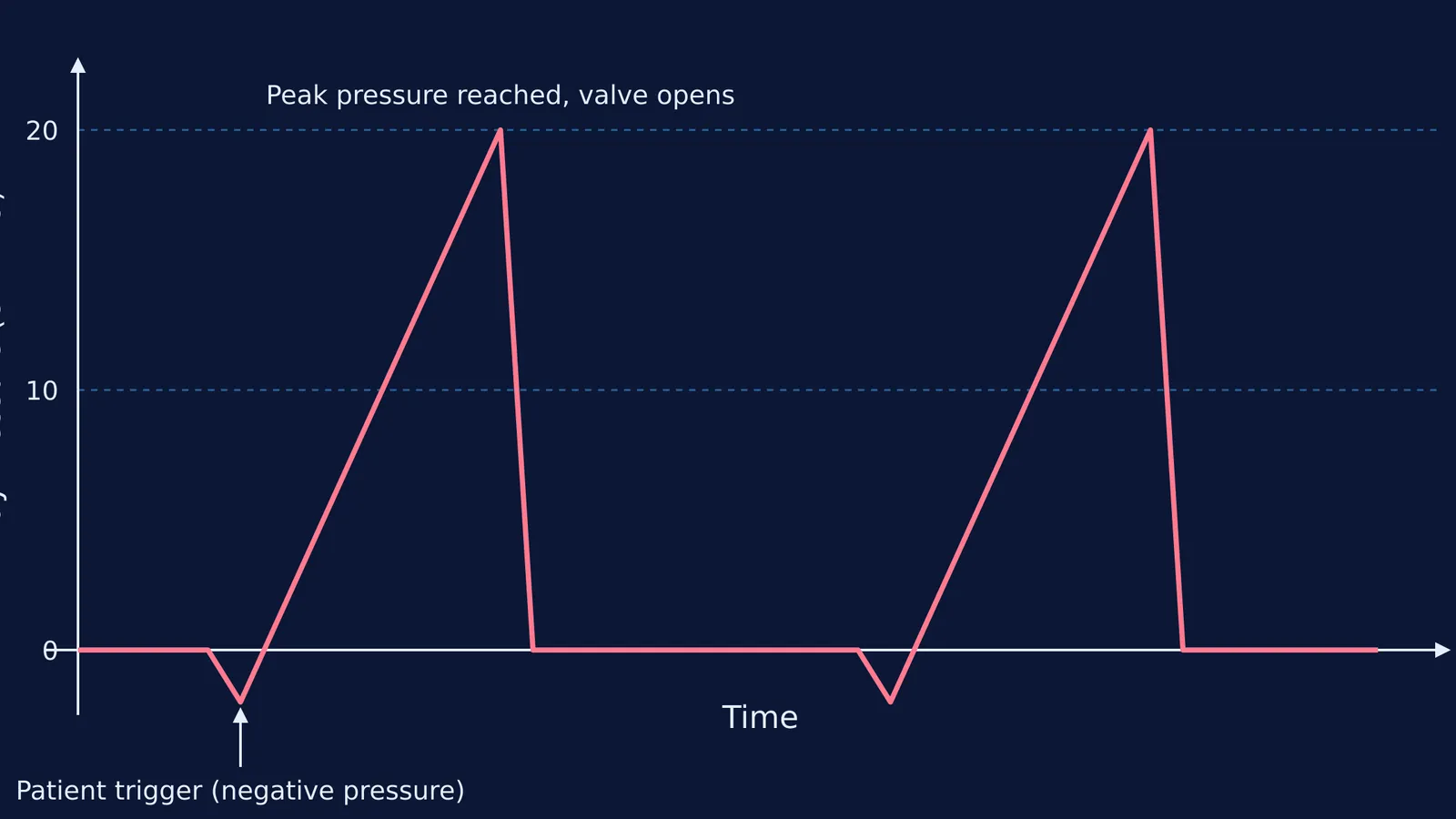
The device was pressure-cycled, delivering a breath until airway pressure reached a preset limit—typically between 5 and 60 cm H₂O (source). At that point, the valve flipped to allow exhalation. Crucially, the Mark 7 was sensitive enough to detect when a patient tried to take a breath. This negative-pressure "trigger" allowed the machine to assist natural breathing, helping doctors slowly wean patients off mechanical support.
How did the Babybird respirator save infants?
While the Mark 7 transformed adult care, premature infants with underdeveloped lungs faced respiratory distress syndrome. Their fragile airways and tiny lung volumes could not handle the high flow rates generated by adult machines.
In 1971, Bird introduced the Babybird respirator, a time-cycled intermittent ventilator designed specifically for the delicate physiology of infants (source). Before its adoption, the mortality rate for these infants was devastatingly high. The Babybird is credited with reducing this infant mortality rate from 70% to less than 10% (source).
Breakthroughs like the Babybird require linking the physics of pressure with the biology of human tissue. If you get stuck connecting these overlapping fields, Fermi's AI tutor can help. The tutor works out what you already know, builds a plan for the session, and teaches through it—writing on a board, drawing the figure, running the simulation, and checking understanding as it goes.
How does thinking across disciplines drive invention?
Forrest Bird died in 2015 at age 94, holding over 200 patents. He was inducted into the National Inventors Hall of Fame in 1995 and received the National Medal of Technology and Innovation in 2009 (source).
If you want to solve difficult problems, look outside your subject. Whether you are modelling converting PV, PT and VT graphs or exploring how respiration acts as an amphibolic pathway, physics and biology share a mathematical foundation. Learn the principles deeply in one field, and you might build the tool that revolutionises another.


