

On this page
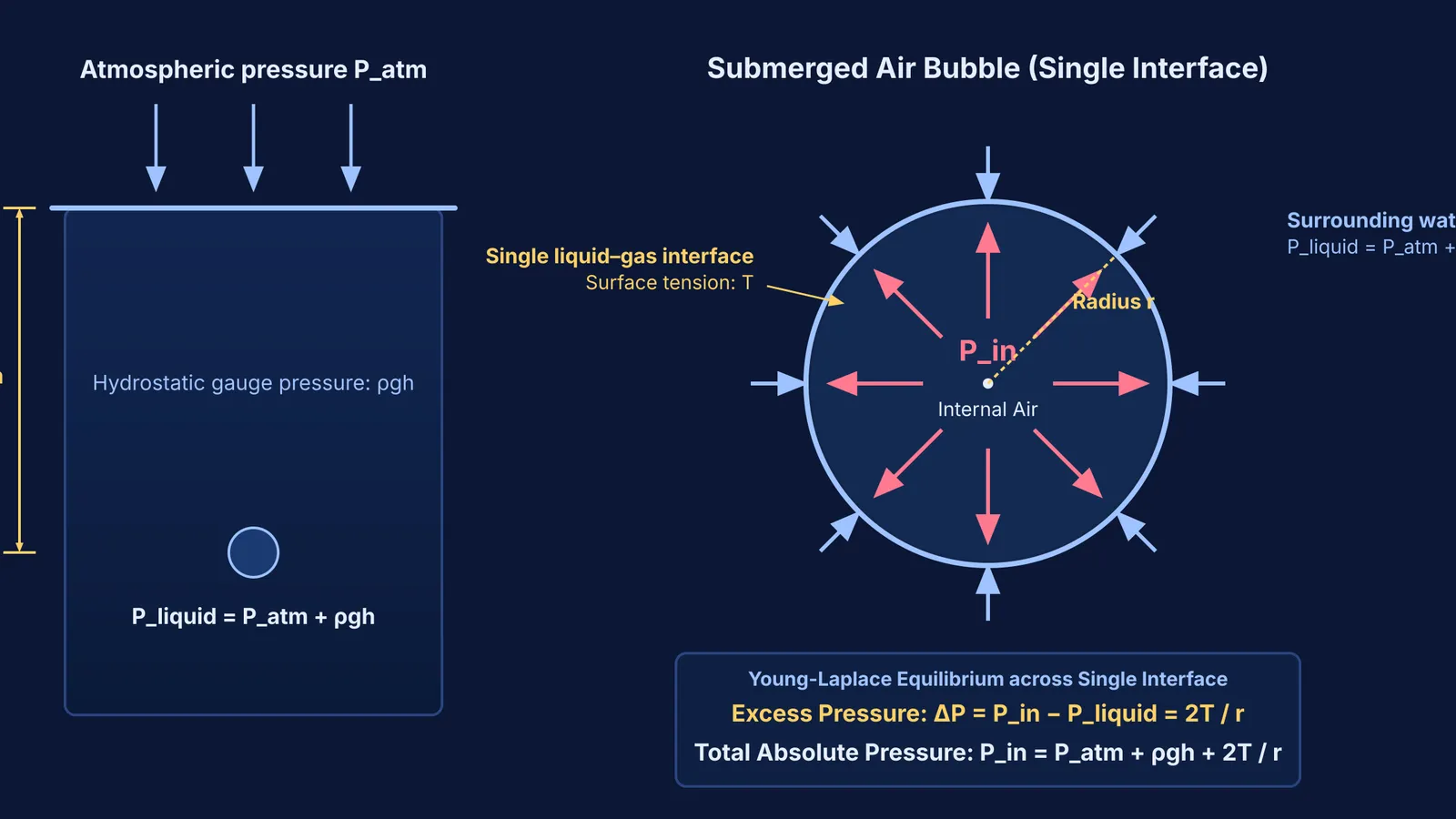
When an air bubble rests beneath the surface of water, three physical factors determine the pressure of the air trapped inside it. First, the atmosphere presses down on the open water surface. According to the CODATA fundamental physical constants recommended by NIST, standard sea-level atmospheric pressure is exactly 101,325 Pa.
Second, the water column above the bubble exerts hydrostatic pressure. As described in the NCERT Class 11 Physics textbook, this contribution equals ρgh, where ρ is the density of water (1,000 kg/m³ for pure freshwater), g is acceleration due to gravity (approximately 9.8 m/s²), and h is depth in metres. The liquid surrounding the bubble is therefore under external pressure P_liquid = P_atm + ρgh.
Third, surface tension pulls along the curved boundary between gas and liquid, contracting the interface to minimize surface area. In 1805, Thomas Young's foundational analysis of fluid cohesion established that curved liquid interfaces support a pressure jump proportional to interfacial tension and curvature. In mechanical equilibrium, the trapped gas pushes outward with excess pressure ΔP = P_in − P_liquid. Combining all three contributions yields the complete expression for absolute pressure inside the bubble:
P_in = P_atm + ρgh + 2T/r
Here, T represents the surface tension of the liquid in newtons per metre (N/m), and r is the radius of the bubble in metres (m).
Why does an air bubble in liquid have only one surface?
One of the most persistent sources of confusion in competitive physics exams like JEE Main and NEET is choosing between 2T/r and 4T/r. The factor of 2 versus 4 depends entirely on the count of physical interfaces separating liquid from gas.
As outlined in the NCERT Class 11 Physics syllabus, a soap bubble blown in air is a hollow spherical film of soapy water. It possesses two separate interfaces: an inner surface meeting internal trapped air, and an outer surface meeting room air. Because both liquid surfaces contract under surface tension T, each contributes excess pressure 2T/r. Adding both interfaces yields the familiar soap bubble formula ΔP = 4T/r. You can explore how charges counteract this inward contraction in our guide to electrostatic pressure on conductors and bubbles.
In contrast, an air bubble submerged under water is not a thin liquid film. It is a pocket of gas enclosed within a continuous body of liquid. There is only a single liquid-gas interface where the air touches the water. Because there is no second outer surface, surface tension acts across only one boundary.
According to the international reference tables for the surface tension of water established by Vargaftik, Volkov, and Voljak, pure water at 20 °C has a surface tension of 0.0728 N/m. Because excess pressure 2T/r is inversely proportional to radius, a tiny microbubble with r = 0.1 mm sustains ten times the excess pressure of a larger bubble with r = 1.0 mm.
How do you calculate total pressure at a given depth?
To see how these forces combine in practical problems, consider an air bubble of radius r = 0.5 mm (0.0005 m) submerged at a depth h = 10.0 m beneath the surface of a freshwater lake at 20 °C, referenced to the physical values in Vargaftik's surface tension tables.
You can determine the total internal pressure through four sequential steps:
Determine the hydrostatic gauge pressure of the water column. Using freshwater density of 1,000 kg/m³ and acceleration g = 9.8 m/s² from the NCERT Class 11 Physics textbook, the hydrostatic gauge pressure is P_hydro = ρgh = 1,000 kg/m³ × 9.8 m/s² × 10.0 m = 98,000 Pa.
Determine the external pressure in the surrounding liquid. Using standard atmospheric pressure of 101,325 Pa from the NIST CODATA reference, the external pressure on the outer wall of the bubble is P_liquid = P_atm + ρgh = 101,325 Pa + 98,000 Pa = 199,325 Pa. This hydrostatic transmission in quiescent fluids operates on the exact principles explored in our explainers on Pascal's law in hydraulic machines and pressure columns in manometers.
Compute the Young-Laplace excess pressure across the single interface. Taking T = 0.0728 N/m from Vargaftik's surface tension tables, the excess pressure inside the bubble is ΔP = 2T/r = (2 × 0.0728 N/m) / (0.0005 m) = 291.2 Pa.
Sum all contributions for the final internal pressure. P_in = P_liquid + ΔP = 199,325 Pa + 291.2 Pa = 199,616.2 Pa (approximately 1.996 × 10⁵ Pa).
At a depth of 10.0 m, the hydrostatic head almost doubles atmospheric pressure, while curvature excess pressure adds roughly 291.2 Pa. Although 291.2 Pa is modest for a 0.5 mm bubble, surface tension becomes the dominant term for sub-micrometre microbubbles as r approaches zero.
What mistakes do students make in exam numericals?
Students preparing for competitive examinations frequently encounter fluid surface problems based on the NCERT Class 11 Physics curriculum, yet they lose marks through four predictable errors:
Confusing the bubble medium: Applying 4T/r whenever they see the word bubble. If an air bubble is submerged in liquid—even inside a vat of soapy water—it has only one boundary, so the excess pressure is 2T/r.
Omitting atmospheric pressure: Confusing gauge pressure with absolute pressure. If an exam question asks for the pressure inside the bubble, it requires absolute pressure (including P_atm), unless it explicitly specifies excess pressure or gauge pressure.
Neglecting unit conversions: Radii are routinely given in millimetres or micrometres, and surface tension in mN/m or dyn/cm. Always convert to standard SI units (metres and N/m) before calculating.
Misapplying Boyle's law as a bubble ascends: In ascent problems at constant temperature, students often assume pressure is simply ρgh. As the bubble ascends, h decreases while the bubble expands, reducing both ρgh and 2T/r until internal pressure reaches P_atm + 2T/r_surface.
When practising multi-step fluid mechanics problems, the Fermi Problem Library provides worked problems with a step-by-step solver that explains the reasoning behind each boundary term rather than printing a bare answer. If you find it difficult to connect hydrostatic pressure distributions with surface curvature, the Fermi Concept Library maps every concept in physics and links fluid statics directly to surface energy fundamentals.


