

On this page
A hummingbird at a flower stays almost still in mid-air while its wings blur. Many birds hover only for a moment; hummingbirds can hold one spot for as long as they like. Here is how, and what pays for it.
How do hummingbirds hover?
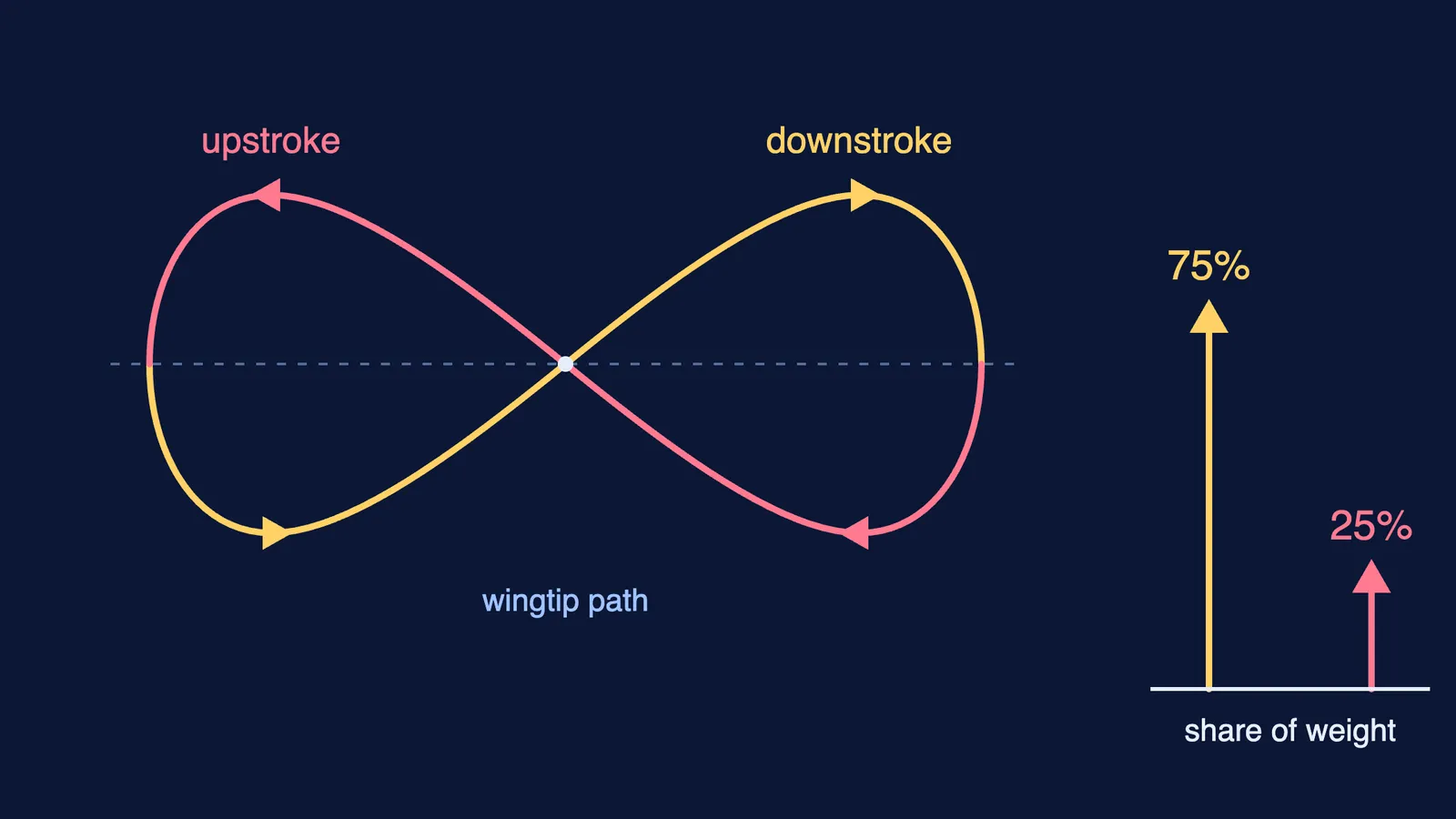
The wings sweep forward and back, not up and down. The Stanford Birds essay on hovering flight by Paul Ehrlich, David Dobkin and Darryl Wheye describes a figure-eight lying on its side, with the body at about 45 degrees to the ground.
The trick is in the shoulder. An extremely mobile shoulder joint rotates the wing so far on the backstroke that it is, in effect, upside down, the essay explains. The front edge leads both ways, so the wing makes lift on the return as well as on the way forward. The essay gives more than 20 wingbeats a second, sometimes as many as 80.
How much lift does the upstroke make?
People long assumed the two strokes shared the work equally, as in insects of similar size. Douglas Warrick, Bret Tobalske and Donald Powers tested this by tracking airflow around hovering rufous hummingbirds with digital particle image velocimetry, a laser method (Nature, 2005).
Hummingbirds support 75% of their weight on the downstroke and 25% on the upstroke; insects support 50% on each, and other birds in slow flight and brief hovering 100% on the downstroke (ScienceDaily report of the study). So the downstroke makes three times the lift of the upstroke. The authors put part of the gap down to the curved wing being upside down on the upstroke.
A 2009 follow-up on seven rufous hummingbirds averaging 3.3 g found that the circulation of air around the wing stays attached as the wing stops and flips, giving "a near-continuous lift production through wing turn-around, previously unknown in vertebrates" (Proceedings of the Royal Society B).
How much power does hovering take?
You can estimate the minimum with the air-momentum method from our post on the power a helicopter needs to hover. By Newton's third law, wings that push air down are pushed up; the same idea explains what a scale reads when a bird flies in a closed cage.
Take the 3.3 g bird from the 2009 study. It measured four wing sections 1 cm apart, from 2 cm out from the wing root to the tip, so the wing is roughly 5 cm long.
Weight: W = 0.0033 kg x 9.8 m/s^2 = 0.032 N.
Area swept, treated as a full disc of radius 0.05 m: A = pi x 0.05^2 = 0.0079 m^2.
Speed of air pushed down, with sea-level air at 1.2 kg/m^3: v = square root of W / (2 x 1.2 x A) = 1.3 m/s.
Ideal power: P = W x v = 0.032 x 1.3 = about 0.042 W, or about 13 W per kilogram of bird.
That is a floor. A real wing sweeps only part of a circle and loses energy to drag and flipping, so the true cost is higher.
Why do hummingbirds need sugar so often?
Small hummingbirds have the highest known mass-specific metabolic rates of any warm-blooded vertebrate, according to a 1992 review by Raul Suarez. Nectar pays for it.
A 1986 Nature study by Jared Diamond and colleagues noted that hummingbirds spend only about 20% of their waking hours feeding and 75% perched. It found that their intestine has the highest active glucose transport rate reported for any vertebrate, and that the time the crop takes to empty may limit how often they can feed.
The sugar is burnt almost at once. In broad-tailed hummingbirds, dietary sugar supported about 74% of hovering metabolism by 20 minutes after the first meal (Welch and colleagues, 2006). In rufous and Anna's hummingbirds feeding often, newly drunk sugar rose over 30 to 45 minutes to supply virtually 100% of the fuel, then cleared over a similar time (Welch and Suarez, 2007). Kenneth Welch's lab notes that people can fuel only as much as 30-35% of exercise this way.
How do you explain hummingbird hovering in an exam?
A five-point answer:
Motion: the wings sweep forward and back in a sideways figure-of-eight, body tilted.
Trick: the shoulder turns the wing upside down on the backstroke, so both strokes make lift.
Number: about 75% of the weight is held on the downstroke and 25% on the upstroke (Nature, 2005), unlike insects at 50% each.
Physics: lift equals the rate at which the wings give downward momentum to the air.
Cost: hovering is expensive, and in birds feeding often it runs almost entirely on sugar drunk in the previous 30 to 45 minutes (Welch and Suarez, 2007).
For ideas that are easier to see than to read, the Fermi Simulation Lab has interactive simulations. If the momentum estimate trips you up, the Fermi Problem Library has worked problems with a step-by-step solver that explains the reasoning rather than printing an answer. Not sure where to start on mechanics? Fermi's AI tutor can work out what you already know and build a plan for the session.


