

On this page
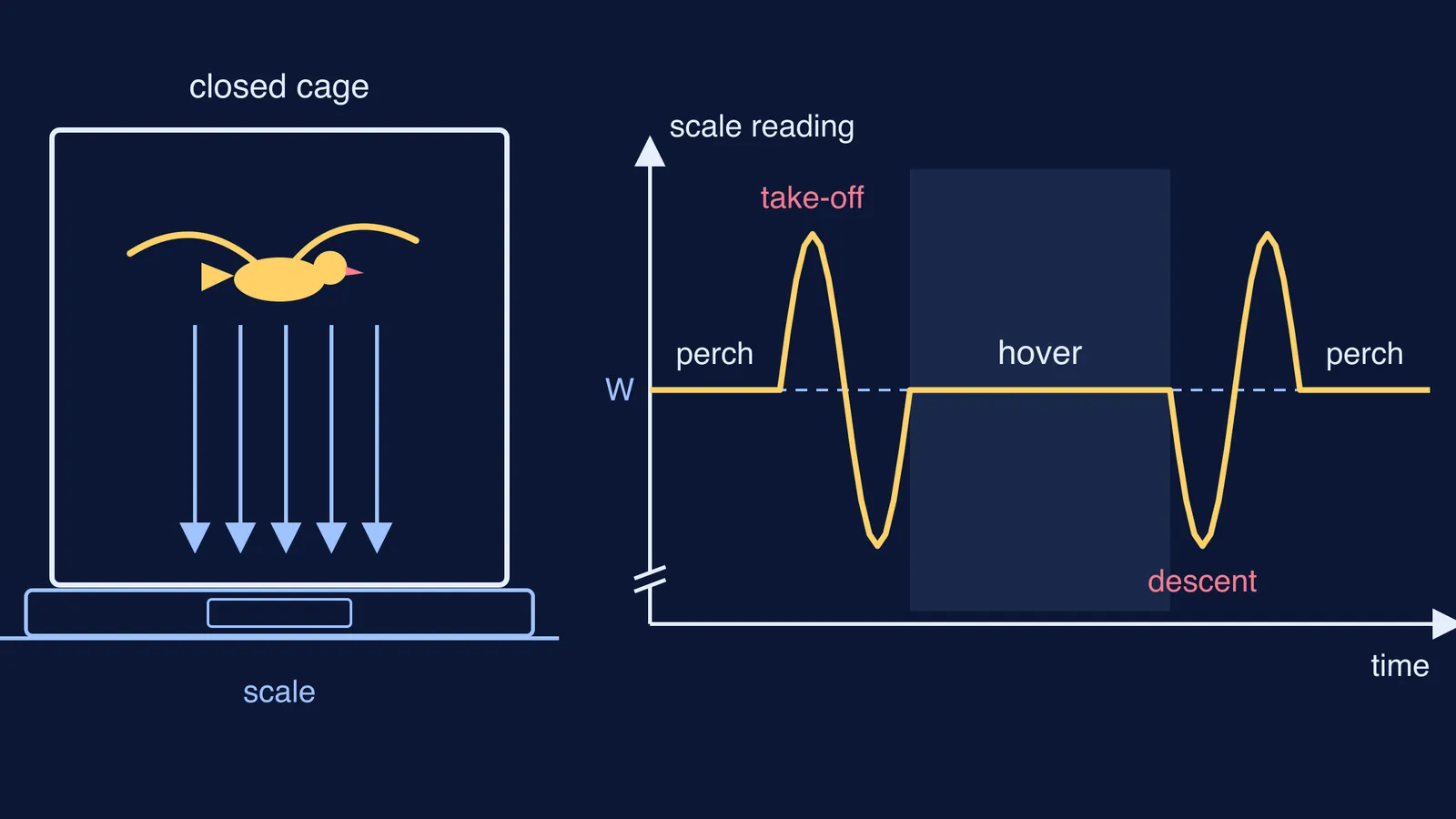
Picture a sealed cage on a weighing scale with a bird perched inside. The bird takes off and hovers. Does the reading drop? On average, no; while the bird speeds up or slows down vertically, yes.
Does a closed cage weigh less when the bird inside flies?
Treat the cage, its air and the bird as one system. Internal forces (wing on air, air on cage) cancel in pairs; only external forces change the motion of the system's centre of mass: the net external force equals the total mass times the acceleration of the centre of mass (OpenStax University Physics, section 9.6).
The external forces are gravity, (M + m)g, and the scale's upward push, N. The cage does not move, and once the bird is hovering the air settles into a steady flow pattern. So the only thing whose acceleration matters is the bird:
N − (M + m)g = ma
Here M is the cage plus its air, m is the bird and a is the bird's vertical acceleration, up positive. A hovering bird has a = 0, so N = (M + m)g: the same reading as when it sat on its perch. Rising or sinking at constant speed also gives a = 0.
How does the bird's weight reach the scale if it isn't touching anything?
Through the air. The bird pushes air down with its wings, and the air pushes the bird up (Newton's third law). That moving air raises the pressure on the cage floor, so in a closed cage the whole push ends up on the cage, and from there on the scale.
Engineers at Stanford built this experiment for real. David Lentink, Andreas Haselsteiner and Rivers Ingersoll enclosed a small quadcopter, and then birds, in an instrumented box that "mechanically integrates the net aerodynamic force that is transferred to the earth", as their abstract puts it (Journal of the Royal Society Interface, 2015).
They trained two Pacific parrotlets, each 28 g with a wingbeat of 20 Hz, to fly between two perches inside the box (full methods in the arXiv preprint). During take-off and landing, the downstroke produced a vertical force of up to twice the bird's body weight, while the upstroke supported little of it (same preprint).
The parrotlets were making short hops, not hovering, but the same physics applies to a hovering bird. A sensitive scale flickers within each wingbeat: up on the downstroke, down on the upstroke, because the bird's body briefly accelerates up and then down. Averaged over whole wingbeats of steady hovering, the reading comes back to cage plus bird.
What happens when the bird takes off or lands?
Take a cage plus air of M = 1.500 kg (our choice) and a bird of m = 0.028 kg, the parrotlet mass from the Stanford study. With g = 9.8 m/s², the total weight is 1.528 × 9.8 = 14.97 N.
Perched: a = 0, so the reading is 14.97 N.
Lifting off, speeding up at 2 m/s² upward: 14.97 + 0.028 × 2 = 15.03 N.
Still rising but slowing into a hover, so a = 2 m/s² downward: 14.97 − 0.056 = 14.92 N.
Hovering: 14.97 N.
Gliding down at constant speed: 14.97 N.
Braking just before landing, so a points up: above 14.97 N again.
The change in step 2 is 0.056 N, the weight of about 6 g: a kitchen scale might just catch it. In the extreme case of a bird dropping with folded wings (a = g downward), the bird's term becomes −mg, and once the air it pushed earlier has settled, the scale shows the cage alone.
What changes if the cage is made of wire mesh?
Then it is not a closed system. Air the bird drives downward can pass through the bars and strike the room's floor instead of the cage floor, so the scale can read less than cage plus bird while the bird hovers. This is why exam questions say "closed" or "sealed": that word decides the answer.
How do you answer this in a JEE or board exam?
Draw the system boundary around the cage, the air and the bird.
List external forces only: (M + m)g down and N up.
Ask what is accelerating. Usually only the bird: look for "accelerates", "starts to rise" or "slows down".
Write N = (M + m)g + ma, with up as positive.
Sanity-check: a = 0 must give the perched reading, and a = g downward must give the cage alone.
Related reading: how a scale reading changes in an accelerating lift, four checks for identifying action-reaction pairs and checking Atwood machine answers with centre of mass.
If you keep picking the wrong system or flipping the sign of a, the Fermi Problem Library has worked problems with a step-by-step solver that explains the reasoning rather than printing an answer. If the gap is centre of mass itself, start with its lesson in the Fermi Concept Library.


