On this page
You have probably heard it on a school playground: cut an earthworm in half and you get two worms. The research says no. At best you get one worm, and which piece it is depends on where the cut falls.
Do both halves of a cut earthworm live?
Not as a rule. The clearest data come from the red wriggler, *Eisenia fetida*. In 2011, Nengwen Xiao, Feng Ge and Clive Edwards compared how well this worm regenerates depending on where along the body it is cut (Xiao et al., Acta Ecologica Sinica, 2011).
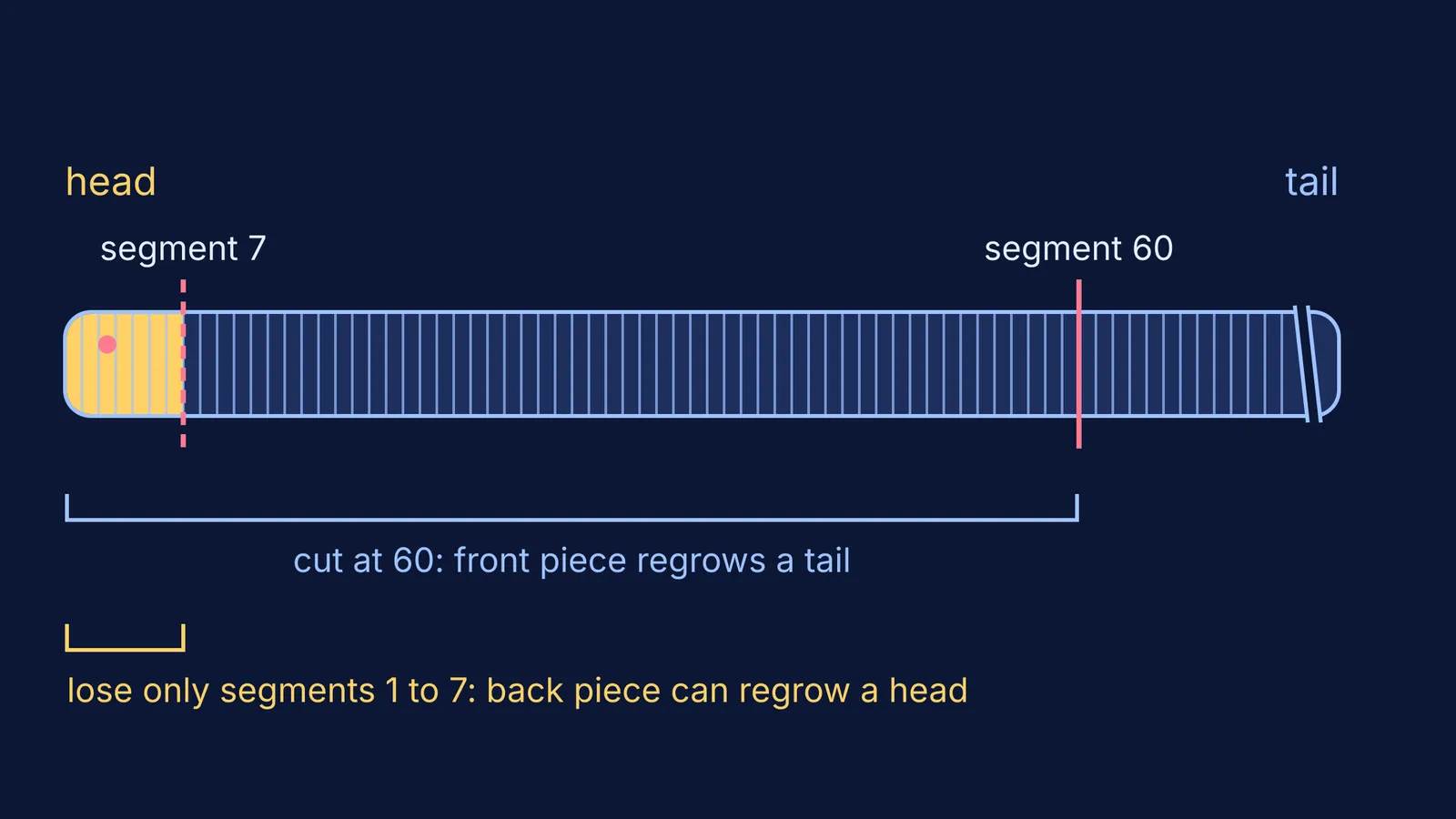
A later paper summarises their key result: the tail piece could survive and regrow a head only when the loss was restricted to the first 7 segments (Bhambri et al., PLOS ONE, 2018).
The front piece is far better at recovering. The same 2018 paper, which worked with an Indian isolate of *Eisenia fetida*, describes the species as capable of regenerating more than two-thirds of its body. In that study, worms were cut at about segment 60 and the front piece regrew the missing rear, with the team sampling the new tissue at 15, 20 and 30 days after the cut (Bhambri et al., 2018).
Why does the head end have better odds?
A likely reason is that the first few segments hold the parts a worm needs to feed and coordinate. The first segment, the peristomium, contains the mouth, and the earthworm brain is a fused pair of nerve ganglia mostly located in the third segment (WormWatch anatomy guide).
A rear piece starts with no mouth and no brain, so it has to build both before it can feed. A front piece keeps its mouth and brain and only has to add segments behind them. For a refresher on what each part of the body does, see our guide to earthworm segments, setae and the clitellum.
A wider pattern across segmented worms points the same way. Eduardo Zattara and Alexandra Bely compiled regeneration data for 401 annelid species and concluded that anterior and posterior regeneration were present in the common ancestor but were lost 18 and 5 times respectively, and never regained (Zattara and Bely, Invertebrate Biology, 2016). In other words, the ability to regrow a head has been lost more than three times as often as the ability to regrow a tail.
How is Planaria different from an earthworm?
Planarians are flatworms, not segmented worms, and for them the playground story is close to true. In 1898, Thomas Hunt Morgan reported that a fragment 1/279th the size of the original planarian was enough to produce a complete animal (Sánchez Alvarado, BMC Biology, 2012).
The difference is a cell type. Neoblasts are pluripotent somatic stem cells spread broadly across the planarian body, according to the same review. Because they sit almost everywhere, a small piece still carries cells that can rebuild a head, a tail or both.
An earthworm rebuilds lost segments at the wound over several weeks, and how much it can rebuild depends on where the cut falls. To compare more animals, read how axolotls regrow limbs, and how Hydra and Planaria differ, and why a starfish needs its central disc to regrow arms.
How can you check a biology myth like this yourself?
Ask four questions of any claim about regeneration:
Which species? "Earthworm" covers many species. Bhambri and colleagues note that *Eisenia fetida* regenerates strongly while *Paranais litoralis*, which they describe as closely related, seems to have lost the ability.
Where was the cut? For *Eisenia fetida*, the back piece regrew a head only when no more than the first 7 segments were lost, while the front piece of a worm cut near segment 60 regrew its tail.
What does "live" mean? A piece that moves for a while has not survived. The studies above followed regrowth for weeks.
Who measured it? A confident sentence is not data. A BBC Science Focus answer states that the common earthworm "will only regenerate from the tail end; the head end always dies". That answer is about a different species, *Lumbricus terrestris*, and runs opposite to the *Eisenia fetida* results above.
Now try an assertion-reason question.
Assertion: Both halves of a cut earthworm grow into complete new worms.
Reason: An earthworm's mouth is in its first segment and its brain mostly in the third.
The assertion is false and the reason is true. The assertion fails because a tail piece of *Eisenia fetida* regrows a head only after a very short loss from the front. The reason is true but does not explain the assertion; if anything, it helps explain why a back piece struggles.
If regeneration, segmentation or stem cells feel shaky, the Fermi Concept Library has a lesson for every concept in biology, each with its place in the map, so you can see how related ideas connect. Fermi's AI tutor can also ask you questions like the one above and check your understanding as it goes.
Next time someone repeats the playground myth, ask them which end, which species, and where the cut was.