On this page
A crocodile spends much of its life in rivers and swamps, and the San Diego Zoo notes that crocs can hold their breath underwater for more than an hour. So it is natural to guess "amphibian". The guess is wrong, and the reason is a habit worth building for every biology chapter: classify by features, not by address.
Why is a crocodile not an amphibian if it lives in water?
The word "amphibian" loosely translates from the Greek as "dual life", a reference to the metamorphosis that many frogs and salamanders undergo, according to the OpenStax Biology 2e chapter on amphibians.
So the "dual life" is about two body forms in one lifetime, not about swimming in the morning and sunbathing in the afternoon. A frog starts as a tadpole with gills and a tail; during metamorphosis the gills and tail disappear, four limbs develop, and air-breathing lungs form, as the same OpenStax chapter describes.
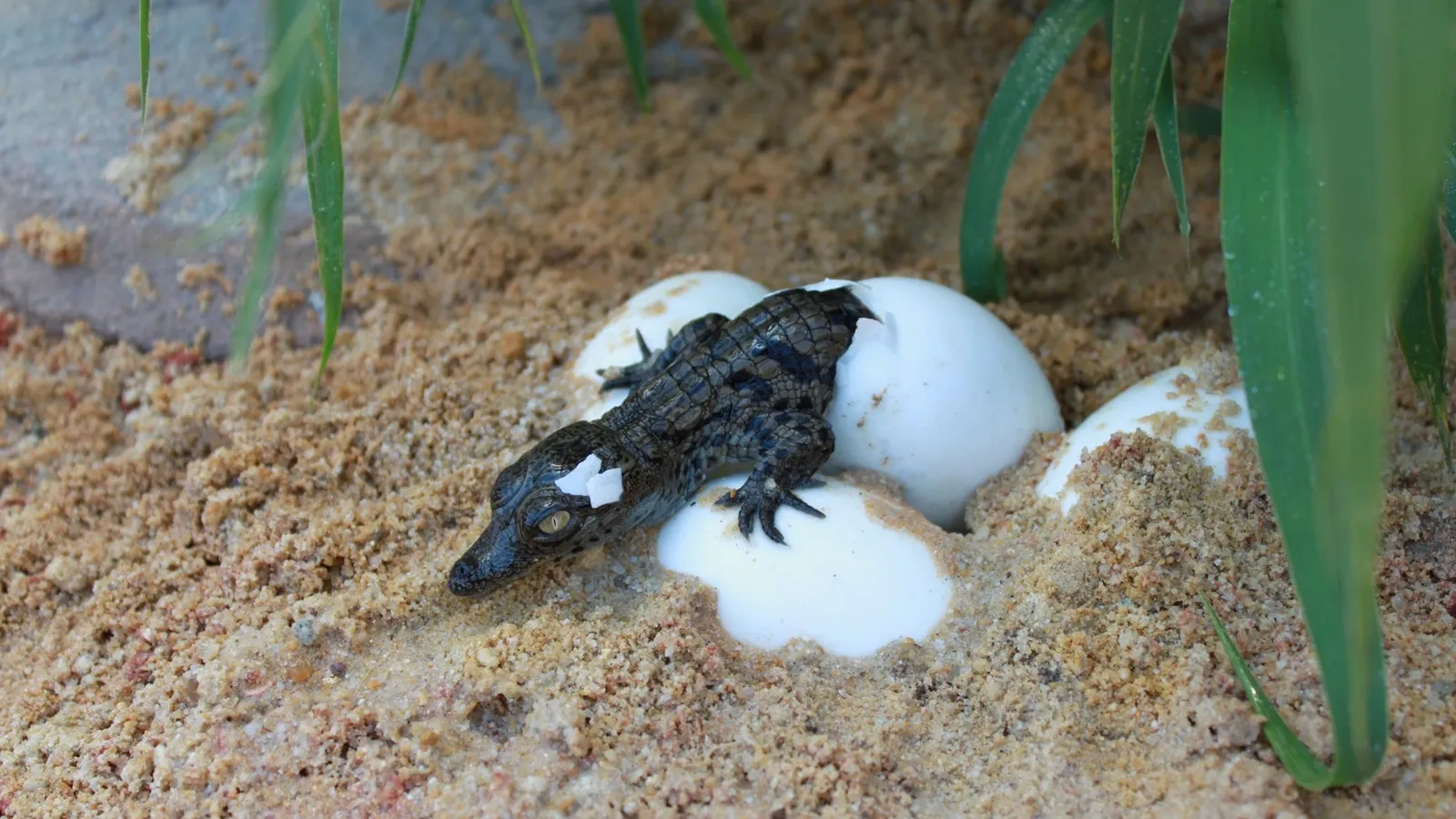
A crocodile never goes through any of that. It hatches with legs, lungs and scales, and simply grows bigger.
What features make a crocodile a reptile?
Three features settle it. Each one is a clear contrast with amphibians.
Skin. Reptile skin is scaly and contains the protein keratin and waxy lipids that reduce water loss, says the OpenStax Biology 2e chapter on reptiles. Amphibians instead have a moist, permeable skin kept wet by mucus glands, and the skin is one of their breathing surfaces (OpenStax, amphibians).
Eggs. Reptiles lay calcareous or leathery eggs enclosed in shells on land (OpenStax, reptiles). Crocodilians make a mound nest of soil and plant material or dig a hole in a sandy beach, and lay 10 to 60 eggs depending on the species (San Diego Zoo). Amphibian eggs are protected by a thick jelly layer but would still dehydrate quickly in a dry environment (OpenStax, amphibians).
Young. Reptile young do not go through a larva stage like amphibians; they look like small versions of the adults when they emerge, as the San Diego Zoo's reptile guide puts it. Young amphibians are larvae that change in body shape, diet and lifestyle through metamorphosis (San Diego Zoo, amphibians).
The crocodile's love of water is real, but it is behaviour. A mother crocodile even carries her hatchlings to the water in her mouth (San Diego Zoo). The eggs themselves are laid on land.
The habitat-versus-features checklist
Use these four questions on any animal that confuses you. Answer from the body, not the scenery.
Skin: dry with scales or scutes, or moist and slimy with no scales?
Eggs: shelled and laid on land, or jelly-coated and laid in water or damp places?
Young: a small copy of the adult, or a larva with gills that later changes form?
Breathing: lungs only, or lungs plus a skin that also breathes?
Ignore where it lives, how well it swims and what it eats. If most answers fall on the first side, you are looking at a reptile; if they fall on the second, an amphibian.
Here is the checklist on a crocodile and a frog side by side:
Crocodile: scaly dry skin; shelled eggs in a nest on land; hatchling looks like a small adult; breathes with lungs. Four out of four point to reptile.
Frog: moist skin with no scales; jelly-coated eggs in water; tadpole with gills; skin helps it breathe. Four out of four point to amphibian.
Both animals live by water. The checklist still separates them cleanly, because it never asks about water at all.
Is the crocodile heart an exception?
Yes, and it is a common trick in biology questions. A 2023 Linköping University bachelor's thesis on the functional anatomy of the crocodilian heart notes that the crocodilian heart is four-chambered with completely separated ventricles, which makes it unique among reptiles; lizards, snakes and turtles have a three-chambered heart.
That one feature does not move crocodiles out of Reptilia. Their skin, eggs and young are still reptile features. This is why the checklist uses several clues rather than one: any single trait can have an exception, but the pattern holds. For more, see our guide to reptile features: dry scales, eggs and the crocodile heart.
How do you avoid mixing up animal classes in exams?
A whale lives in the sea but is a mammal; our post on why a whale is a mammal, not a fish runs a similar clue check. For the amphibian side, read how frogs live a dual life.
When a question says "lives in water" or "lives on land", underline it, then write the four checklist questions in the margin and answer them first.
If Reptilia and Amphibia still feel like two lists to memorise, the Fermi Concept Library gives every concept in biology its own lesson and its place in the map. For practice questions, the Fermi Problem Library has worked problems with a step-by-step solver that explains the reasoning rather than printing an answer.
Next time an animal confuses you, skip the habitat and check the skin, the eggs and the young.