On this page
Every spring, many birds of temperate regions that spent the winter with small, inactive gonads are suddenly ready to breed. Their reproduction is under photoperiodic control: the main trigger is day length. Here is how that signal travels from light to brain to hormones to gonads, and the experiments that worked it out.
Who first showed that day length controls bird breeding?
One of the first clear answers came from the biologist William Rowan, who reported it in Nature in 1925. He caged dark-eyed juncos, small birds of the sparrow family, in his backyard in Edmonton and gave one group artificially lengthened days while a control group was left alone, as the Junco Project's account of his experiment describes. The extra light grew by five minutes per day for three months, imitating spring during an especially cold Canadian winter.
In the middle of that winter, the lit males began to sing and their testes began to swell. The cold had not changed. The day length had.
In 1935, Jacques Benoit asked where the light was being sensed. Blind ducks still responded to long days, but covering their heads with black caps blocked the testicular response, as Yusuke Nakane and Takashi Yoshimura summarise in their 2014 review. The detector was inside the head, not only in the eyes.
How does day length trigger breeding in birds?
Most of the modern detail comes from Japanese quail, which respond sharply when moved from short days to long days. You can trace the signal in six steps:
Light reaches the brain. An opsin called OPN5 sits in cerebrospinal-fluid-contacting neurons of the mediobasal hypothalamus, and these cells may be the deep brain photoreceptors that matter for seasonal breeding.
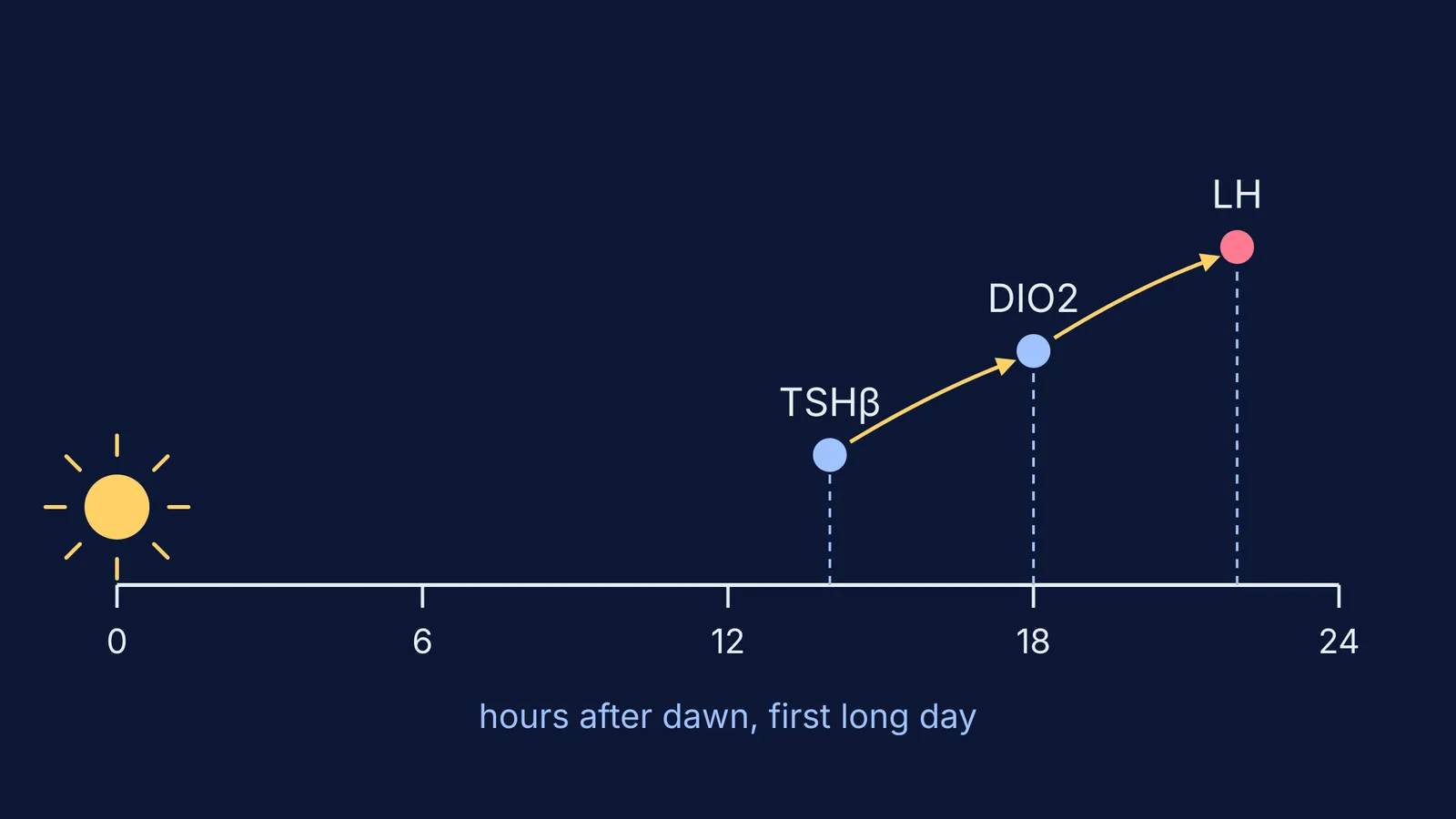
The pars tuberalis makes TSH. In quail moved to long days, thyrotrophin (TSH) beta-subunit expression in the pars tuberalis rose about 14 hours after dawn of the first long day, Nobuhiro Nakao and colleagues reported in 2008.
TSH switches on DIO2. About 4 hours after the TSH wave, expression of the enzyme DIO2 rose in the hypothalamus, and TSH delivered into the brains of short-day quail made their gonads grow (Nakao and colleagues, 2008).
DIO2 makes active thyroid hormone. DIO2 converts the prohormone T4 into active T3. T3 delivered into the brain mimicked long days, and the DIO2 blocker iopanoic acid prevented gonadal growth, Takashi Yoshimura's team showed in 2003.
GnRH gets out. Under short days, many GnRH nerve endings in the median eminence are wrapped by glial endfeet; under long days they sit close to the basal lamina, which is thought to let GnRH pass into the portal capillaries that lead to the pituitary.
LH rises and the gonads grow. In quail, plasma LH rises 22 hours after the dawn of the first long day. The same review notes that birds show the most dramatic change in gonad size among vertebrates, typically more than 100-fold.
Why do birds stop breeding while days are still long?
Long days do not keep a bird breeding forever. In many species the system shuts down on its own even as days keep lengthening, a state called photorefractoriness, described in the 2014 review by Ai Shinomiya and colleagues. That review also gives the reason for the whole system: offspring grow when the climate is moderate and food is abundant.
A review by Alistair Dawson and colleagues explains that photorefractoriness ends breeding before short days return, and that internal yearly (circannual) rhythms may matter more than day length for tropical and opportunistic breeders.
How can you remember the chain for a biology exam?
The experiments above make a ready-made self-test. Cover each prediction, guess, then check.
A junco in a cold winter gets extra light that grows each day. Prediction: testes swell and males sing (Rowan).
A blinded duck is kept on long days. Prediction: testes still grow (Benoit).
A duck with working eyes wears a black cap on long days. Prediction: no testis response (Benoit).
A short-day quail gets TSH or T3 delivered into the brain. Prediction: gonads grow as if days were long (Nakao; Yoshimura).
A long-day quail gets a DIO2 blocker. Prediction: gonads stay small, because T4 is not turned into T3 (Yoshimura).
If you can tie each answer to one step of the chain, you understand the mechanism, not just the names. For more practice, try these chemical coordination arrange-in-order questions, see how GnRH and other hypothalamic hormones reach the pituitary, or read how clownfish change sex from male to female.
If the hypothalamus and pituitary themselves feel shaky, the Fermi Concept Library gives every biology concept its own lesson and its place in the map, so you can fill that gap before coming back to the chain.