On this page
The lights go off in a power cut, or you step from a sunny corridor into a dark cinema hall, and you can barely see your hand. Half an hour later you can find your way around. Two things inside your eyes have changed: the pupil, and the chemistry of the retina.
Why can't we see when we enter a dark room?
In bright light the pupil is small and much of the retina's light-sensing pigment is used up. The pupil recovers first. Your pupil can change size from roughly 2 mm to roughly 8 mm across, which changes the light reaching the retina by about 16 times, or 1.2 log units, according to a 2024 study in Royal Society Open Science.
The eye needs far more. Right after a very bright light, your threshold for seeing is about 100,000 times (5 log units) higher than when your eyes are fully adapted to the dark, as measured by Lamb and Pugh in Investigative Ophthalmology and Visual Science. Most of the recovery happens in the retina, and it is slow.
What does rhodopsin have to do with seeing in the dark?
Your retina has two kinds of light-sensing cells. Cones handle daylight and colour. Rods handle dim light, and in the human retina rods outnumber cones by about 20 to 1, Lamb and Pugh note.
Rhodopsin is the pigment in rods: a protein called opsin holding a small molecule, 11-cis retinal. When a photon hits rhodopsin, the retinal changes shape, the pigment loses its colour and is said to be "bleached" (Lamb and Pugh). The rod stays less sensitive until fresh 11-cis retinal arrives from the retinal pigment epithelium, a layer of cells just behind the rods, and rebuilds rhodopsin.
That rebuilding sets the pace. Measurements in living eyes show dark adaptation and rhodopsin regeneration following the same time course, though Webvision adds that this does not fully explain the rise in sensitivity (Kalloniatis and Luu). How vitamin A fits in is the story of George Wald and the molecule that lets us see.
How long does dark adaptation take?
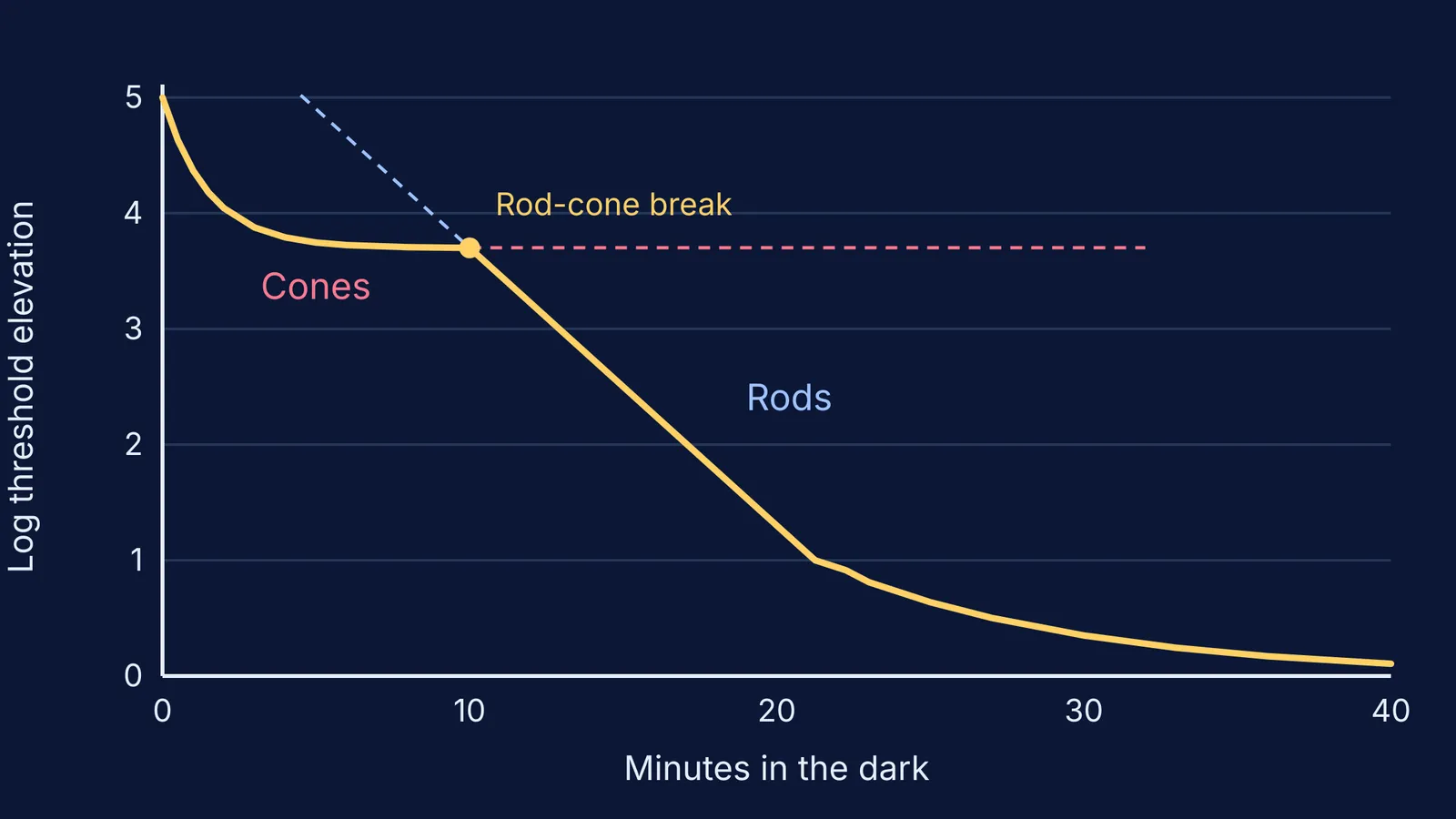
Scientists measure it with a dark-adaptation curve: bleach the eye with bright light, switch off the lights, and test the dimmest spot a person can see, minute by minute. After a near-total bleach, Lamb and Pugh describe two phases:
Cones first. In the first few minutes, cone vision recovers fast, then stalls at a "cone plateau" about 3.7 log units (5,000 times) above the best possible threshold.
Rod-cone break. After about 10 minutes, rods become more sensitive than cones, and the curve drops again.
Rods take over. Rod recovery then improves the threshold at a steady 0.24 log units per minute in young adults.
Webvision puts the rod-cone break at 5 to 8 minutes and says sensitivity reaches its limit after about 40 minutes (Kalloniatis and Luu). The exact times depend on how bright the light was before: in the same Lamb and Pugh data, smaller bleaches started lower on the curve and recovered sooner.
What does 0.24 log units per minute mean?
One log unit is a factor of 10. At the rod recovery rate of 0.24 log units per minute measured by Lamb and Pugh, the rods get 10 times more sensitive roughly every 4 minutes (1 divided by 0.24 is about 4.2). Over 10 minutes of rod recovery, that is 2.4 log units, or about 250 times. That is why the room keeps getting clearer long after your pupils have widened.
Can you see dark adaptation for yourself?
Yes. Rhodopsin is rebuilt inside each eye's own rods, so you can dark-adapt one eye while the other stays light-adapted.
In a well-lit room, cover one eye with a folded cloth or eye mask. Keep reading with the other eye for 20 to 30 minutes.
Switch off the lights, then uncover the eye.
Close one eye at a time and note what each can see: a door frame, a chair, the edge of a bed.
The covered eye should pick out shapes much sooner than the other. Both eyes are in the same dark room, so the difference comes from the retina. Do this sitting down, and keep bright screens away: they bleach rhodopsin again.
Once adapted, faint things may look clearer slightly off-centre; see why faint stars vanish when you look straight at them. For more on rod chemistry, read why you can't see when the lights go off.
When is poor night vision a reason to see a doctor?
Needing many minutes to see well in the dark is normal. If you find dim light much harder than others do, or your night vision changes, see an eye doctor. The WHO lists night blindness as one of the first signs of vitamin A deficiency.
If curves like this make more sense when you can watch them change, the Fermi Simulation Lab has interactive simulations for ideas that are easier to see than to read.