

On this page
On a dark terrace, a faint star glints at the edge of your view. You look straight at it and it is gone; look slightly away and it returns. That is the layout of your retina, and stargazers beat it with averted vision.
Why do faint stars vanish when you look directly at them?
Your retina has two kinds of light-sensing cells. Cones handle colour, fine detail and bright light. Rods take over in dim light. In a study that mapped eight human retinas, Curcio and colleagues (1990) counted an average of 4.6 million cones and 92 million rods per retina.
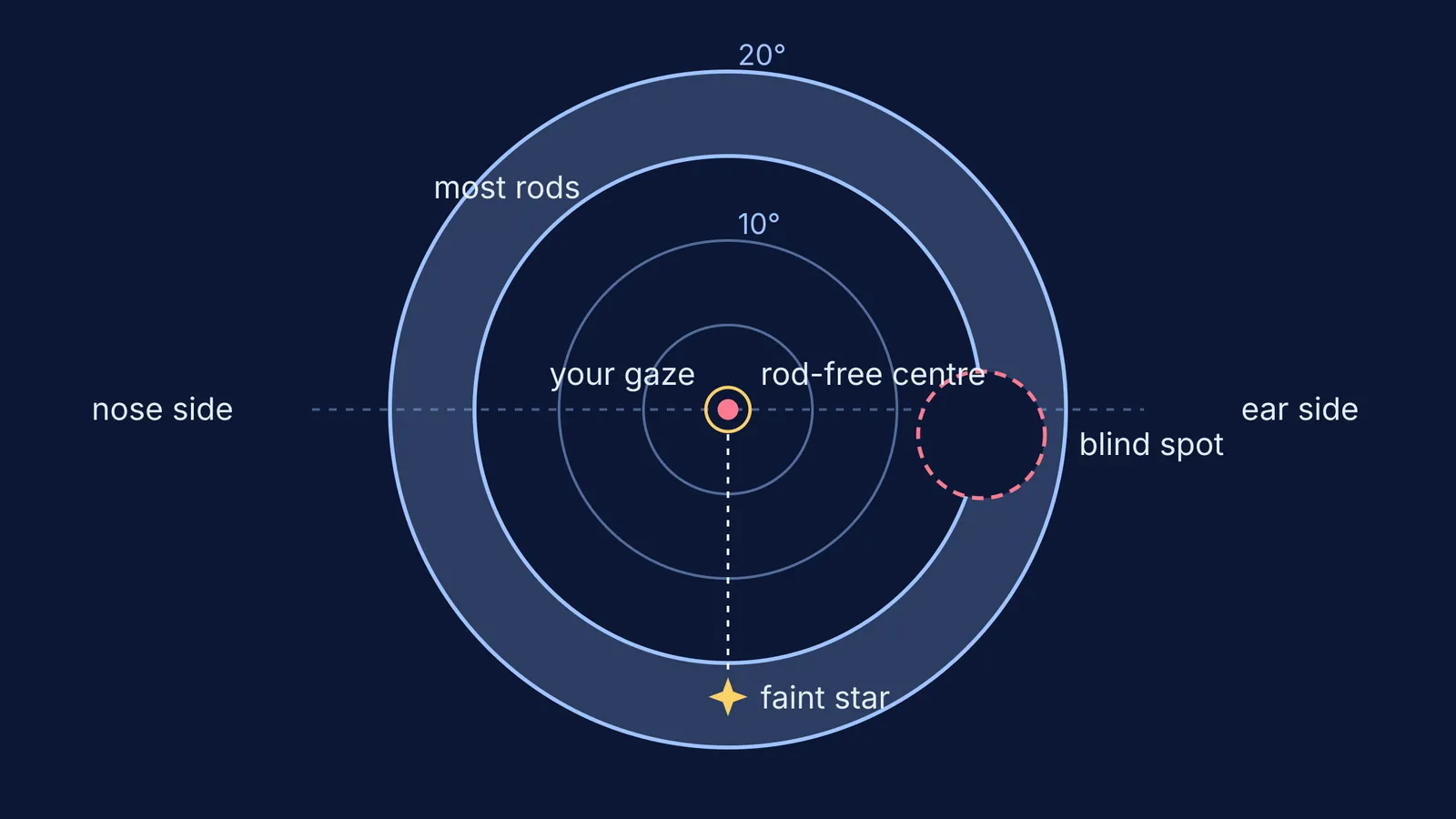
The fovea, the small pit you aim at whatever you look at, is packed with cones. In the same study, the average rod-free zone at the centre of the fovea was 0.350 mm across, which covers 1.25° of your view (Curcio et al., 1990). That is about the width of your little finger held at arm's length, which EarthSky puts at 1 to 1.5 degrees.
So when you stare straight at a faint star, its light lands on cones only, and cones need more light to respond. The textbook Webvision shows this in dark-adaptation tests: a small spot at the fovea needs more light to be seen than the rods need, while the same spot in the peripheral retina shows the rods taking over. Shift your gaze and the star's light reaches rods.
New to rods and cones? Our explainer on the difference between rods and cones in the retina covers the basics.
Where on the retina are the most rods?
Curcio's team found the highest rod densities along an elliptical ring at the same distance from the centre as the optic disc, with the densest point usually in the upper (superior) retina (Curcio et al., 1990). The paper also notes that an earlier study by Østerberg, in 1935, placed a ring of high rod density at about 20° from the centre.
Two more details matter for stargazing:
Rod density is 15 to 25% lower where that ring crosses the horizontal line through your eye, according to the same paper.
The optic disc has no light-sensing cells, so it leaves a blind spot. The EyeRounds visual-field tutorial places it 15° to the ear side of where you look, centred 1.5° below the horizontal, and 7.5° across on average.
The eye forms a real, inverted image on the retina (Physics LibreTexts/11:_Geometric_Optics_and_Image_Formation/11.06:_The_Eye)), so the upper retina sees things below your gaze. So a faint star a fist-width or two below where you look should land on the rod-rich upper retina, well clear of the blind spot.
How do you test averted vision on a real night sky?
You need a dark terrace or field, a notebook and about 20 minutes.
Adapt first. Go somewhere dark and keep your phone screen off. Webvision reports that rod sensitivity improves considerably after 5 to 10 minutes in the dark, and that the threshold reaches its minimum after about 40 minutes (Webvision).
Pick a target. Choose a star you can only just see, near a brighter one you can find again.
Learn your ruler. At arm's length, a fist is about 10°, according to EarthSky, so 15° is a fist and a half.
Cover your left eye. With only your right eye open, your ear side is to the right, so you know where the blind spot is.
Test five gazes. Look straight at the star, then a fist and a half above it, below it, to its left and to its right, five seconds each.
Score each gaze. 0 for not visible, 1 for flickering, 2 for steady.
Repeat three times in a different order, so you are not just seeing what you expect.
What the anatomy predicts:
Straight at it: a low score, because the light falls on the fovea's rod-free centre.
Above it: the star lands on the upper retina, where rods usually peak, so this may score best.
To its left: the star sits about 15° to your ear side, in the blind spot, so it may vanish completely.
Below it or to its right: in between, as the star lands on parts of the ring with fewer rods.
Why is this worth knowing for school biology?
Rods, cones, the fovea and the blind spot are easy to mix up on a page. The test ties each to something you saw: the fovea is where the star faded, the blind spot where it vanished, the rod ring where it came back. The same rods explain whether carrots really help you see in the dark.
If the chain from lens to retina still feels loose, the Fermi Concept Library has a lesson for every concept in biology and physics, each with its place in the map, so you can see how the eye's optics and its cells connect.
Next clear night, take your notebook and run the five-gaze test.


