
On this page
Every human eye has a patch of retina that cannot detect light. You can find yours in two minutes with a card, a pen and a ruler, and you can predict where it should be using Class 10 trigonometry.
How do you find your blind spot with a card test?
The classic version, described by vision scientists Richard Gregory and Patrick Cavanagh in Scholarpedia, uses a fixation mark and an X on paper, viewed with one eye.
On a white card or notebook page, draw a small O on the left and an X on the right, 8 cm apart at the same height, each about 1 cm across.
Close or cover your left eye.
Hold the card at arm's length, O in front of your right eye, and stare at the O.
Bring the card slowly closer. At some distance the X vanishes; keep going and it returns.
For your left eye, turn the card upside down and swap eyes.
The one rule: never look at the X. If your eye flicks to it, it reappears at once.
Where should your blind spot be?
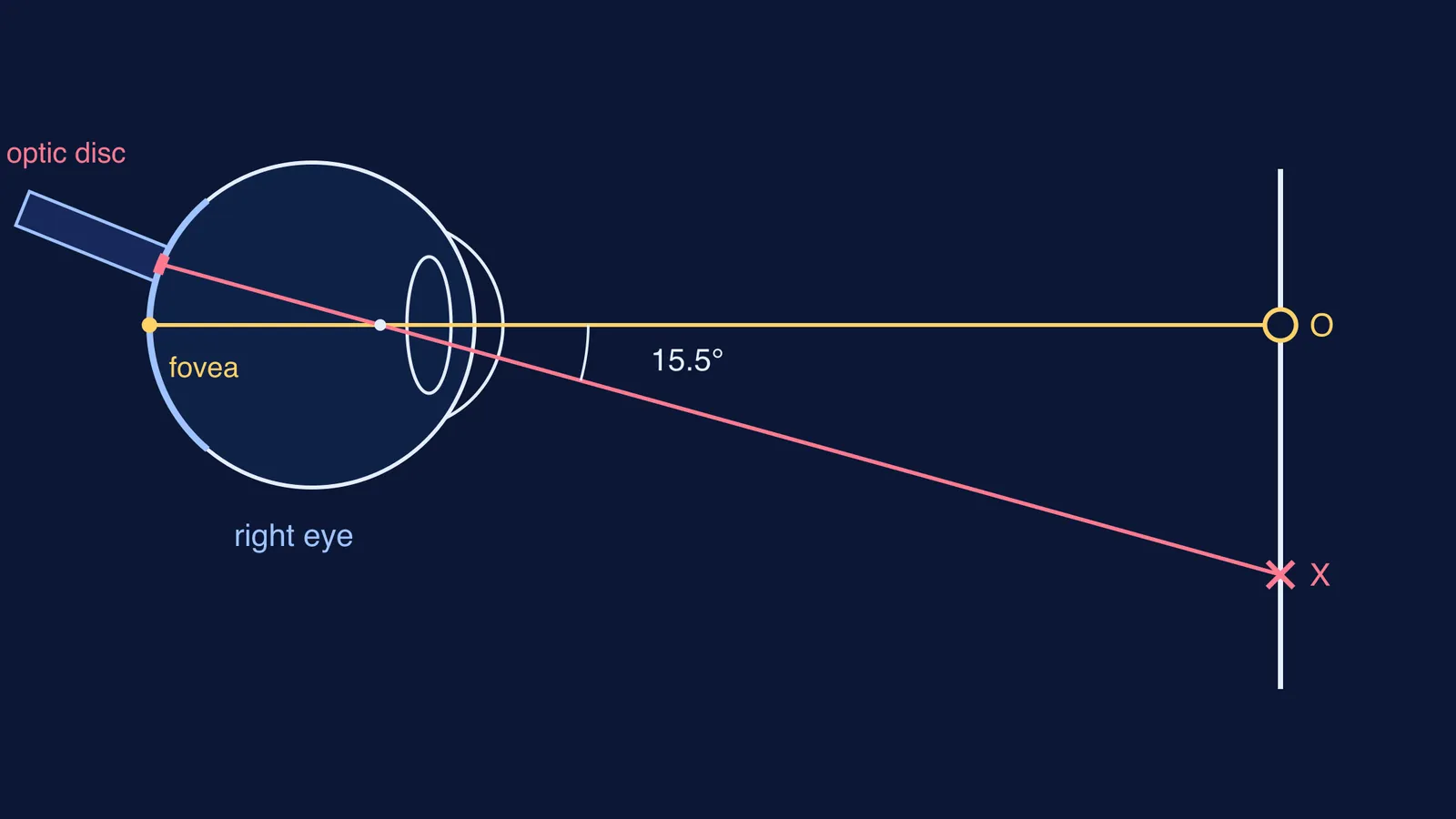
The blind spot is the optic disc projected into your view. In a study of 104 healthy eyes, the centre of the optic disc sat on average 15.5 degrees horizontally from the fovea (the spot you look with), ranging from 13.0 to 17.9 degrees, with the two about 1.5 degrees apart vertically (Rohrschneider, 2004, Investigative Ophthalmology and Visual Science).
The optic disc lies on the nose side of each retina, and light crosses the eye in a straight line, so the blind spot appears on the ear side of your view.
Now predict. With the card a distance d away and the marks a gap g apart, the X disappears when g = d × tan 15.5°. Since tan 15.5° is about 0.28, you should be roughly 3.6 times the gap away.
Gap of 8 cm: about 29 cm. Using the 13 to 17.9 degree range, anywhere from about 25 cm to 35 cm.
Gap of 10 cm: about 36 cm.
Then ask someone to measure from your open eye to the card when the X vanishes, and work backwards: your angle is arctan(g ÷ d). An 8 cm gap vanishing at 30 cm gives arctan(8 ÷ 30), about 15 degrees, inside the measured range.
The spot is not tiny. Gregory and Cavanagh put it at about 4 degrees of visual angle, roughly the width of four fingers held at arm's length (Scholarpedia). At 29 cm, that works out to about 2 cm across (2 × 29 × tan 2°), so a 1 cm X can vanish completely.
Why is there a blind spot in the eye at all?
The optic disc is where nerve fibres from across the retina gather to leave the eye as the optic nerve, and where blood vessels enter and exit, "resulting in a hole in the photoreceptor mosaic", as Gregory and Cavanagh write.
You rarely notice yours. With both eyes open, each eye covers the other's gap, and even with one eye shut the brain shows you no black hole. If the lens and retina are hazy for you, our guide to the human eye and its defects covers the parts, and the Fermi Concept Library has a lesson for each concept in biology and physics.
What is filling-in, and how can you see it happen?
Filling-in is "a perceptual phenomenon in which a visual attribute such as colour, brightness, texture or motion is perceived in a region of the visual field even though such an attribute exists only in the surround" (Komatsu, 2006, Nature Reviews Neuroscience). The review reports that early visual areas of the cortex are involved.
In 1991, V. S. Ramachandran and Richard Gregory showed a grey square 1.5 degrees wide on twinkling noise. After 10 seconds of steady fixation off to one side, the square vanished and the twinkling spread into it. They concluded filling-in is an active process that probably builds a representation of the surround, rather than ignoring the gap (Nature).
You can test this on your own blind spot:
Draw the O and X on a coloured sticky note. Gregory and Cavanagh say the gap fills with the surrounding colour, not just with white.
Draw them on ruled notebook paper. Predict first: will the lines look broken, or will they run straight through? Then look.
Ideas where a single angle decides what you see are often easier to see than to read, which is what the interactive simulations in the Fermi Simulation Lab are for.
When should a blind spot worry you?
If you notice blank or blurry patches in everyday life, flashes, a shadow across your view or any sudden change in vision, see an ophthalmologist or optometrist promptly.
For the history of how we see, read about Ibn al-Haytham's Book of Optics, or try these five safe kitchen science experiments.