

On this page
Walk from a sunny street into a dark cinema and at first you see almost nothing. Then the seats slowly appear. That return of night vision depends on a molecule made from vitamin A, and one of the scientists who worked out its chemistry was George Wald (1906 to 1997), a New York-born biochemist at Harvard.
Wald shared the 1967 Nobel Prize in Physiology or Medicine with Ragnar Granit and Haldan Keffer Hartline "for their discoveries concerning the primary physiological and chemical visual processes in the eye", according to the Nobel Prize page on Wald. The page credits him with showing that vitamin A is part of rhodopsin and how light makes rhodopsin change form.
What did George Wald discover about vitamin A in the eye?
In his 1967 Nobel lecture, Wald says he went to Otto Warburg's laboratory in Dahlem, Berlin, "where I found vitamin A in the retina". He reported it in a short paper, Vitamin A in the Retina, published in Nature in 1933.
He had good reasons to look there. The lecture notes that dietary night blindness, known since ancient Egypt, had been shown in Denmark during World War I to be a sign of vitamin A deficiency, and that rats short of vitamin A make less rhodopsin.
Next, working with frogs in Heidelberg, Wald found retinene, a substance formed on the way from rhodopsin to vitamin A. Later work in Liverpool showed it is vitamin A aldehyde. Today vitamin A is called retinol and retinene is called retinal, in honour of the retina.
How does light change the shape of rhodopsin?
Rhodopsin is the light-sensitive pigment in the rod cells you use in dim light. Wald's lecture describes every known visual pigment the same way: retinal bound to a protein called an opsin.
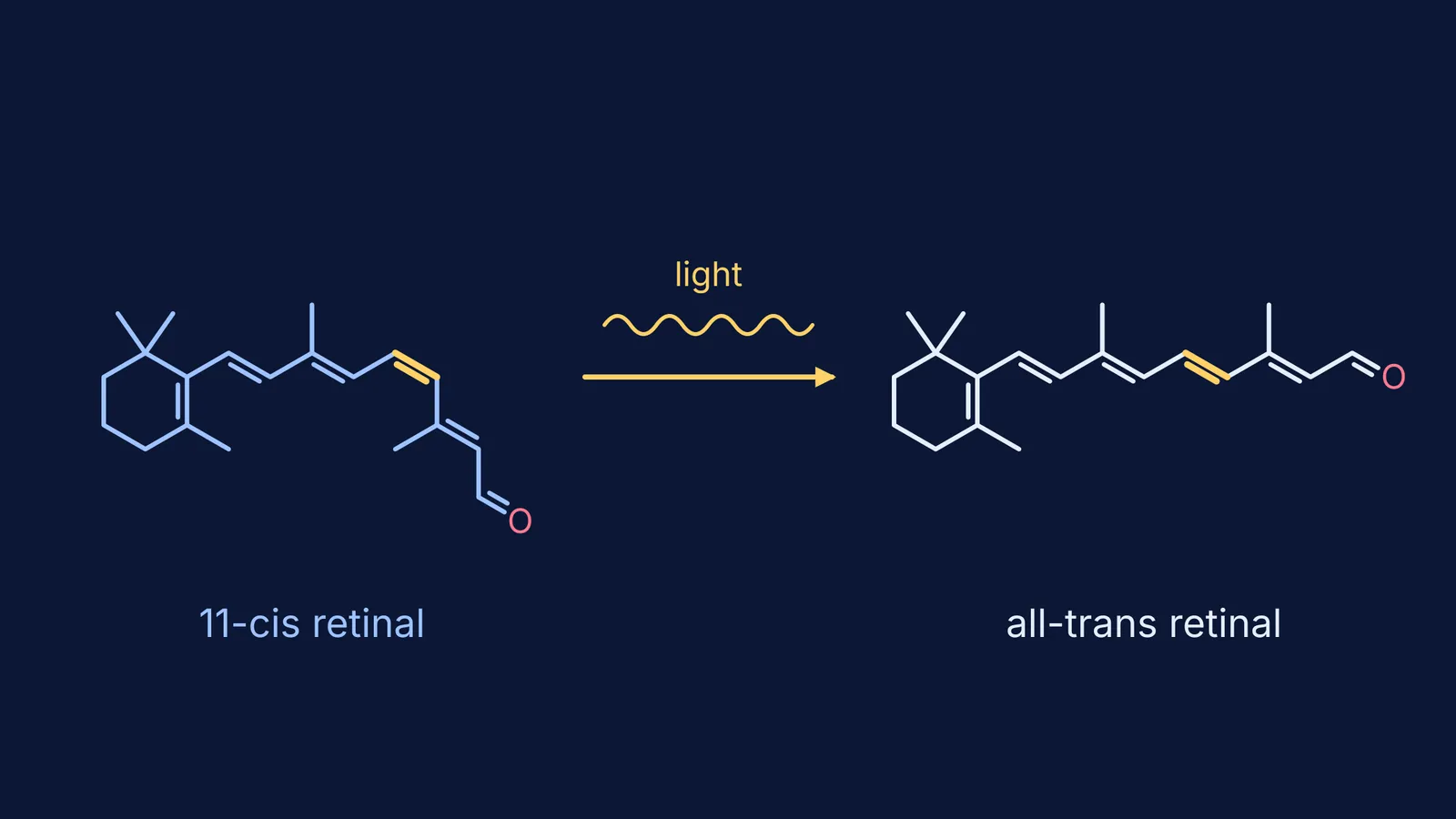
Each of the four double bonds in retinal's side chain could in principle be cis (bent) or trans (straight). Rhodopsin holds retinal in the 11-cis form, bent and twisted at the double bond between carbons 11 and 12. The lecture puts the central result in one sentence: Hubbard and Kropf showed that "the only action of light in vision is to isomerize the chromophore of a visual pigment from the 11-cis to the all-trans configuration" (Wald, Nobel lecture).
Everything after that flip happens without light. The opsin changes shape through a series of intermediates, and Wald writes that excitation must have occurred by the stage called metarhodopsin II, reached within about 1 millisecond at mammalian body temperature. Along the way the pigment loses its colour, which is why the process is called bleaching, and finally all-trans retinal comes off the opsin.
Why does a lack of vitamin A cause night blindness?
Bleached retinal is the wrong shape. Wald's lecture explains that it must be turned back into 11-cis before it can rebuild rhodopsin. Some of it is reduced to vitamin A along the way, and the body's vitamin A comes from food. When that store runs low, rods cannot make enough rhodopsin, and seeing in dim light suffers.
The WHO page on vitamin A deficiency lists night blindness as one of its clinical signs and describes deficiency as the world's leading preventable cause of childhood blindness. It estimates that 250,000 to 500,000 children who lack vitamin A go blind every year, and that the problem affects more than half of all countries, especially in Africa and South-East Asia.
According to MedlinePlus, vitamin A comes ready-made in eggs, dairy, fish and liver, and as beta-carotene in carrots, mangoes and dark green leafy vegetables. It also warns that too much vitamin A can make you ill, and that large doses in pregnancy can cause birth defects, so more is not better.
How do you explain the visual cycle in an exam answer?
Use this five-step chain, based on Wald's lecture, and practise saying it aloud without notes.
Rhodopsin in a rod cell (opsin plus 11-cis retinal) absorbs a photon.
Light turns 11-cis retinal into all-trans retinal. In Wald's account, this is the only action of light in vision.
The opsin changes shape in the dark, and the rod is excited by the metarhodopsin II stage.
All-trans retinal separates from opsin: the pigment is bleached.
Retinal is turned back to 11-cis and rejoins opsin, with vitamin A from food replacing what is lost.
Then test yourself:
What must happen before a bleached rod works again? (Retinal must go back to 11-cis.)
What is the link between carrots and rods? (Beta-carotene becomes vitamin A, which becomes retinal.)
Which isomer is the stable, common one? (All-trans; Wald's lecture notes that the 11-cis form was once thought too unstable to find.)
If cis and trans isomers still feel shaky, the Fermi Concept Library has its own lesson for every concept in chemistry and biology. If you do not know where to start, Fermi's AI tutor works out what you already know and builds a plan for the session.
Where does this fit in the syllabus?
The optics of the eye is in our guide to the human eye and its defects. Fat-soluble and water-soluble vitamins are in vitamins in Class 12 chemistry. For how the word vitamin began, read about Casimir Funk and vital amines.
Next time your eyes adjust to a dark room, that is Wald's cycle at work, remaking bent retinal.


