On this page
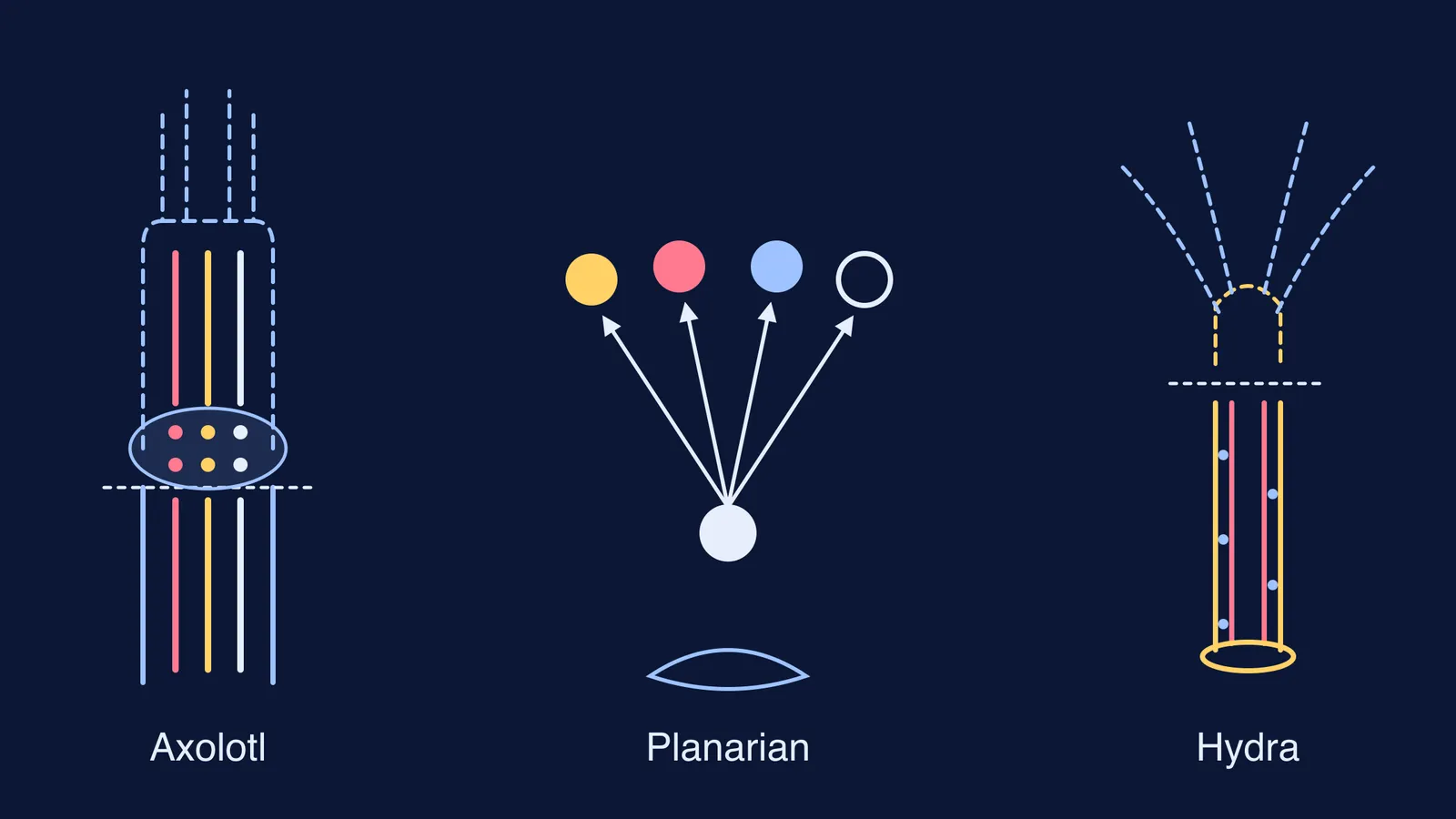
Cut off a salamander's limb and a complete new one grows back, with all its structural elements. Salamanders such as the Mexican axolotl (*Ambystoma mexicanum*) and newts regenerate damaged or lost body parts throughout their entire life, according to a 2019 review of salamander models in Development. In the regeneration chapter the axolotl sits next to Hydra and Planaria, and the three animals do it differently.
How does an axolotl regrow a whole limb?
The salamander review by Joven, Elewa and Simon describes limb regeneration as a sequence:
Wound healing. Skin closes over the stump without a scar, and a wound epidermis forms over the injured site.
Blastema formation. Cells from the stump gather under that epidermis into a blastema, a growing mass of undifferentiated progenitor cells.
Growth and rebuilding. Blastema cells divide and differentiate into the missing tissues until the limb has all its structural elements again.
Nerves are essential: the same review notes that denervation prevents blastema growth and so stops limb regeneration. For timing, the eastern newt (*Notophthalmus viridescens*) completes adult limb regeneration in less than 2 months (Joven et al., 2019).
Is the blastema a mass of dedifferentiated cells?
Partly, and this is the step that is easiest to oversimplify. Earlier experiments had led to wide acceptance that limb tissues dedifferentiate into pluripotent cells that can become anything.
In 2009, Martin Kragl, Elly Tanaka and colleagues re-examined this by marking axolotl limb tissues with green fluorescent protein (GFP) and following the cells as the limb regrew (Kragl et al., Nature, 2009). They found that each tissue produces progenitor cells with restricted potential, so the blastema is a heterogeneous collection of restricted progenitor cells. As the paper's title puts it, cells keep a memory of their tissue origin.
Muscle shows that salamanders differ among themselves too. In newts, multinucleated muscle cells break up into single cells that re-enter the cell cycle, which is true dedifferentiation. In axolotls, new muscle fibres seem to come entirely from resident Pax7-expressing stem cells (Joven et al., 2019).
For the plant version, see our explainer on differentiation and dedifferentiation in plants.
How is axolotl regeneration different from Hydra and Planaria?
A 2011 review by Tanaka and Reddien in Developmental Cell describes an array of cellular strategies for regeneration, from pluripotent stem cells to tissue-specific stem cells and dedifferentiation. The three textbook animals sit at different points on that range.
Planaria. These flatworms regenerate from tiny body fragments using dividing cells called neoblasts. In 2011, Daniel Wagner, Irving Wang and Peter Reddien showed that a single transplanted clonogenic neoblast restored regeneration in a lethally irradiated worm (Wagner et al., Science, 2011). These neoblasts produce neurons, gut cells and other cell types, so they are pluripotent adult stem cells. Our post on regeneration vs fragmentation in Planaria and Spirogyra covers the textbook side.
Hydra. Abraham Trembley discovered Hydra's regenerative capacity in 1740, the story told in how Abraham Trembley cut hydras to discover regeneration. A 2019 Development review of Hydra explains that it relies on three stem cell populations: unipotent epithelial stem cells in each of its two layers and multipotent interstitial stem cells. The same review cites work showing that head regeneration can occur in the absence of DNA synthesis, so a head can be rebuilt without new cell division. Pull a Hydra apart into single cells and the cells re-aggregate; three to five days later, complete polyps have formed.
A comparison you can revise from
Ask the same two questions of each animal:
Axolotl. Source of new cells: lineage-restricted progenitors from each limb tissue. Is cell division needed? Yes, a dividing blastema. Key study: Kragl et al., 2009.
Planaria. Source of new cells: pluripotent neoblasts spread through the body. Is cell division needed? Yes, proliferating neoblasts. Key study: Wagner et al., 2011.
Hydra. Source of new cells: three stem cell populations, two of them unipotent. Is cell division needed? Not always, since a head can form without DNA synthesis. Key source: Vogg, Galliot and Tsiairis, 2019.
Worked example: a 3-mark answer
Question: How does limb regeneration in an axolotl differ from regeneration in Planaria?
Name the structure (1 mark): an axolotl forms a blastema of undifferentiated progenitor cells under the wound epidermis.
State the cell source (1 mark): axolotl blastema cells are lineage-restricted, each tissue making more of itself, while Planaria use pluripotent neoblasts that can form many cell types.
Add a condition (1 mark): axolotl limb regeneration depends on nerves; without them the blastema does not grow.
If you wrote "cells dedifferentiate into stem cells" for the axolotl, revise it to "restricted progenitors".
When terms like pluripotent, unipotent and dedifferentiation start to blur, the Fermi Concept Library covers every concept in biology, each with its own lesson and its place in the map, so you can see how the ideas connect. Then come back to the comparison above and try writing it from memory.