

On this page
A plant's growth is not a one-way street. While human cells generally commit to a specific job for life, many plant cells can reverse their specialisation, divide again, and take on entirely new roles. This plasticity is what allows trees to grow wider year after year, and it complements their primary arithmetic or geometric growth patterns. It is also the biological mechanism that makes it possible to grow an entire plant from a single leaf in a laboratory.
Understanding the difference between differentiation, dedifferentiation, and redifferentiation is a common hurdle for biology students, especially when studying plant anatomy and secondary growth for NEET-UG or board exams.
What is differentiation in plants?
When a seed sprouts, its growth is driven by meristems, which are regions of actively dividing cells. As these new cells are pushed away from the meristem, they undergo differentiation.
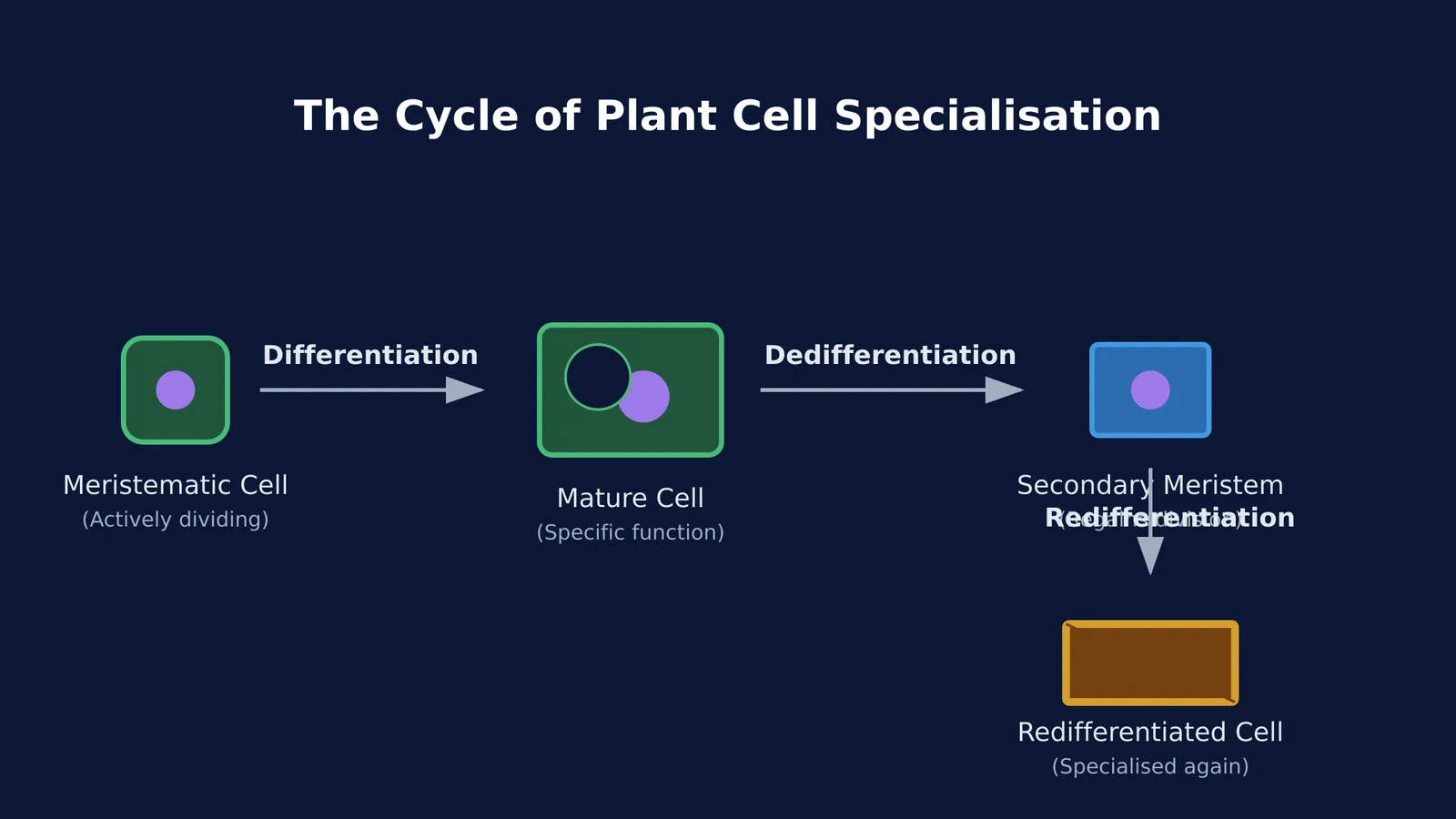
Differentiation is the process where meristematic cells lose their ability to divide and mature to perform specific functions. During this phase, the cell undergoes major structural changes to its cell wall and protoplasm. For example, a cell might thicken its walls and lose its living contents to become part of the primary xylem, carrying water up the stem. Once a cell has differentiated, it is generally considered a mature, permanent tissue.
How does dedifferentiation form the cork cambium?
Plants often need to grow new tissues in places where no meristems exist. This happens when a stem needs to grow thicker, a process known as secondary growth, or when the plant is wounded. To achieve this, mature, living cells undergo dedifferentiation.
Dedifferentiation is the biological phenomenon where fully differentiated, mature cells regain their capacity to divide. By doing so, they form a new, secondary meristem.
Two classic examples of dedifferentiation occur during the secondary growth of dicot stems:
Interfascicular cambium: Parenchyma cells in the medullary rays, located between the vascular bundles, dedifferentiate to form this cambium. This completes the cambial ring that allows the stem to thicken.
Cork cambium (phellogen): As the stem expands in girth, its outer layers stretch and break. To replace them, parenchyma cells in the cortex dedifferentiate to form the cork cambium, which builds a protective new outer layer of bark.
What happens during redifferentiation?
Once a secondary meristem is formed through dedifferentiation, the new cells it produces must commit to a job. This final step is called redifferentiation.
Redifferentiation occurs when dedifferentiated cells lose their ability to divide and specialise once more. These cells mature to perform specific functions, just like in the primary growth phase.
For instance, the cork cambium divides to produce cork (phellem) on the outside and secondary cortex (phelloderm) on the inside. Similarly, the continuous vascular cambium ring produces secondary xylem inwards and secondary phloem outwards. These new tissues are the final products of redifferentiation.
How does tissue culture rely on dedifferentiation?
This ability to reverse specialisation is the foundation of plant tissue culture. If you take a piece of mature plant tissue, known as an explant, and place it on a nutrient medium with the right plant growth regulators, its cells will dedifferentiate and form a callus—an unorganised mass of actively dividing cells.
A classic 1957 study by Folke Skoog and Carlos Miller established that the exact ratio of two plant hormones, auxin and cytokinin, controls whether these cells stay as a dedifferentiated callus or redifferentiate into new organs. High auxin and low cytokinin push the callus to form roots, while low auxin and high cytokinin induce shoots.
The efficiency of this process varies depending on the environment and the plant species. For example, a 2020 study on *Lotus (Nelumbo nucifera)* found that keeping the explant cultures in darkness increased the callus induction rate to 45.41%, compared to 37.00% when grown in the light.
More recently, biologists have discovered that dedifferentiation is not simply a rewind button. A 2019 review by Attila Fehér notes that forming a callus involves complex genetic reprogramming and the activation of specific gene networks, rather than just erasing the cell's history.
If you are struggling to remember the sequence of how plant tissues develop, the Fermi Concept Library maps out every concept in physics, chemistry, biology, mathematics and computing, each with its own lesson and its place in the map. If you are getting stuck on the logical side of biology questions, the Fermi Problem Library provides worked problems with a step-by-step solver that explains the reasoning rather than printing an answer.


