

On this page
A student opening their biology textbook often finds *Planaria* and *Spirogyra* on the same page. Both are famous for the same trick: if you chop them into pieces, the pieces grow into complete new organisms. It is easy to assume they are doing the exact same thing.
However, biologists draw a strict line between fragmentation and regeneration. While both lead to new individuals, they rely on different cellular mechanisms, occur in organisms with different levels of complexity, and serve entirely different primary purposes in nature.
What is fragmentation in Spirogyra?
*Spirogyra* is a type of filamentous green algae found in freshwater environments. It has a very simple, uniform body structure. Every cell along its long, thread-like chain is largely identical, containing a characteristic spiral chloroplast, and is fully capable of photosynthesis and independent survival.
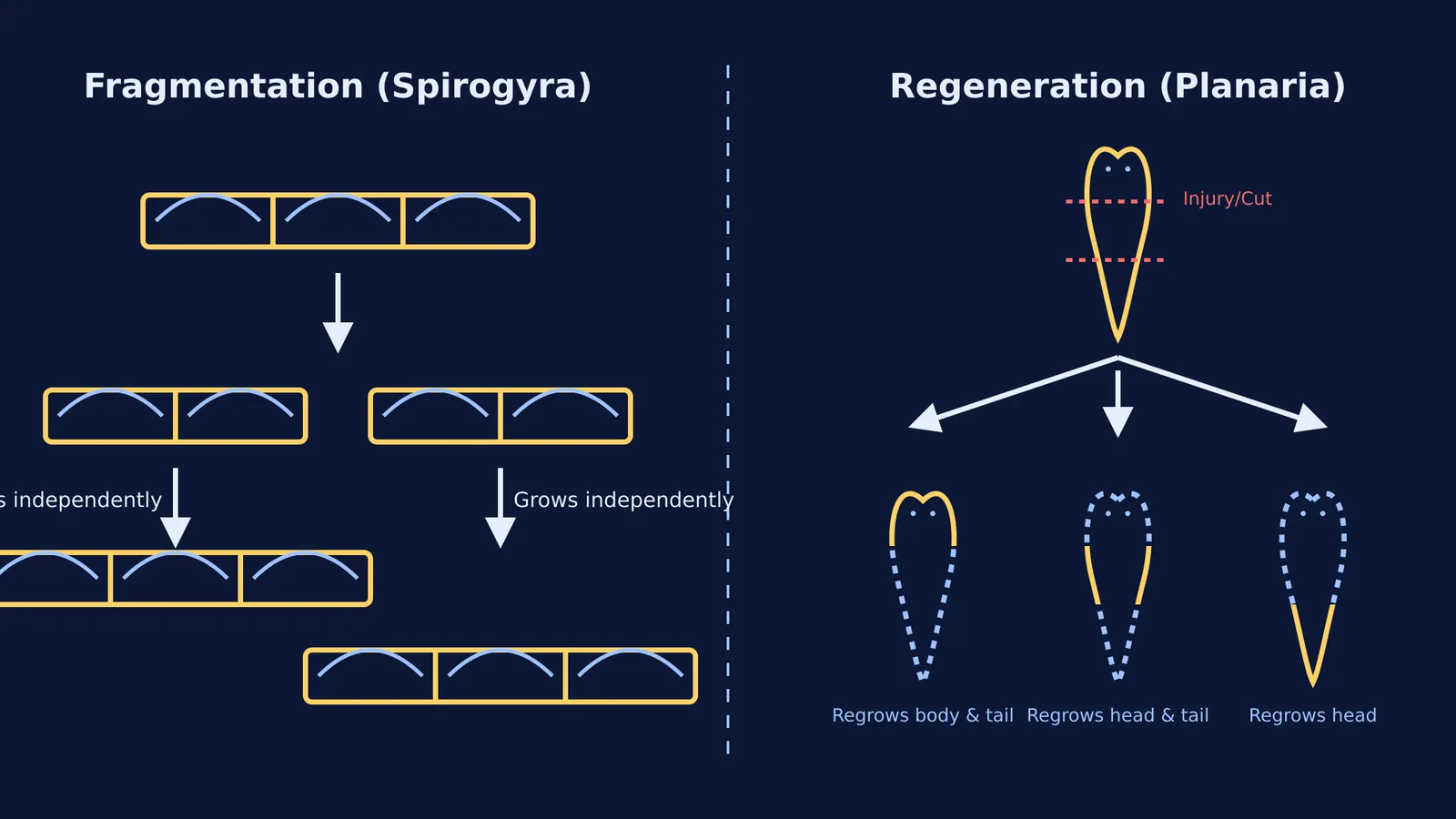
When a *Spirogyra* filament reaches maturity and the environmental conditions are favourable, it naturally breaks into smaller fragments. This process is called fragmentation. Because every cell in the filament retains the ability to divide and grow, each broken piece simply continues adding new cells through mitosis until it becomes a full-length filament again.
For *Spirogyra*, fragmentation is a deliberate, primary method of asexual reproduction. The organism does not need complex tissues, a nervous system, or specialized stem cells to achieve this; it is essentially growth by breaking. The organism is biologically programmed to split apart to increase its population.
How does regeneration work in Planaria?
*Planaria* are freshwater flatworms, which means they belong to a significantly more complex level of biological organization than simple algae. They possess a distinct head with eyespots, a tail, a centralized nervous system, and clearly differentiated tissues.
If a *Planaria* is accidentally cut into three pieces—a head, a middle, and a tail—each piece will regrow the exact parts it is missing. The head piece grows a new middle and tail, while the tail piece grows a new middle and head. This astonishing feat is driven by specialized totipotent stem cells called neoblasts, which make up about a fifth of the worm's cells (doi:10.1126/science.1203983). When the worm is injured, these neoblasts migrate to the wound site, form a mass of dividing cells called a blastema, and then multiply rapidly. Crucially, they differentiate into the specific nerve, muscle, or gut cells required to rebuild the missing anatomy perfectly.
If you find it hard to picture how these specialized cells migrate and differentiate to form new tissues, Fermi's AI tutor can draw the figure and check your understanding as it goes.
Why is regeneration not considered true reproduction?
The key distinction lies in the organism's biological intent and its dependence on the process. As noted in the NCERT Class 10 Science curriculum, regeneration is primarily a mechanism for repair and restoration, not a scheduled reproductive event. The textbook explicitly states that organisms do not normally depend on being cut up to be able to reproduce.
While *Planaria* possess such extreme regenerative abilities that a severe, accidental injury results in multiple new worms, their natural, unforced way of reproducing is typically through deliberate transverse fission (where they pull themselves apart) or through sexual reproduction.
In more complex animals, regeneration is strictly limited to healing localized damage. For instance, a lizard can regenerate a lost tail to escape a predator, but the dropped tail cannot regenerate a new lizard because it lacks the necessary stem cells and central organization.
If you are mapping out how different species multiply and repair themselves, you can find the complete biological breakdown in the Concept Library, which covers every concept in physics, chemistry, biology, mathematics and computing.
How do you tell them apart?
When you are facing an exam question or trying to classify a biological process, use this three-point checklist to decide whether you are looking at fragmentation or regeneration:
Check the trigger: Did the organism break naturally upon reaching maturity (fragmentation), or was it cut by an external force or injury (regeneration)?
Check the cell types: Are all the cells doing the same basic division to lengthen a chain (fragmentation), or are specialised stem cells migrating and differentiating into entirely new tissue types (regeneration)?
Check the organism's complexity: Is it a simple organism with uniform cells, like a fungus or algae (fragmentation), or a more complex animal with distinct body regions and organs (regeneration)?
To solidify these concepts for your board exams, reviewing the standard examples is crucial. You can see how these processes fit into the wider syllabus in our guide on How do organisms reproduce? Class 10 revision with key diagrams. If you are preparing for medical entrances, paying attention to the exact wording used to describe these mechanisms is vital; our breakdown on Using NCERT lines for NEET biology: how to study the text closely explains how to catch these subtle distinctions.


